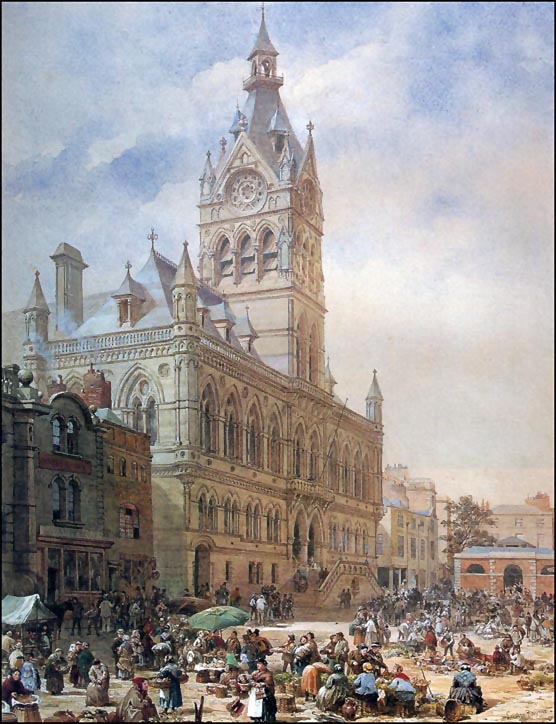
Chester's Town Hall was built in late 13th century Gothic style in 1865-9, during Louise's early period of residence in Chester, by William Henry Lynn (1829-1915) of Belfast, to replace the 17th century Exchange which formerly stood in the middle of the square before burning down in 1862. The new building was inspired by the beautiful medieval Cloth Hall in Ypres, Belgium.
The design of the new building came about as the result of a competition which specified that the new Town Hall should be "substantial and economical rather than ornamental... and costing no more than £16,000". Construction was considerably delayed when the stonemasons fell out with the management, resulting in their going on strike for nine months. But the building was eventually opened, amid great pomp and ceremony, in 1869 by the Prince of Wales- the future King Edward VII and the Prime Minister of the day, William Gladstone. It somewhat overran the original budget- eventually costing almost £50,000.
Notably absent in the painting are the clock faces on the Town Hall's 160 foot tower. When the building was planned, the question of adding a clock arose but, because of the rapidly over-running budget, the costs of purchase, installation and maintainance of a clock were considered extravagences too many and the idea was scrapped. Space for a future installation was, however, provided in the tower and the clock we see today was commissioned as recently as 1979 and installed there in 1980 to commemorate Chester's 1900th anniversary. It is curious to note that only three clock faces look out from the four-sided tower- the west side, facing towards Wales, has none, giving rise to a cynical local saying that "Chester people wouldn't give the time of day to the Welsh"!
 The City Council meet in a grand chamber on the first floor which had to be rebuilt by local architect Thomas Lockwood after a disastrous fire which completely destroyed it in 1897. Today, as well as the affairs of local government, the Town Hall is used for concerts, receptions, exhibitions and the like- and you can even get married there! The ornate interior is well worth viewing. The City Council meet in a grand chamber on the first floor which had to be rebuilt by local architect Thomas Lockwood after a disastrous fire which completely destroyed it in 1897. Today, as well as the affairs of local government, the Town Hall is used for concerts, receptions, exhibitions and the like- and you can even get married there! The ornate interior is well worth viewing.
Chester's main police station was situated on the Town Hall's ground floor until 1967, when its (recently demolished) replacement was opened near the Roodee. The old cells still exist, however, and a small police station has recently been re-established in its original location, accessible from the Princess Street side of the Town Hall.
The Market Square has been a place of commerce for many centuries. The regular markets and twice-yearly fairs, when country people would bring their produce from the fields and farms to sell, were once administered and strictly controlled by the monks of the Abbey of St. Werburgh (now Chester Cathedral).
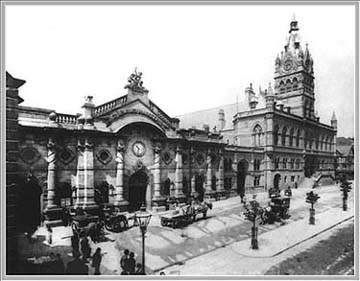
One end of the ornate Market Hall can just be seen on the extreme left of the painting- and in this late 19th century photograph. Built in 1863, it just predated the construction of the Town Hall.
The Town Hall and market were completed by around 1869, and this meant that many of the inns and building (such as the Boot, White Lion etc) were demolished to make way for them. However, physically in between the (then completed) Town Hall and the Market there were 2 buildings that were left untouched until 1882- The Market Inn on the left (immediately to the right of the Market) and The Saracens Head on the right (immediately to the left of the Town Hall). The 'extension' connecting the Town Hall and Market wasn't completed until 1882 (building work was started either the year before or that same year).
The last mention of the Saracens Head was in 1868, and the last mention of the Market Inn was in 1880. It appears that the Saracens Head was left derelict sometime after 1868, but the Market Inn survived until it was demolished for the 'extension'.
The above painting shows the Saracens Head and Market Inn before the 'extension' was built connecting the Town Hall with the Market. To the lasting disgust of many local people, both were needlessly demolished at the end of the 1960s.
Aside from those trading from within the comfort of the Market Hall or the now-vanished Green and Fish Markets- the red brick building seen on the extreme right- the painting shows how a throng of less fortunate others, mostly shawl-wrapped women, are selling their goods from ad hoc stalls- or just heaped on the ground- in the Market Square. Today, the ancient tradition of trading outdoors in the square continues in the form of the regular Farmer's Markets. |