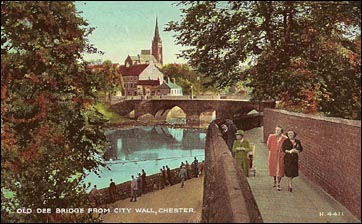
 "In whatever point of view these old ramparts are considered, they possess an imposing interest and confer incalculable benefits. To the invalid, the sedenatary student, or the man of business, occupied during the day in his shop or counting house; to the habitually indolent, who require excitement to necessary exercise, to all these, the the promenade on Chester walls have most inviting attractions, where they may breath all the salubrous winds of heaven in a morning or an evening walk. "In whatever point of view these old ramparts are considered, they possess an imposing interest and confer incalculable benefits. To the invalid, the sedenatary student, or the man of business, occupied during the day in his shop or counting house; to the habitually indolent, who require excitement to necessary exercise, to all these, the the promenade on Chester walls have most inviting attractions, where they may breath all the salubrous winds of heaven in a morning or an evening walk.
Here the enthusiastic antiquarian, who would climb mountains, ford rivers, explore the bowels of the earth, and, regardless of toil, and the claims of nature, exhaust his strength in the search for a piece of rusty cankered brass, or a scrap of Roman earthenware, can scarcely advance a dozen paces, but the pavement on which he treads, or some contiguous object, forces upon his observation the reliques of times of earliest date.
Nor can the philosophic moralist encompass our venerable walls without having his mind, comparing the splendid and gigantic works of antiquity with their present condition, strongly impressed with the mutations produced by the lapse of ages, and the perishing nature of all mundane greatness".
Joseph Hemingway: Panorama of the City of Chester 1836.
 aving
read Lucian
the
Monk's comments
about
Chester,
here
are
some
extracts
from
the
accounts
of
other
travellers
who
have
passed
through
the
city
over
the
centuries. aving
read Lucian
the
Monk's comments
about
Chester,
here
are
some
extracts
from
the
accounts
of
other
travellers
who
have
passed
through
the
city
over
the
centuries.
We
preface
our
exploration
with
a
modern
translation
of The
Ruin,
the
first
English
meditation
on
old
stones:
the
Saxon
poet
strolls,
not
through
Chester-
the
Roman Deva-
but
immediately
post-Roman Aqua
Sulis (modern
Bath-
although
the
exact
location
is
disputed): "Down
brambled
streets,
past
oozing
pipes,
carved
walls
and
columns,
sculpted
heads-
and
seeing
in
them
not
something
mute,
but
a
society
like
his
own
writ
large,
a
place
of
weapons
and
gems
and
beery
halls" (Ronald
Wright: A
Scientific
Romance).
His
words
would
have
applied
equally
well
to
Deva
and
the
hundreds
of
other
abandoned
Roman
towns
and
fortresses
throughout
5th
century
Britain:
The city buildings fell apart, the works
Of giants crumble. Tumbled are the towers
Ruined the roofs, and broken the barred gate,
Frost in the plaster, all the ceilings gape,
Torn and collapsed and eaten up by age.
And grit holds in its grip, the hard embrace
Of earth, the dead-departed master-builders,
Until a hundred generations now
Of people have passed by. Often this wall
Stained red and grey with lichen has stood by
Surviving storms while kingdoms rose and fell.
And now the high curved wall itself has fallen.
The heart inspired, incited to swift action.
Resolute masons, skilled in rounded building
Wondrously linked the framework with iron bonds.
The public halls were bright, with lofty gables,
Bath-houses many; great the cheerful noise,
And many mead-halls filled with human pleasures.
Till mighty fate brought change upon it all. |
Slaughter was widespread, pestilence was rife,
And death took all those valiant men away.
The martial halls became deserted places,
The cities crumbled, its repairers fell,
Its armies to the earth. And so these halls
Are empty, and this red curved roof now sheds
Its tiles, decay has brought it to the ground,
Smashed it to piles of rubble, where long since
A host of heroes, glorious, gold-adorned,
Gleaming in splendour, proud and flushed with wine,
Shone in their armour, gazed on gems and treasure,
On silver, riches, wealth and jewellery,
On this bright city with its wide domains.
Stone buildings stood, and the hot streams cast forth
Wide sprays of water, which a wall enclosed
In its bright compass, where convenient
Stood hot baths ready for them at the centre.
Hot streams poured forth over the clear grey stone,
To the round pool and down into the baths. |
  Despite
the
centuries
of
occupation,
today,
we
possess
no
surviving
Roman
references
to
the
fortress
of
Deva
apart
from
its
listing
in
the Antonine
Itinerary and
all
the
'Dark
Age'
references
are
mere
mentions
rather
than
descriptions.
The
author
of
the
early
ninth
century History
of
the
Britons,
sometimes
attributed
to
Nennius,
lists Cair
Legion as
one
of
the
twenty
eight
cities
of
Britain-
not
Caerlleon-ar-Wysg
in
South
Wales,
by
the
way,
as
that's
also
listed
as Cair
Legion
guar
Uisc:
"Camp
of
the
Legion
on
the
(river)
Usk". Despite
the
centuries
of
occupation,
today,
we
possess
no
surviving
Roman
references
to
the
fortress
of
Deva
apart
from
its
listing
in
the Antonine
Itinerary and
all
the
'Dark
Age'
references
are
mere
mentions
rather
than
descriptions.
The
author
of
the
early
ninth
century History
of
the
Britons,
sometimes
attributed
to
Nennius,
lists Cair
Legion as
one
of
the
twenty
eight
cities
of
Britain-
not
Caerlleon-ar-Wysg
in
South
Wales,
by
the
way,
as
that's
also
listed
as Cair
Legion
guar
Uisc:
"Camp
of
the
Legion
on
the
(river)
Usk".
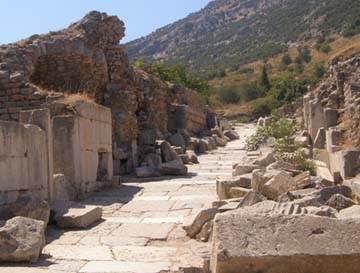
Right: Just such an abandoned street as was described in The Ruin, seen in Ephesus, Turkey. Photograph by the author.
The Annales
Cambrie ('Annals
of
Wales')
mention
a
"Synod
of
The
City
of
the
Legion"
in
a
year
which
might
be
603
or
606-
they
followed
an
eccentric
chronology
all
of
their
own,
and
it's
often
difficult
to
place
an
event
into
the
correct
calendar
year.
Everyone
seems
to
agree
that
this
'City
of
the
Legion'
was
Chester
and
that
the
Synod
is
the
one Bede mentions
when
describing
how
the
British
church
rejected Saint
Augustine's authority.
In
Bede-
who
refers
to
"The
City
of
the
Legion,
which
is
called
Carlegion
by
the
Britons
and
Legacaistir
by
the
English"-
this
then
becomes
the
cause
of
the
Battle
of
Chester
(in
the
year
613
or
616),
when
the
monks
from Bangor Isycoed (Bangor-on-Dee) were
slaughtered
by
the
pagan
Aethelfrith.
In
the Anglo-Saxon
Chronicle,
at
the
end
of
the
entry
for
the
year
893,
we
read,
"on
anre
westre
ceastre
on
Wirhealum,
seo
is
Legaceaster
gehaten"-"in
a
deserted
fort
on
Wirral,
which
is
called
Legaceaster".
Arguments
have
raged
for
years
about
whether
the
old
fortress
had
been
deserted
since
the
end
of
the
Roman
period
or
if
its
inhabitants
had
recently
fled
at
the
approach
of
the
Danish
army.
There is
also
the
possibility
that
the
local
population
actually
colluded
with
the
Danes,
letting
them
in-
something
the
writer
of
the
Chronicle
would
evidently
rather
pass
over
in
silence!
The
archaeological
evidence,
however,
shows
that
there
were
certainly
people
living
in
the
fort
before
the
arrival
of
the
Danish
army.
In
972
(really
the
following
year),
Manuscript
E
of
the Anglo
Saxon
Chronicle says-
"And
soon
after
that
(his
consecration
at
Bath
at
Pentecost),
the
king
led
all
his
navy
(ship-army)
to
Legeceaster.
And
there
came
six
kings
to
him,
and
all
with
promises
that
they
would
forever
be
his
vassals
on
sea
and
on
land". Then,
in
the
year
1000
"Her
on
issum
geare
se
cyng
ferde
in
to
Cumerlande...
his
scipu
wendon
ut
abuton
Legceastre"-
"In
this
year,
the
King
went
into
Cumberland
(probably
Lancashire!).
And
his
ships
went
out
from
Legceaster".
Five
hundred
years
after
the
Legions
withdrew
from
Deva,
their
Saxon
successors
knew
the
city
as Legecaester,
a
translation
of
part
of
the
British
(Welsh) Caer
Lleon
Vawr
ar
Ddyfrdwy or
'Camp
of
the
great
Legion
on
the
Dee'-
also
Caerleon-ar-Dour.
 A
fascinating
and
convincing
body
of
evidence
was
propounded
by Robert
Stoker in
his
book The
Legacy
of
Arthur's
Chester (1965)
which
points
out
that
there
were
actually two Caerleons
(see Henry
Bradshaw's poem
below)
and,
after
the
departure
of
the
Romans,
it
was
Chester
that
became
the
ecclesiastical
and
civil
capital
of
the
Kings
of
Britain
and
the
city
of
the
coronation
of
the
not-so-legendary
King
Arthur, not Caerleon-on-Usk (Isca)
in
South
Wales.
The
confusion
apparently
lies
with
Arthur's
medieval
chronicler, Geoffrey
of
Monmouth,
whose
patron,
Robert
of
Gloucester,
was
Lord
of
the
Monmouth
Marches,
where
Caerleon-on-Usk
is A
fascinating
and
convincing
body
of
evidence
was
propounded
by Robert
Stoker in
his
book The
Legacy
of
Arthur's
Chester (1965)
which
points
out
that
there
were
actually two Caerleons
(see Henry
Bradshaw's poem
below)
and,
after
the
departure
of
the
Romans,
it
was
Chester
that
became
the
ecclesiastical
and
civil
capital
of
the
Kings
of
Britain
and
the
city
of
the
coronation
of
the
not-so-legendary
King
Arthur, not Caerleon-on-Usk (Isca)
in
South
Wales.
The
confusion
apparently
lies
with
Arthur's
medieval
chronicler, Geoffrey
of
Monmouth,
whose
patron,
Robert
of
Gloucester,
was
Lord
of
the
Monmouth
Marches,
where
Caerleon-on-Usk
is
It
seems
that
Geoffrey,
doubtess
partly
in
order
to
please
his
Lord,
attributed
all
references
dealing
with
'Caerleon-ar-Dour'
(Chester)
to
'Caerleon'
without
qualifying
which
one
was
meant.
Historians
have
ever
since,
for
example,
been
crediting
Isca
with
having
an
archbishop
since
AD 180
because
the
local
boy
of
Monmouth
said
so
in
1100,
and
nobody
has
ever
checked
the
record...
Whatever
the
case,
think
of
the
still-magnificent
old
fortress
on
the
Dee
as
you
read
Geoffrey's
description
of
Arthur's
coronation
in
the
early
years
of
the
seventh
century:
"From
the
approach
of
the
Feast
of
Pentecost,
Arthur...
resolved
the
whole
magnificent
court,
to
place
the
crown
upon
his
head
and
to
invite
all
the
Kings
and
Dukes
under
his
subjection
to
the
solemnity...
He
pitched
upon
the
City
of
Legions
as
a
proper
place
for
this
purpose,
for
beside
the
great
wealth
of
it,
above
all
other
cities
its
situation...
was
most
pleasant,
for
on
one
side
it
was
washed
by
the
noble
river
so
that
Kings
and
Princes
from
countries
beyond
theseas
might
have
the
convenience
of
sailing
up
to
it;
on
the
other
side
the
beauty
of
the
meadows
and
groves,
and
the
magnificence
of
the
Royal
palaces
with
lofty
gilded
roofs
that
adorned
it
may
even
rival
the
grandeur
of
Rome.
There
came...
the
Archbishops
of
the
three
Metropolitan
Sees-
London,
York
and
Dubricius
of
the
City
of
the
Legions,
this
Prelate
who
was
Primate
of
Britain
and
Legate
of
the
Apostolic
See,
was
so
eminent
for
his
piety
that
by
his
prayers
he
could
cure
any
sick
person."
In connection with the above, an interesting article, entitled "Historians locate King Arthur's Round Table" appeared in The Sunday Telegraph, 11th July 2010:
"Researchers exploring the legend of Britain’s most famous Knight believe his stronghold of Camelot was built on the site of a recently discovered Roman amphitheatre in Chester.
Legend has it that his Knights would gather before battle at a round table where they would receive instructions from their King. But rather than it being a piece of furniture, historians believe it would have been a vast wood and stone structure which would have allowed more than 1,000 of his followers to gather.
Historians believe regional noblemen would have sat in the front row of a circular meeting place, with lower ranked subjects on stone benches grouped around the outside. They claim rather than Camelot being a purpose built castle, it would have been housed in a structure already built and left over by the Romans.
Camelot historian Chris Gidlow said: “The first accounts of the Round Table show that it was nothing like a dining table but was a venue for upwards of 1,000 people at a time. We know that one of Arthur’s two main battles was fought at a town referred to as the City of Legions. There were only two places with this title. One was St Albans but the location of the other has remained a mystery.”
The recent discovery of an amphitheatre with an execution stone and wooden memorial to Christian martyrs, has led researchers to conclude that the other location is Chester. Mr Gidlow said: “In the 6th Century, a monk named Gildas, who wrote the earliest account of Arthur’s life, referred to both the City of Legions and to a martyr’s shrine within it. That is the clincher. The discovery of the shrine within the amphitheatre means that Chester was the site of Arthur’s court and his legendary Round Table.”
 This material was apparently expanded into a TV programme that was aired on the History Channel during July 2010. This material was apparently expanded into a TV programme that was aired on the History Channel during July 2010.
There are, of course, all manner of problems with the above, not least the twice-stated statement regarding the "newly discovered" Chester amphitheatre- which actually occured in 1929, as you'll know if you've followed our brief history of the monument. Just one more example concerns that 'shrine'- actually altar- within the amphitheatre, which, as is known to everyone that has visited it, is dedicated to Nemesis, patron goddess of amphitheatres and goddess of retribution, and was placed there by the Centurion Sextus Marcianus "after a vision". It has nothing at all to do with 6th century martys. You can see a picture of it and learn more on the first page of our story of the amphitheatre.
* Go here to
read T.
H.
White's lively
description
of
Arthur's
entry
into
'Carlion'
from
his
great
novel The
Once
and
Future
King.
Half
a
millennium
later,
Chester
was
the
last
city
in
England
to
fall
to William
the
Conqueror's army-
a
full
three
years
after
the
Battle
of
Hastings.
In
around
1086,
the
city
was
visited
by
William's
commissioners
for
assessment
as
part
of
the
great Domesday
Survey.
Soon
after
the
completion of
the
Domesday
Book
was
born William
of
Malmesbury (c.1095-1143),
a
monk
of
that
Abbey,
who
was
of
mixed
Anglo-Norman
birth.
He
spent
most
of
his
life
as
a
librarian
at
Malmesbury,
but
he
also
travelled
widely
throughout
England.
He
is
considered
the
first
English
historian
after Bede (c.672-735)
William
wrote
this
account
aroundthe year
1125...
"Chester
is
called
the
city
of
the
Legions because
the
veterans
of
the
Julian
legions
were
settled
there.
It
adjoins
the
country
of
the
northern
Britons.
The
region,
like
much
of
the
north,
is
barren
and
unproductive
of
cerials,
especially
corn,
though
it
is
rich
in
beasts
and
fish.
The
natives
greatly
enjoy
milk
and
butter;
those
who
are
richer
live
on
meat
and
are
much
attached
to
bread
made
from
barley
and
wheat.
Goods
are
exchanged
between
Chester
and
Ireland,
so
that
what
the
nature
of
the
soil
lacks,
is
supplied
by
the
toil
of
the
merchants.
In
the
city
there
was
once
a
monastery
of
holy
nuns,
now
re-established
for
monks
by
Hugh,
Earl
of
Chester."
In
1189 Gerard
Barry,
better
known
as Giraldus
Cambrensis ('Gerald
of
Wales'),
accompanied
Archbishop
Baldwin
on
an
epic
journey
around
Wales,
preaching
the
Crusades,
and
kept
a
record
of
his
impressions.
He
wrote
of
Chester:
"A
genuine
city
of
the
Legions,
surrounded
by
walls
of
brick,
in
which
many
remains
of
its
pristine
grandeur
are
still
apparent,
namely
immense
palaces,
a
gigantic
tower,
beautiful
baths,
remains
of
temples
and
sites
of
theatres,
almost
entirely
enclosed
by
excellent
walls
in
part
remaining.
Also
both
within
and
without
the
circumference
of
the
walls
subterranean
constructions,
watercourses,
vaulted
with
passages.
You
may
also
see
furnaces
constructed
with
wonderful
art,
the
narrow
sides
of
which
inhale
heat
by
concealed
spiracles."
He
added
that
he
saw
there
"an
animal
partly
an
ox
and
partly
a
stag,
and
a
woman,
born
without
arms,
who
could
sew
with
her
feet"...
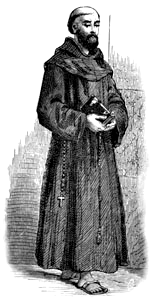 Ranulf
Higden, also
a
Benedictine monk of
St.Werburgh's
Abbey,
who
died
about
1364,
was said to have been the author of the celebrated Chester Mystery Plays but he is better remembered for his Polychronicon.
Originally a compilation from old chronicles and books upon natural history and other subjects penned by one Roger, a fellow monk of the Abbey at the beginning of the 14th century, Higden expanded greatly upon this, dealing with the countries of the known world, especially Britain, and a history of the world from the Creation down to his own time.
The work was first translated into English in 1387 and later added to by the famous early printer William Caxton, who continued the narrative down to the year 1460. He printed this expanded translation "a lytel embelysshed fro tholde" in 1482. It
remained
the
standard
reference
work
for
hundreds
of
years. Only 26 copies of the book are know to exist, of which only two are perfect. This
description
is
a
digression
in
an
early
section
of
the
work
and
is
quoted
from
the
edition
printed
by
Winkyn
de
Worde
(a
pupil
of
Caxton)
around
1495... Ranulf
Higden, also
a
Benedictine monk of
St.Werburgh's
Abbey,
who
died
about
1364,
was said to have been the author of the celebrated Chester Mystery Plays but he is better remembered for his Polychronicon.
Originally a compilation from old chronicles and books upon natural history and other subjects penned by one Roger, a fellow monk of the Abbey at the beginning of the 14th century, Higden expanded greatly upon this, dealing with the countries of the known world, especially Britain, and a history of the world from the Creation down to his own time.
The work was first translated into English in 1387 and later added to by the famous early printer William Caxton, who continued the narrative down to the year 1460. He printed this expanded translation "a lytel embelysshed fro tholde" in 1482. It
remained
the
standard
reference
work
for
hundreds
of
years. Only 26 copies of the book are know to exist, of which only two are perfect. This
description
is
a
digression
in
an
early
section
of
the
work
and
is
quoted
from
the
edition
printed
by
Winkyn
de
Worde
(a
pupil
of
Caxton)
around
1495...
" CHESTRE,
where
this
cronicle
presente
was
laborede,
in
the
coste
of
Wales
betwene
two
armes
of
the
sea
whiche
be
callede
Dye
and
Meresie
(Dee
and
Mersey)
whiche
was
the
chiefe
cite
of
Northe
Wales
in
the
tyme
of
Britones,
the
firste
founder
of
whom
is
not
knowen.
For
hit
scholde
seme
to
a
man
beholdenge
the
fundacion
of
hit
that
werke
to
be
rather
of
the
labor
of
gigantes,
other
Romanes,
then
of
Britones.
That
cite
was
callede
somme
tyme
in
the
langage
of
Britones,
Caerelyon,
in
Latyn
Legecestria,
and
hit
is
callode
now
Chestre,
other
the
Cite
of
Legiones,
in
that
the
legiones
of
knyghtes tariede
ther
in
wynter,
whom
Julius
Cesar
sende
to
Yrlonde
to
subdue
hit
to
hym.
This
cite
habundethe
in
euery
kynde
of
vitelles,
thaughe
William
Malmesbury
dreamede
in
other
wise,
as
in
corne,
flosche,
fische,
and
specially
in
salmones,
whiche
cite
recoyvethe
and
sendethe
from
it
diuerse
marchandise,
whiche
hathe
nye
to
hit
waters
of
salte
and
metalles.
That
cite,
somme
tyme
destroyede
by
men
of
Northumbrelonde,
but
reedificate
by
Elfleda,
lady
of
the
marches,
hathe
under
the
erthe
voltes
to
be
meruailede
thro
the
werke
of
ston,
and
other
grete
stones
conteynenge
the
names
and
pryntes
of
Julius
Cesar,
and
of
other
nowble
men,
with
the
wrytyinge
about."
Higden
was
buried
in
the
South
Choir
Aisle
of
the
Abbey.
In
1873
his
tomb
was
opened
to
reveal
"the
exact
form
of
a
body
still
wrapped
in
coarse
woolen
cloth
of
a
reddish-brown".
"I
cannot
repeat
perfectly
my
pater
noster
as
the
priest
it
singeth,
But
I
can
repeat
rhymes
of
Robin
Hood
and
Randal,
Earl
of Chester"
Langland:
Piers
Plowman
The
great
Welsh
bard Lewys
Glyn
Cothi (c.1420-1489),
whose
works
re-awoke
a
consciousness
of
nationhood
among
the
war-torn
and
subjugated
people
of
Wales,
lived
for
a
time
in
Chester
until
he
was
evicted,
perhaps
as
a
result
of
the
law
which
denied
Welshmen
the
right
to
settle
in
the
boroughs-
or
maybe
as
a
result
of
his
having
married
a
widow
from
the
city
without
the
consent
of
the
burgesses.
He
referred
to
his
experiences
in
his
poem The
Coverlet:
Go, complaint, to Gwynedd's sun,
I complain of the mongrels,
So crafty they were, so cold,
Mobs in the town of Chester.
It's they who plundered my house
Of my bed and fine bedspread,
And they have left me barer
Than salmon swimming a stream. |
Whatever
the
reason,
Cothi
ever
after
bore
considerable
ill-will
towards
the
city
and
its
inhabitants,
as
powerfully
illustrated
in
another
poem, The
Sword,
from
which
we
present
the
following
extracts:
The
lion
with
the
golden
mane
Who
lives
down
in
Croes
Oswallt,
Mighty
Dafydd
ap
Gutun,
May
he
never
grow
white
hair.
This
request
I
make
of
Dafydd,
It's
given
before
I
ask,
Not
for
gold,
and
not
for
land,
A
sword,
one
of
his
weapons.
It
has,
for
proper
gripping,
A
short
hilt
round
as
a
cask;
There's
a
white-corniced
cover,
And
a
clamp
like
a
round
ring.
There's
a
belt,
forked
and
crooked,
A
wooden
sheath
and
bent
cross.
By
the
cross
it's
so
fashioned,
It
is
broader
than
a
hand.
It
has
a
point
that's
as
thin
As
a
wing's
tip,
a
needle,
A
thorn
like
a
fine-honed
dart,
Keen
steel,
two
feet
three
inches,
Blest
cross
against
boorish
boys,
Protecting
cross,
stripped
naked.
|
Blue
blade,
when
it
is
displayed,
Sheet
of
glass
like
a
razor,
A
light
it
is,
a
long
crutch,
And
like
true
gold
it
glitters,
Killer,
like
a
Jew's
dagger,
And
keen
as
a
lion's
tooth.
This
I
request
of
Dafydd,
If
this
request
he
will
grant,
I
will
shave,
by
Saint
Non's
hand,
All
of
the
lads
of
Chester.
On
every
churl
I'll
whet
it,
Rib
of
steel,
if
I
come
there.
Not
one
leaves,
till
Saint
Dwyn's
Feast,
The
hot
town
head
unbroken.
I'll
carve,
if
I
come
near
them,
Twenty
thousand
naked
curs.
That
day,
after
drinking
wine,
I'll
wield
the
blade
of
Cyffin,
I'll
deal
with
my
hands
a
hurt
To
that
two-faced
town
yonder.
From
the
towns
of
Rhos
at
dawn,
By
nightfall
to
dark
Chester:
Let
me
kill,
if
my
day
arrives,
With
Dafydd's
sword
two
thousand! |
Fellow Welsh poet Guto'r
Glyn observed,
as
quoted
by George
Borrow that
the
women
of
London
itself
were
never
more "carn
strumpets" than
those
of
Chester..
Henry
Bradshaw (d.
1513),
born
in
Chester
and
educated
at
Gloucester
College,
Oxford,
was
also
a
monk
of
St.Werburgh's Abbey.
He
wrote
a a
verse
life
of
St.Werburgh
in
1500 and a
chronicle
of
Chester-
now sadly
lost- the De Antiquitate et Magnificentia Urbis Cestriae in the year of his death, 1513. This
extract
is
taken from the earlier work, which
survives
only
in
a
printed
edition
of
1521,
of
which
only
five
copies
are
known...
"This
'cite
of
legions'
so
called
by
the
Romans,
Nowe
is
nominat
in
latine
of
his
proprete
Cestria
quasi
castria,
of
honour
and
pleasance:
Proued
by
the
buyldynge
of
olde
antiquite
In
cellers
and
lowe
voultes,
and
halles
of
realte
Lyke
a
comly
castell,
myghty,
stronge
and
sure,
Eche
house
like
a
toure,
somtyme
of
great
pleasure.
Of
frutes
and
cornes
there
is
a
great
habundaunce,
Woddes,
parkes,
forestes,
and
beestis
of
venare,
Pastures,
feeldes,
comons,
the
cite
to
auaunce,
Waters,
pooles,
pondes,
of
fysshe
great
plente;
Most
swete
holsome
ayre
by
the
water
of
dee;
There
is
great
marchandise,
shyps,
and
wynes
strang,
With
all
thyng
of
pleasure
the
citezens
amonge". |
And here
is
Bradshaw's
description
of
the
two
old
Roman
fortresses
sharing
the
British
(Welsh)
name
of Caerleon-
"Two
Cities
of
Legions
in
chronicles
we
find;
One
in
South
Wales
in
the
time
of
Claudius
Called
Caerusk
by
Britons
had
in
mind;
Or
else
Caerleon
built
by
King
Belinus:
Where
sometimes
was
a
Legion
of
Knights
Chivalrous.
This
City
of
Legions
was
whilom
the
Bishop's
See
To
all
South
Wales
nominate
Venedocie.
Another
City
of
Legions
we
find
also
In
the
West
part
of
England
by
the
waters
of
Dee
Called
Caerleon
of
Britons
long
ago,
After
named
Chester
by
great
authority...
This
City
of
Legions
so
called
by
Romans...
Proved
by
buildings
of
old
antiquity...
Each
house
like
a
castle,
sometimes
of
great
pleasure" |
John
Leland wrote
of
Cheshire
folk in
his Itinerary of
1540:
"The
people
of
the
countrey
are
of
nature
very
gentle
and
courteous,
ready
to
help
and
further
one
another;
in
religion
very
zealous,
howbeit
somewhat
addicted
to
superstition.
Otherwise
they
are
of
the
stomache
stout,
body
and
hardy;
withal
impatient
of
wrong,
and
ready
to
resist
the
enemy
or
stranger
that
shall
invade
their
countrey.
So
have
they
always
been
true,
faithful
and
obedient
to
their
supervisors
insomuch
that
it
cannot
be
said
that
they
have
at
any
time
stirred
one
spark
of
rebellion
either
against
the
King's
Majesty,
or
against
their
own
peculiarhord
or
Government"
 The
following
lengthy
and
interesting
description was
written
in
about 1575,
and
is
taken
from
an
account
of
Cheshire
by William
Smith (c
1550-1618),
a
local
man
who
lived
for
periods
in
London
and
Nuremberg,
and
became
a
herald
(rouge
dragon
pursuivant)
in
1597... The
following
lengthy
and
interesting
description was
written
in
about 1575,
and
is
taken
from
an
account
of
Cheshire
by William
Smith (c
1550-1618),
a
local
man
who
lived
for
periods
in
London
and
Nuremberg,
and
became
a
herald
(rouge
dragon
pursuivant)
in
1597...
"The
Walles
of
the
Cittie,
containe
at
this
present
day
in
Circuite
Two
English
myles.
Within
the
which
in
some
places,
there
is
certayne
void
ground
and
Corne
feilds,
Wherby
(as
also
certaine
Ruines
of
Churches,
and
such
Lyke
great
places
of
Stone)
it
Appeareth
that
the
same
was,
in
old
tyme
all
Inhabited.
But
Looke
what
it
wanteth
at
this
day
within
the
walles:
It
hath
without,
In
very
faire
and
Large
Suburbes"
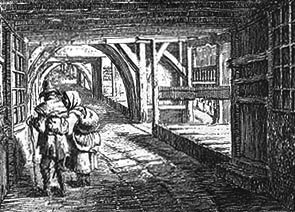
Right:
Eastgate
Row
North
by
George
Cuitt
(1779-1854)
"It
hath
foure
principall
gates.
The
Estyate,
towards
the
Est.
The
Bridge
gate,
towards
the
Sowth.
The
Watergate
towardes
the
West.
And
the
Northyate
towardes
the
North.
These
gates
in
tymes
past,
and
yet
still,
according
to
an
Antient
order
vsed
here
in
this
Cittie:
Are
in
the
protection
or
deffence,
of
dyvers
noble
men,
Which
hold,
or
have
their
Landes
Lying
within
the
Countie
pallatine.
As
first,
the
Erle
of
oxford,
had
(till
of
Late
yeares,
but
now
Sir
Christopher
Hatton)
the
Estyate.
The
Erle
of
Shrewsbury,
the
Bridge
gate.
The
Erle
of
Darby
hath
the
Watergate,
who
in
the
Right
of
the
Castell
of
Hawarden
(not
farr
of)
is
Steward
of
the
Countie
pallatine.
And
the
northyate
belongeth
to
the
Cittie,
where
they
kepe
their
prisoners.
The
Estyate,
is
the
fayrest
of
all
the
Rest.
ffrom
which
gate
to
the
Barres
(which
are
also
of
Stone)
I
ffynd
to
be
160
paces
of
geometrie,
And
from
the
Barrs,
to
Boughton
almost
as
much.
Besydes
these
4
principall
gates:
There
are
certaine
other
lesser,
Lyke
postern
gates,
And
namely
St.
John's
gate,
(
Newgate
or
Wolfgate)
betwene
Estyate
and
Bridge
gate,
So
called,
because
it
goeth
to
the
said
Church
of
St.
John,
which
standeth
without
the
walles.
 The
Bridge
gate,
is
at
the
Southpart
of
the
Cittie,
At
the
entring
of
the
bridge
(Comonly
called
Dee
Bridge)
which
Bridge
is
builded
all
of
Stone,
of
viij.
Arches
in
length.
Att
the
furthest
end
wherof,
is
also
a
gate.
And
without
that
(on
the
other
syde
of
the
water)
The
Suburbes
of
the
Cittie,
called
Handbridge. The
Bridge
gate,
is
at
the
Southpart
of
the
Cittie,
At
the
entring
of
the
bridge
(Comonly
called
Dee
Bridge)
which
Bridge
is
builded
all
of
Stone,
of
viij.
Arches
in
length.
Att
the
furthest
end
wherof,
is
also
a
gate.
And
without
that
(on
the
other
syde
of
the
water)
The
Suburbes
of
the
Cittie,
called
Handbridge.
Thc
Watergate,
is
on
the
west
syde
of
the
Cittie.
whereunto
in
tymes
past,
great
Shipps
and
vessells
might
come,
at
a
full
Sea.
But
now
scarce
small
boates
are
able
to
come,
The
Sandes
have
so
Choaked
the
Chanell.
And
although
the
Citezens
have
bestowed
marvelous
great
charges,
in
building
The
New
Tower,
which
standeth
in
the
very
River,
betwene
this
gate,
and
Northyate:
yet
all
will
not
help.
And
therefore
all
the
Shipps,
do
come
to
a
place,
called
The
New
Kay,
6.
myles
from
the
Cittie.
(Neston)
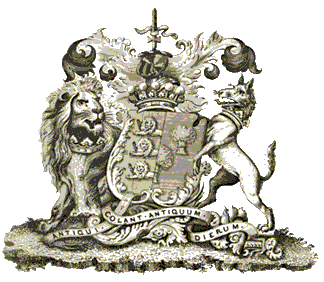
Left: the coat of arms of the City of Chester. The Latin motto, Antiqui Colant Antiquum Dierum translates as 'Let the ancients worship the ancient of days'.
The
Castle
of
Chester,
Standeth
on
a
Rocky
hill,
within
the
Wall
of
the
Cittie,
not
farr
from
the
Bridge.
Which
Castell,
is
a
place
having
privelege
of
it
selff.
And
hath
a
Constable.
The
building
thereof
seemeth
to
be
very
Ancient.
At
the
first
coming
in,
is
The
gate
house,
which
is
a
pryson
for
the
whole
County,
having
dyuers
Roumes
and
Lodgings.
And
hard
within
the
gate,
is
A
howse,
which
was
somtimes
the
Exchekor:
but
now
the
Custome
house.
Not
farr
from
thence,
in
the
base
court,
is
A
deepe
well,
and
thereby,
Stables
and
other
howses
of
office.
On
the
left
hand
is
A
Chapell.
And
hardby
adioyning
thervnto,
The
goodly
ffayre
and
Largo
Shyre
hall.
newly
Repayred.
Where
all
matters
of
Law,
touching
the
Countie
pallatine,
are
hard,
and
judically
determyned.
And
at
the
end
thereof
is
The
Brave
new
Exchequer,
for
the
said
Countie
pallatine.
All
these
are
in
the
Base
Court.
Then
there
is
A
draw
Bridge
into
the
Innerward,
wherein
are
dyvers
fayre
and
pleasant
Lodgings,
for
the
justices,
When
they
come.
And
herein
The
Constable
hym
selff
dwelleth.
The
Theeves
and
Fellons,
are
Arraigned
in
the
said
Shire
hall,
And
being
Condemned:
Are
by
the
Constable
of
the
Castell,
or
his
deputie,
delyvered
to
the
Shireffs
of
the
Cittie,
a
Certayne
distance,
without
the
Castlegate,
At
a
Stone,
called
The Glovers
Stone ffrom
which
place,
The
said
Sheriffs
do
Convay
them
throwgh
the
Citty,
to
the
place
of
Execution,
called
Boughton.
 PARISH
CHURCHES
IN
CHESTER
Tho
Cittie
is
devyded
into
ix
Parishes.
The
first
wherof
is
named
St.
Werburgs.
otherwise
called
The
Abbay,
or
Minster,
And
is
The
Cathedrall
Church,
having
the
parish
Church
in
the
South
yle
of
the
same.
This
is
a
goodly,
fayre
and
Large
Cross
Church,
having
a
square
Steple
in
the
middest,
And
at
the
West
end,
is
A
Steple
begon,
but
not
halff
finished.
Hardby
adioyning,
is
the
Bishopps
pallace,
and
not
farr
of
The
Deanes
howse. PARISH
CHURCHES
IN
CHESTER
Tho
Cittie
is
devyded
into
ix
Parishes.
The
first
wherof
is
named
St.
Werburgs.
otherwise
called
The
Abbay,
or
Minster,
And
is
The
Cathedrall
Church,
having
the
parish
Church
in
the
South
yle
of
the
same.
This
is
a
goodly,
fayre
and
Large
Cross
Church,
having
a
square
Steple
in
the
middest,
And
at
the
West
end,
is
A
Steple
begon,
but
not
halff
finished.
Hardby
adioyning,
is
the
Bishopps
pallace,
and
not
farr
of
The
Deanes
howse.
Tho
Second
parish
Church,
is
called
St.
Johns.
and
is
hard
without
the
Walles
vppon
tho
banck
of
the
River
Dee.
A
very
fayre
and
Large
Church,
with
a
fayre
brode
Steple
at
the
West
end
therof,
Which
Steple
the
yeare
past
Anno
1574,
did
halff
of
it
fall
downe,
from
the
very
topp
to
the
Bottome.
Two
squares
did
fall
downe,
And
two
squares
do
stand
still.
but
it
is
building
upp
agayne.
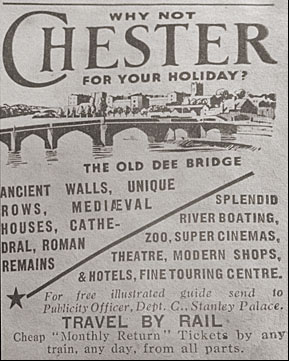
Right: a holiday advertisment for Chester which appeared in the Radio Times, 5th May 1939, just before the start of World War Two.
St.
Peters,
at
the
high
Cross,
In
the
middest
of
the
Cittie,
A
ffayre
Church,
with
a
Spyre
Steple,
vnderneath
which
Church
is
The
Pendice,
wherof
more
shalbe
said,
shortly
after.
St.
Trinities,
betwene
St.
Peters
Church,
and
the
Watergate,
A
ffayre
Church,
with
a
Spyre
Steple
also.
St.
Michaells,
in
the
Bridge
Strete.
St.
Brydes,
Right
over
against
St.
Michaells.
St.
Olaffs,
comonly
called St.Tolas,
in
the
same
streete
nerer
to
the
Bridge.
St.
Maries,
on
the
Hill,
by
the
Castle
gate,
a
very
ffayre
[sic]
with
a
square
brode
Steple.
In
which
Church
are
certayne
fayre
Tombes,
of
dyvers
gentlemen,
and
ospecially
of
the
Troutbecks,
Who
(as
it
should
appeare)
Were
ffounders
therof.
St.
Martins,
not
farr
from
the
freres,
towards
the
west
part
of
the
Cittie.
St.
Thomas,
without
Northyate.
OF
THE
MAIOR,
ALDERMEN
AND
SHERIFFS
OF
THE
CITTIE,
ETC.
The
Estate
that
the
Maior
of
Chester
kepeth
is
great.
ffor
he
hath
both
Swordbearer,
Macebearer,
Sergeants
with
their
Silver
Maces,
in
as
good
and
Decent
order,
as
in
any
other
Cittie
of
England.
His
howsekeping
accordingly,
but
not
so
Chargeable,
as
in
some
other
Citties,
because
all
things
are
bettor
cheape
there.
He
Remayneth
most
part
of
the
day,
at
a
place
called
The
Pendice.
(demolished
1803)
Which
is
a
brave
place,
builded
for
the
purpose,
at
the
High
Cross,
vnder
St.
Peters
Church.
And
in
the
Middest
of
the
Cittie,
In
such
sort,
that
a
man
may
stand
therein,
and
see
into
the
Marketts,
or
4.
principall
streets
of
the
Cittie.
There
was
wont
to
sitt
also
(in
a
Roume
adioyning)
the
clarks
of
the
said
Maiors
Courts,
Where
all
actions
Were
entred,
Recognizances
made,
and
such
Iyke,
but
this
is
now
Removed
into
the
Comon
Hall
of
the
cittie.
 There
is
none
chosen
alderman,
except
he
have
byn
first
Maior.
The
Sheriffs
(as
also
the
Maior)
on
the
workdaies,
do
go
in
fayre
Long
gownes,
Welted
with
velvet,
and
Whyte
staves
in
their
handes.
But
they
have
Violett
and
Scarlett
also,
for
festival
daies. There
is
none
chosen
alderman,
except
he
have
byn
first
Maior.
The
Sheriffs
(as
also
the
Maior)
on
the
workdaies,
do
go
in
fayre
Long
gownes,
Welted
with
velvet,
and
Whyte
staves
in
their
handes.
But
they
have
Violett
and
Scarlett
also,
for
festival
daies.
The Canal Packet House c.1840. The building to its right is today a fine pub, restaurant and live music venue known as Telford's Warehouse.
Not
farr
from
the
Pendice,
towardes
the
Abbay
Gate
is
The
Comon
Hall,
of
the
Cittie,
Which
is
a
very
great
howse
of
Stone.
And
serveth
in
stead
of
their
guildhall,
or
Towne
house.
The
Buildings
of
the
Cittie
are
very
Antient.
And
the
howses
build
in
such
sort:
that
a
man
may
go
dry,
from
one
part
of
the
Cittie,
to
another,
and
never
come
in
the
street,
But
go,
as
it
were
in
galleries,
which
they
call
The
Roes
which
have
Shopps,
on
both
sydes,
and
vnderneath,
with
dyvors
stayres
to
go
vpp
and
downe,
into
the
streets.
Which
maner
of
building,
I
have
not
hard
of,
in
any
p]ace
of
Christendome.
Some
will
ay,
that
the
Lyke
is
at
Padua
in
Italy.
But
that
is
not
so,
for
the
howses
at
Padua,
are
builded,
as
tho
Suburbes
of
this
Cittie
be,
that
is
on
the
ground,
vppon
posts,
that
a
man
may
go
dry
Vnderneth
them,
Lyke
as
they
are
at
Billings
gate
in
London.
But
nothing
Lyke
to
these
Roes.
It
is
a
goodly
sight,
to
see
the
nomber
of
fayre
Shopps
that
are
in
these
Roes,
of
Mercers,
grocers,
Drapers
and
Haberdashers.
Especially
in
the
Street
called
the
Mercers
Row.
Which
Street,
with
the
Bridgestreet
(being
all
one
street)
reacheth
from
the
High
Cross,
to
the
Bridge,
in
Length
380
paces
of
geometry,
Which
is
above
a
quarter
of
A
myle.
There
are
certayne
Conduits
of
freshwater.
And
now
of
Late
(following
the
example
of
London)
they
have
builded
one,
at
the
High
Cross,
in
the
middest
of
the
Cittie,
And
bring
the
water
to
it,
from
Boughton"
Onward
to
the Seventeenth
Century and
more
traveller's
tales
of
Chester...
Lucian
the
Monk | Nuns
of
St. Mary's | Chester
and
Domesday | Chester
Walls
Stroll
Introduction | Chester books on the Chester Wiki | Site Front Door | Top
of
page
|
 If you're enjoying your visit to our site, please consider donating a small sum to help us keep it online and growing for the benefit of all who love Chester. Simply click the button and enter your contribution, no matter how small. It's safe and easy- you don't even need a PayPal account. We thank you!