
Your treasured old photographs expertly restored at the Black & White Picture Place
Fine photography for all occasions. Click on the boys to find out more
Your treasured old photographs expertly restored at the Black & White Picture Place Fine photography for all occasions. Click on the boys to find out more |
"Chester is built as a city the site
whereof allureth the eye"
 s
long
as
there
has
been
visitors
to
Chester,
people
have
been
writing
guidebooks
to
help
them
find
their
way
around
and
to
teach
them
a
little
of
the
extraordinary
history
of
the
city. The
first
such
we
know
of,
the De
Laude
Cestrie ('Of
the
Praise
of
Chester')
was
written
around
1195
in
the
cloisters
of Chester
Abbey by
a
monk
by
the
name
of Lucian.
His
work
is,
in
fact,
the
earliest
guidebook
to
any
provincial
English
town,
and
only
a
little
later
than
the
first-known
description
of
London. s
long
as
there
has
been
visitors
to
Chester,
people
have
been
writing
guidebooks
to
help
them
find
their
way
around
and
to
teach
them
a
little
of
the
extraordinary
history
of
the
city. The
first
such
we
know
of,
the De
Laude
Cestrie ('Of
the
Praise
of
Chester')
was
written
around
1195
in
the
cloisters
of Chester
Abbey by
a
monk
by
the
name
of Lucian.
His
work
is,
in
fact,
the
earliest
guidebook
to
any
provincial
English
town,
and
only
a
little
later
than
the
first-known
description
of
London.
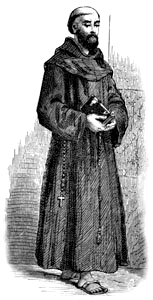
Lucian is one of the few members of the monastery, apart from the Abbots, that we know by name. He was almost certainly English, not Norman or Welsh (British), and was educated in Chester at the Collegiate Church of St. John the Baptist. Much of Lucian's work, undertaken in the second year of the tenure of Abbot Geoffrey (1194-1208), is taken up with sermonising, but there are also numerous fascinating references to the abbey and city as it was at the end of the 12th century. For example:
This latter road took its origins in the Roman road which ran
from the fortress of Deva, along the line of today's Frodsham Street and Brook
Street, through the suburb of Hoole and on to Frodsham and Warrington. Much
of the route remains in use to this day- although some sections, as at the Newton
Hollows in Hoole, are now little more than footpaths. Readers will be relieved to know that Lucian's 'devils' have long since been driven away and Hoole is now a pleasant residential suburb where the author sits writing this, the most recent of guides to the ancient city of Chester! Lucian continues, "Chester has four gates, which look on the east to India, on the west to Ireland, on the north to Norway and on the south to Wales, which is all of the island left to the Britons, through their unnatural civil wars. Our Chester has also, by the favour of God, a rich and graceful river beneath its walls, beautiful and abounding in fish, with a harbour on its south side for ships from Aquitaine, Spain, Ireland and Germany, which by Christ's guidance and by the labour and skill of the merchants come and unload at the city bay with many goods, so that comforted in all ways by the grace of our God, we may drink wine more often and more plentifully.... Here also, by the marvellous power of the Creator, a most marvellous sea shore gladdens our eyes, being now water and now dry land... on the same day and at the same place God provides both a road most suitable for travellers to use, and the deepest waters for aquatic beasts to swim in". This refers to the Roodee which at that
time was completely submerged at high tide. The Dee at this time was a much
larger and more active river than it is today and was the chief sea port of north
west England until the continued silting of the estuary made it impossible for
large ships to reach Chester's quays and the bulk of international trade went
to Liverpool, a few miles away
on the river Mersey. "Chester has two straight streets that meet in the centre and make four... The market is in the centre whence may be seen on the east the churches of St John the Forerunner, on the west St. Peter the Apostle, on the north St. Werburgh the Virgin and on the south St. Michael the Archangel." Referring to the patroness of the abbey, St. Werburgh, he somewhat generously claims, "There is no-one among the people so simple or so foolish who does not know the etymology of her name- she is called Were-burg because she is the preserver of the city... When fire invaded the streets and destroyed everything, (this was in 1180) immediately her name came into mind. She was called on and her shrine placed in the street and she answered the prayers of her petitioners." Presumably this means that the abbey and its precincts were not damaged by the flames. It would seem that the prayers of the unfortunate townsfolk did not, unfortunately, carry quite as much influence. "But you, the most delightful of cities, heedlessness lies heavy in your eyes. Commonly you run to behold the savagery of hounds, the ferocity with which they tear the flesh of bulls, the limbs of bears. Only a few years ago, you leapt up and rushed outside the walls, people of all ages and both sexes and of every walk of life, so that scarcely one old woman remained, to watch two men armed to the teeth and on horseback fighting on a level piece of ground... Though they had no military training, yet with a reckless courage they made sport that was no sport, and for the ready cheers of the crowd of spectators they fought, spurring hard with their hearts on fire. And then the Engishman prevailed as you willed him to do and pursued and pressed hard on his adversary..." Again referring to the townspeople, some mixed messages: "For they seem affable in company, cheerful at meals,
liberal in hospitality, quick-tempered, glib tongued, merciful to the afflicted,
compassionate to the poor, not double-dealing, not grossly gluttonous, not knowing
what hard work means, often borrowing other people's property without leave..." "The visitor meets with a cheery and kindly welcome and with joyful and affectionate looks. Food is put before him and a place at table is freely granted him with befitting graciousness. In their (the monks) characters are found simplicity, sincerity and refinement; in their manners orderliness, calm and self-control. Their goodness, as if emanating from the atmosphere of the place, should refresh every human mind. Just as we praise well-trained men because they are not borne down by the weight of their arms or the pertinacity of the enemy, so we admire the monks of Chester because they are not wearied by the toil of their joyful yoke. To the local people they are are cheery; to those who come from afar they are jovial, ready to open their hearts to them. The seats about their table are worn by reason of their being well-known and frequented by strangers. Seldom are they free from crowds flocking round them, and in all this do they follow the example of their King - if much has been given you, distribute it liberally; if little, this also impart cheerfully." |
To learn about another of Chester's vanished religious
communities, visit the Nuns of St. Mary's
and here to read the accounts of centuries
of later visitors to Chester..
 "The native of Chester remembers
how three roads branch off outside Eastgate and how beautiful and pleasing are
the names of the places to which they lead. The road straight in front straight
in front leads to Christ's Town (Christleton), that on the right to the Old
Ford (Aldford) but if it turns to the left it comes to a place which they rightly
call the Valley of Demons (Hoole) with reference to the hiding places of those
who lie in wait... the wanderer... is despoiled by thieves and robbers".
"The native of Chester remembers
how three roads branch off outside Eastgate and how beautiful and pleasing are
the names of the places to which they lead. The road straight in front straight
in front leads to Christ's Town (Christleton), that on the right to the Old
Ford (Aldford) but if it turns to the left it comes to a place which they rightly
call the Valley of Demons (Hoole) with reference to the hiding places of those
who lie in wait... the wanderer... is despoiled by thieves and robbers".
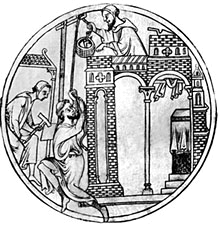 Lucian
sternly admonishes his fellow Cestrians:
Lucian
sternly admonishes his fellow Cestrians: