Old Photographs & Drawings of Chester
The Old Exchange
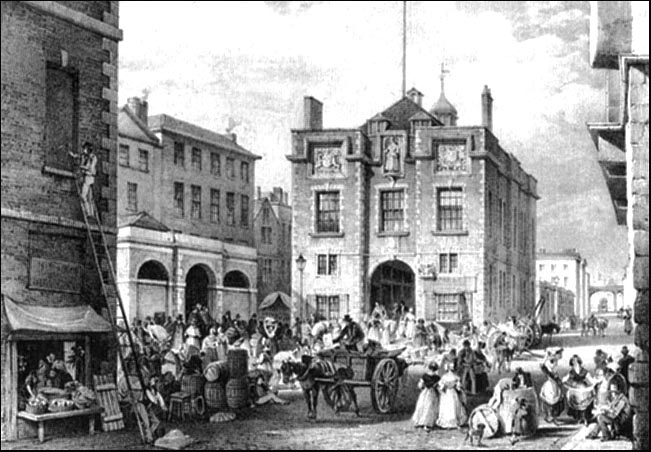
The Exchange in Northgate Street, Chester was built between 1695 and 1698 and destroyed by fire on 30th December 1862. Also known, at least in its early years, as the New Common Hall, the costs of its construction were shared between the town corporation, the King, William III, and a number of prominent local gentlemen. Its architect is unknown.
Regarding this statue, the Cheshire Sheaf of June 1878 contained the following enquiry from one C. O’Donnell, "Many years ago, while passing through Chester to Ireland, I stayed a night at that comfortable hostelry, the White Lion Hotel [Chester's principal coaching inn, which long stood where the Forum entrance is today]. From my bedroom window, next morning, I saw a STATUE OF QUEEN ANNE under a lofty niche on the south front of the Town Hall. The other day when in Chester I found that both statue and town-hall, and even my old hotel, had vanished: so, having ascertained the existence of the CHESHIRE SHEAF, and indeed seen one or two of the earlier numbers, I write to enquire whether the Statue is still in being, and whether it is known who was the sculptor ? He was manifestly, to my mind, a man of considerable ability; and something ought surely to be known of him". This reply came from the historian, author and first editor of The Cheshire Sheaf, Thomas Hughes, "In The Stranger in Chester, 1816, p. 941, I find that there lies buried in the south aisle of St. John's Church, John Tilston, sculptor, of this city, who died September 27, 1723, aged 52. To this is appended the following statement : "He carved the figure of QUEEN ANNE and the armorial shields which adorn the front of the Exchange." Mr Hughes wrote the following month, July 1878 that he had personally inspected the statue in that council depot.
John Tilston, incidentally, was also the sculptor of the ornate (and today, sadly eroded) plaque mounted on Pemberton's Parlour, which bears the Royal and City Arms and records the remarkable (and probably unique) conversion of the war-battered City Walls into the pleasant elevated promenade which millions of visitors have enjoyed ever since. In 1852, just eight years before its destruction, the Exchange underwent a radical restoration, Thomas Hughes of Aldford being the contractor and Benjamin Baylis the architect. Queen Anne was included in the work, "the statue of Queen Anne is to be restored, painted and regilt, and securely fixed to the building by a copper bar one inch square, with nuts and screws; also the pedestal the statue rests upon, and the moulding around the niche". The anonymous author of the early 19th century work, A Walk Round the Walls and City of Chester, wtote that "The Exchange is a large handsome pile, supported by five columns in the centre, and has a row of shops on the west side. It was built around the year 1698, in the mayoralty of Colonel Robert Whitley, who gave his toll toward defraying the expences of the building. The length is 126 feet, and the breadth 46 feet. The courts of Justices are held in a large commodious common hall over the exchange. In this place the Mayor, assisted by the Recorder, holds the courts of crownmote, portmote and sessions. Here the body corporate hold their assemblies for making bye-laws and other public business. The elections for Mayor, and other annual Officers, as likewise for Members of parliament, are held here; also the mansion house, where the Mayors have their entertainments, and the citizens their assemblies during the winter. Fifteen
years
later-
and
seven
years
before
it
was
destroyed-
the
old
Exchange
was
recorded
in the remarkable
aerial
view below-
a
small detail
from
John
McGahey's
famous View
of
Chester
from
a
Balloon in
1855. You can see it towards the top centre of the picture dominating a Market Square that is radically different from that we know today.
Read more of the old White Lion and the hundreds of other hostelries that are no longer with us in our Lost Pubs of Chester chapters... This view must have been made before 1862 because in that year a terrible fire destroyed the Exchange, but most of its valuable contents, including the city records and all but two large paintings were fortunately saved. After the fire, its site was cleared and an open space created which remains with us. All trace of the old Exchange was obliterated so efficiently that nobody visiting the spot today would have any clue that it had ever existed. Within two years, work started on its replacement, the great Town Hall we know today, designed by W H Lynn of Belfast, which was built in 1864-9, inspired by the medieval Cloth Hall in Ypres, Belgium. You can see a couple of photographs of it here. |
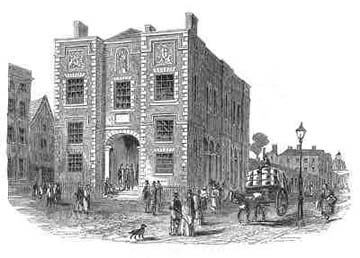 Built of brick with stone quions, its ground floor was originally an open piazza but, after sixty years, the building started to sag and was judged to be in imminent danger of collapse so the ground floor area was supported with strong pillars and the space between filled in with rows of small shops. The space was changed again in 1801-2 when the eminent Chester architect Thomas Harrison (builder of the
  At some point during the 130 years since that letter was written, the statue was transferred, complete with its original round-topped niche, to
  The Exchange
is
shown
above
in
an
anonymous
engraving
and
on
the
right
in
one
of
the
earliest
known
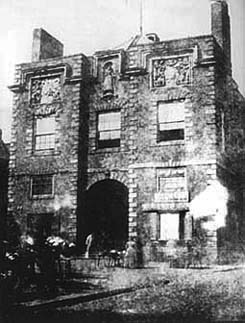
photographs
of
Chester
(or anywhere else for that matter) by Henry
Fox-Talbot,
the
inventor
of
the
negative-positive
process,
who
visited
the
city
in
the
1840s. Our main illustration above
gives
a
good
impression
of
the
bustle
of
the
market
which
was
held
here
for
many
centuries-
alas
no
more-
but
the
time
necessary
to
expose
Fox-Talbot's
photograph
meant
that
it
failed
to
record
all
but
a
few
ghostly
images
of
the
market
traders
and
customers
gathered
around
the
Exchange.
The Exchange
is
shown
above
in
an
anonymous
engraving
and
on
the
right
in
one
of
the
earliest
known
photographs
of
Chester
(or anywhere else for that matter) by Henry
Fox-Talbot,
the
inventor
of
the
negative-positive
process,
who
visited
the
city
in
the
1840s. Our main illustration above
gives
a
good
impression
of
the
bustle
of
the
market
which
was
held
here
for
many
centuries-
alas
no
more-
but
the
time
necessary
to
expose
Fox-Talbot's
photograph
meant
that
it
failed
to
record
all
but
a
few
ghostly
images
of
the
market
traders
and
customers
gathered
around
the
Exchange. 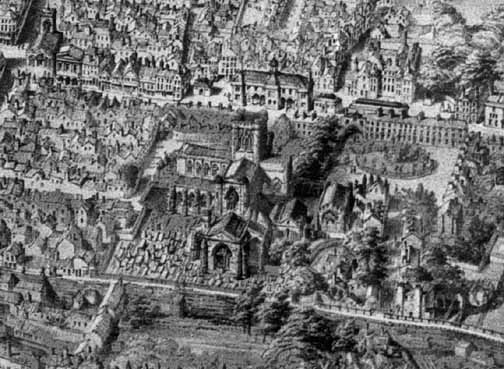 George
Cuitt,
writing
in
1815,
recorded
that
the
statue
of
Queen
Anne
situated
above
the
main
entrance
had
been
badly
damaged-
including
the
loss
of
the
orb
and
sceptre
she
formerly
held-
as
a
result
of
being
pelted
with missiles by
factions
opposed
to
the
Corporation
during
elections
of
the
late
eighteenth
and
early
nineteenth
centuries.
George
Cuitt,
writing
in
1815,
recorded
that
the
statue
of
Queen
Anne
situated
above
the
main
entrance
had
been
badly
damaged-
including
the
loss
of
the
orb
and
sceptre
she
formerly
held-
as
a
result
of
being
pelted
with missiles by
factions
opposed
to
the
Corporation
during
elections
of
the
late
eighteenth
and
early
nineteenth
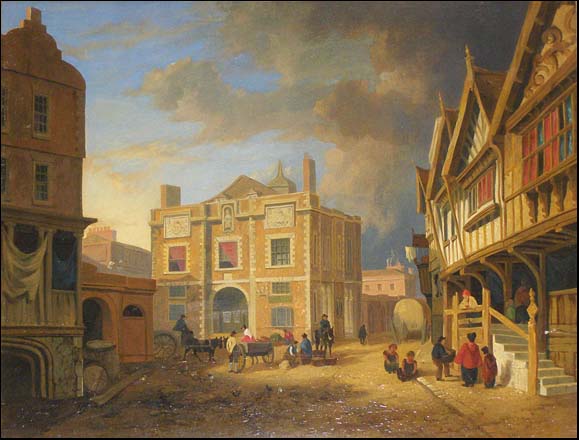
centuries. 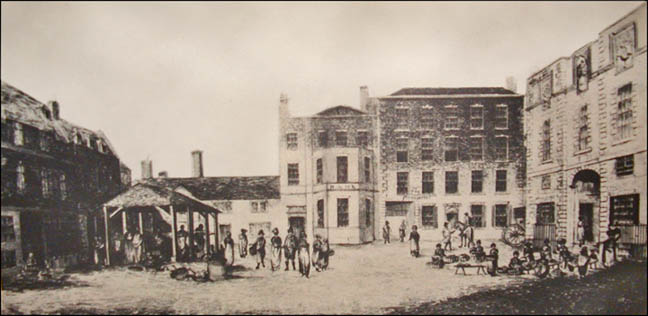 This interesting view of the south end of the Market Square shows the Exchange on the far right and behind it,
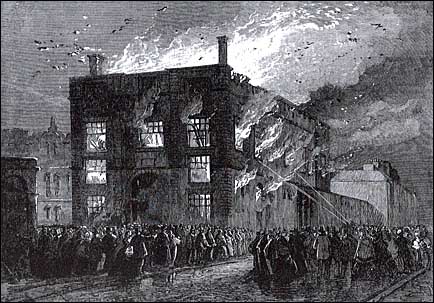
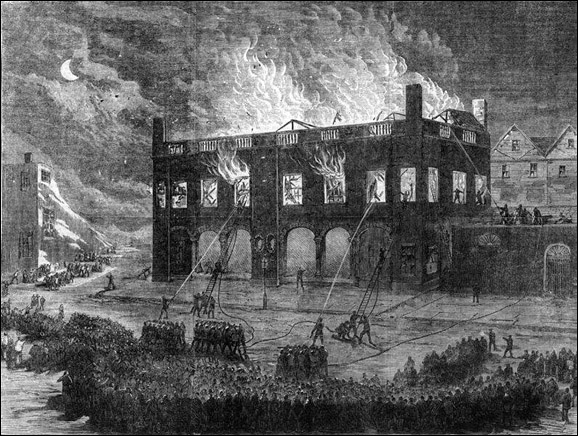
The Exchange in flames: 30th
December
1862
Old
Pics
of
Liverpool
&
Chester
| Chester Gallery | Liverpool Gallery |
B&W
Picture
Place
|
Site
Front
Door | Contact us | Next Picture
Old
Pics
of
Liverpool
&
Chester
| Chester Gallery | Liverpool Gallery |
B&W
Picture
Place
|
Site
Front
Door | Contact us | Next Picture