 elcome! We
commence
our exploration of Chester's ancient city walls by
standing
here, on
top
of
the Northgate. elcome! We
commence
our exploration of Chester's ancient city walls by
standing
here, on
top
of
the Northgate.
This
is
the
highest
point
in
the
city
and
from
here
you
can
observe
the
course
of
its ancient defensive ramparts
running
gently
downhill
on
each
side,
east
to
the Phoenix
Tower,
west
towards St. Martin's
Gate,
the Watertower and
the
Clwydian
hills
of
North
Wales
and,
less
obviously,
south
towards
the
city
centre,
the High
Cross and
beyond
to
the River
Dee.
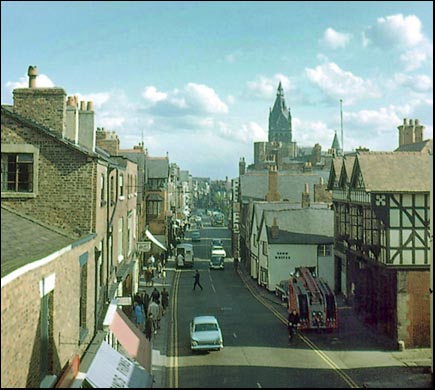
Right: Northgate Street 1967.
Courtesy of Phil Wilson
This Chester Virtual Stroll is but the latest in a long line
of guides to the splendours of our ancient city- many of which have been consulted and are named in the bibliography- but is the first to
be published exclusively on the World Wide Web, instantly and freely available
to you, wherever you may be (although your donations, sponsorship and advertising help keep us going and are always gratefully received!)
Bear in mind that our intention is not to provide a definitive history
of the City of Chester, many of which already exist (by far the richest online source is at British History Online) - but rather to provide a pleasant and illuminating
day out with a few anecdotes, pictures and personal comments thrown in at no extra cost.
Nevertheless, if you do need specific information about Chester,
Liverpool or their surrounding areas, don't hesitate to get in touch and
we will do our best to help or pass your enquiries on to those who can. All of your letters will be answered- and may even be published on our lively reader's comments pages!
Our first photographs show the view along Northgate Street as seen from the top of the Northgate; above on a sunny day in 1967, 'the summer of love' half a century ago, and below, as it appeared at the end of the nineteenth century. Not a lot of difference- and should the visitor compare them with the same view as seen today, it is truly remarkable how little seems to have changed, only the buildings in the right hand foreground of the Victorian image having since been replaced, as we shall learn later.
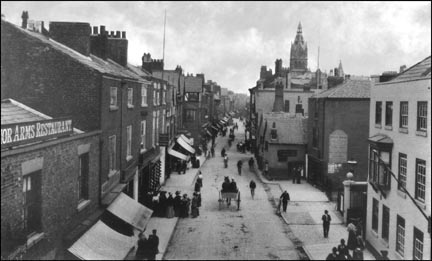 Close to where the ladies in the lower picture are queuing up for a bargain is the entrance to Abbey Green and Rufus Court, a fascinating community of bars, restaurants, cafes and specialist shops. Close to where the ladies in the lower picture are queuing up for a bargain is the entrance to Abbey Green and Rufus Court, a fascinating community of bars, restaurants, cafes and specialist shops.
You can read more about Rufus Court in our North Wall chapter and explore the fascinating businesses to be be found there both on ChesterTourist.com and on their own website..
It is interesting to compare these photographs with this painting of the same location and from around the same time as the earlier by the famous watercolourist Louise Rayner (some of her other fine images of Chester are here).
Two
thousand ago,
on
this
very spot
stood
the Roman gateway, the Porta
Decumana of
the
great
regional capital and military
fortress
of Deva. The Via
Decumanus was
the
name
given
to
the
main
north-south
street
of
a
Roman
town,
and
occasionally
to
other
large
streets
parallel
to
it.
It
entered
the
fortress
at
the
point
were
we
now
stand,
but
then
ran
slightly
to
the
right
(west)
of
the
modern
street
line,
at
an
angle
that
would
end
where
you
see
the
present
tower
of St. Peter's
Church,
at
the
Cross. In Roman times the open space we see today was filled with all manner of buildings but for many centuries it served as the home of Chester's markets and fairs, indeed being known, both then and now, as Market Square. However, since the opening of the great Town Hall on its west side in 1869, it has also been commonly referred to as Town Hall Square.
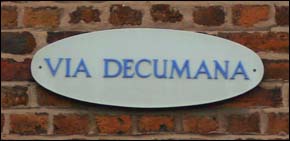 During your wanderings around our city, you may be intrigued to note how the main streets are named, in tribute to our founders, in both English and Latin. Chester is the only city in Britain where this occurs. During your wanderings around our city, you may be intrigued to note how the main streets are named, in tribute to our founders, in both English and Latin. Chester is the only city in Britain where this occurs.
The Dead Men's Room
The
Norman / medieval
gate
which, after a thousand years or so,
rose upon and incorporated the foundations of its
Roman predecessor,
was
in
the
care
of
the
sheriffs
of
the
city,
who
received
the
tolls
taken
on
goods
entering
here,
in
return
for
which
they
maintained
the
gate
and
the
terrible prison
housed
within
it,
attended
to
the
pillory
and
the
stocks,
executed
felons
and
robbers
sentenced
by
courts
throughout
the
whole
of
Cheshire (Chester being the County Town),
published
the
Earl's
proclamations
and
called
the
citizens
to
assembly "by
sound
of
the horn."
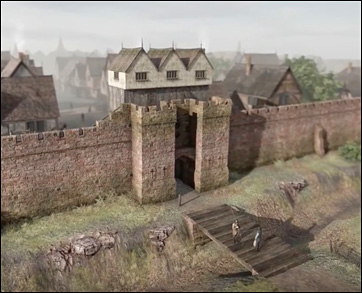 This
second
Northgate,
first
mentioned
in
documents
in
1096,
comprised
a "dark,
narrow
and
inconvenient
passage,
under
a
pointed
arch,
over
which
was
a
mean
and
ruinous
gaol." It was defended on the outside by a drawbridge. Almost five centuries later, in the city's accounts for 1569, we read, "For making the north-gate bridge new, grette joists and thick planks: £4 3s 2d". This
second
Northgate,
first
mentioned
in
documents
in
1096,
comprised
a "dark,
narrow
and
inconvenient
passage,
under
a
pointed
arch,
over
which
was
a
mean
and
ruinous
gaol." It was defended on the outside by a drawbridge. Almost five centuries later, in the city's accounts for 1569, we read, "For making the north-gate bridge new, grette joists and thick planks: £4 3s 2d".
The bridge we see in its place today was constructed in October 1772 as part of the construction of the Chester Canal. The following month, "Henry Bullock and Robert Mason, masons, were to compleate the bridge at the Northgate for the sum of eighty two pounds ten shillings".
People could be confined in the Northgate Goaol for all manner of offences, some quite trivial such as rowdyism, non payment of debts- and even the baking of poor quality bread (loaves had to marked with the 'baker's mark' so that they could, if necessary, be traced back to those responsible). The worst parts
of
the
prison- the main entrance to which was on the west side of the gate
were
excavated
from
the
bedrock
up
to
30
feet
below
the
street. Descriptions
written
in
the
17th
century
talk
of
them
being "noisome,
pestilential,
stinking,
and
crowded
with
venomous
creatures". One cell was known as 'the snake pit'-
and
another
a "dark
and
stinking
place
called
the Dead
Men's
Room" where
prisoners
who
had
been
condemned
to
death
were
confined,
"in
order
to make
them
more
callous
to
their
impending
fate". It had no windows, and was accessible only by a trapdoor in the roof.
Another
infamous cell
was known
as
the Chamber of Little
Ease, which was described by a contemporary visitor as "a hole hewed out in a rock; the breadth and cross from side to side was seventeen inches from the back to the great door; at the top seven inches, at the shoulders eight inches and at the breast nine inches and a half; with a device to lessen the height as they were minded to torture the person put in, by drawboards which shot over across the
two sides, to a yard in height or thereabouts".
 Another account described it thus, "In the court of the said House of Correction in a hole in the side of a rock is a little prison place called the Little Ease in which stubborn youths are thrust, and a grate locked upon them, where they can neither stand, sit, kneel nor ly, but are bent in all their joyntes, & have no resting place for any part". Another account described it thus, "In the court of the said House of Correction in a hole in the side of a rock is a little prison place called the Little Ease in which stubborn youths are thrust, and a grate locked upon them, where they can neither stand, sit, kneel nor ly, but are bent in all their joyntes, & have no resting place for any part".
Right: Martin Moss has produced this evocative recreation of the old Northgate in its final, forbidding, form, as it would have appeared around the year 1750. The view is from outside the City Walls with Bishop Stratford's Bluecoat Charity School on the right. This was erected in 1717 and, unlike the dreadful Northgate Gaol, remains with us today.
The view also illustrates clearly what a great obstruction to traffic the old gate must have been, even in those days. It seems remarkable that its presence was tolerated into the early years of the nineteenth century.
A wonderful animated recreation of the old Northgate and its neighbourhood by Martin Moss may be viewed on his channel on YouTube.
You will also find there the talented Mr Moss's fly-bys of Beeston, Ewloe and Chester Castles among much else..
During the reign of Queen Mary, the clergyman and martyr George Marsh was held at the Northgate before being burned at the stake for heresy at nearby Boughton in April 1555. His brief stay there after his trial in the Lady Chapel of the Cathedral was recorded thus in chapter XVI of Foxe's Book of Martyrs (1563):
"After this the Bishop delivered him unto the Sheriffs of the city (then his late keeper bade him: Fare well, good George!- with weeping), which caused the officers to carry him to a prison at the Northgate where he was very straightly kept until the time he went to his death. During which time he had small comfort or relief of any worldly creature, for being in the dungeon none that willed him good could speak with him, or at least durst enterprise so to do for fear of accusation. And some of the citizens which loved him in God for the gospel's sake (whereof there were but a few), although they were never acquainted with him, would sometimes in the evening (at a hole upon the wall that went into the said prison) call to him and ask him how he did. He would answer them most cheerfully that he did well, and thanked God most highly that He would vouchsafe of His mercy to appoint him to be witness unto His truth and to suffer for the same. Once or twice he had money cast him in at the same hole, about ten pence at one time, and two shillings at another time, for which he gave God thanks and used the same to his necessity".
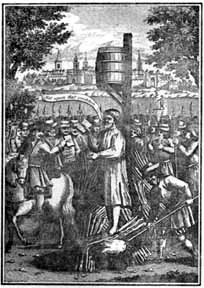 At the place of execution, he "was chained to the post, having a number of fagots under him, and a thing made like a firkin, with pitch and tar in it, over his head. The fire being unskilfully made, and the wind driving it in eddies, he suffered great extremity, which notwithstanding he bore with Christian fortitude. When he had been a long time tormented in the fire without moving, having his flesh so broiled and puffed up that they who stood before him could not see the chain wherewith he was fastened, and therefore supposed that he had been dead, suddenly he spread abroad his arms, saying, "Father of heaven have mercy upon me!" and so yielded his spirit into the hands of the Lord". At the place of execution, he "was chained to the post, having a number of fagots under him, and a thing made like a firkin, with pitch and tar in it, over his head. The fire being unskilfully made, and the wind driving it in eddies, he suffered great extremity, which notwithstanding he bore with Christian fortitude. When he had been a long time tormented in the fire without moving, having his flesh so broiled and puffed up that they who stood before him could not see the chain wherewith he was fastened, and therefore supposed that he had been dead, suddenly he spread abroad his arms, saying, "Father of heaven have mercy upon me!" and so yielded his spirit into the hands of the Lord".
The place where poor Marsh and countless others died so horribly, at the top of Barrel Well Hill in Boughton, just a mile or so from Chester Cross, is today marked by a commemorative obelisk which bears the inscription, "George Marsh born Dean, Co. Lancaster. To the memory of George Marsh martyr who was burned to death near this spot for the truth sake April 24th 1555. Also John Plessington 19th July 1679. Canonised Saint 25th October 1970."
A further memorial to him is in the lovely Church of St. John the Baptist which we will have the pleasure of visiting later in our journey.
From the reign of Elizabeth I in the 1560s, the Spanish Armada in 1588 to the so-called 'Popish Plot' concocted by Titus Oates in 1678, persecution of the Catholics resulted in many being imprisoned both here in the Northgate and at Chester Castle. One such was the above-named John Plessington, who suffered the ghastly punishment of being hanged, drawn and quartered at Boughton in 1679 for the crime of being a Catholic priest.
In
the
17th
century,
during
Oliver
Cromwell's
English
Commonweath,
Chester's Quakers were
actively
persecuted
by
the
Puritans
and
Prebyterians,
and
many
of
them
were
imprisoned
at
the
Northgate.
Of
one
unfortunate, Richard Sale, it
is
recorded: "that,
being
a
portly
man,
he
was
too
large
vilWor
the
dungeon
known
as
Little
Ease,
but
was
nevertheless
squeezed
into
it
and
the
door
shut,
which
caused
the
blood
to
run
from
his
nostrils".
The Northgate was a foul place out of which few escaped and many died- but in which one or two conformed and went to church. One Ralph Langton, however, was confined here after he rashly boasted that "he would never go to church for any man's pleasure in Chester".
The
cells
were
continually
wet
and
the
only
way
air
could
enter
was
by
the
way
of
pipes
which
led
from
the
street
above.
There
is
a
story
that
when
some
men
were
suspected
of
sheep
stealing
and
one
of
them
was
captured
and
placed
in
the
Dead
Man's
Room,
his
accomplices
stuffed
rags
into
these
pipes,
suffocating
the
prisoner
overnight
before
he
had
a
chance
to
reveal
their
names.
 In 1494, it was recorded that, "Mistress Marion Houghton, wife of a servant of the Abbot of St. Werburgh, in Northgate Street did assault Elizabeth - and struck her on the head with her right fist, dragged her hair, and struck her face so that blood flowed freely. Sir John Savage, Mayor, ordered two Sheriffs to arrest both women and deliver them to Oliver Hepay, Keeper of the Northgate Gaol, there to remain until they could find sufficient security to keep the peace". In 1494, it was recorded that, "Mistress Marion Houghton, wife of a servant of the Abbot of St. Werburgh, in Northgate Street did assault Elizabeth - and struck her on the head with her right fist, dragged her hair, and struck her face so that blood flowed freely. Sir John Savage, Mayor, ordered two Sheriffs to arrest both women and deliver them to Oliver Hepay, Keeper of the Northgate Gaol, there to remain until they could find sufficient security to keep the peace".
In 1663, a widow named Elizabeth Powell was convicted of witchcraft. Debatably more fortunate than others, such as the three women who a few years earlier had been hanged at the Castle for the same offence, she was confined in the Northgate Gaol and remained there until she died six years later.
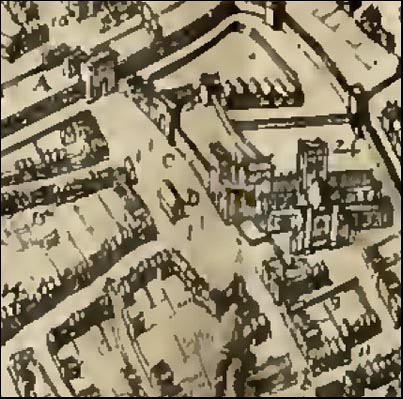
Right: Northgate Street and the Market Square as recorded in pen-and-ink in Daniel King's 'Vale Royal of England', 1656, a decade after the end of the Civil War. The old Northgate is at the top, giving access to a street that appears to be very much wider at its northern end than it is today.
In the 18th century, debtors, too, were confined at the Northgate, where they could be held for a decade or more, but their treatment was, relatively speaking. not as severe as for other classes of criminal. They were allowed to stroll about on the North Wall and even wander a little way down Northgate Street and 'gentlemen' could, for a weekly rent of five shillings, live in the relative comfort of the 'Blue Room'. Felons, too, had the use of a day room but they had to wear irons and return to their windowless cells at night.
Intriguingly, this debtor's prison seems also to have made itself available to paying guests! In the May 1879 edition of the Cheshire Sheaf, we read about "an old Cheshire character" by the name of Captain Robert Thomas, who had served in the American War and who "armed with a tremendous shillelagh after a Baccanalian debauch, would sally through the Rows and streets of the city, and fortunate was the sconce which avoided the indiscriminate sway of his arm; occasionally he played in the Rows upon his flute, which at times served him as a cudgel, and his music therefore must have been frequently out of tune"... He died in 1824, aged 77, "near the Northgate, where for over twenty years he had been a voluntary tenant of the debtor's side of the Chester City Gaol".
When
prison
reformer John
Howard visited
the
Northgate
Gaol
in
1787,
he
reported
that
both
convicted
prisoners
and
those
awaiting
trial
had
shackles
around
the
necks,
hands,
waists
and
feet
which
would
be
attached
to
the
floors
during
the
day
and
their
beds
at
night.
They
were
allowed
to
beg
for
several
hours
a
day-
a
necessity,
because
they
were
not
given
enough
food
to
live
on
by
the
authorities,
a
situation
Howard
described
as
a "disgrace
to
such
an
opulent
city." We
will
be
meeting
with
the
great
John
Howard
again
later
in
our
stroll,
when
we
visit Chester
Castle.
In addition to those at the scaffold and stake at Boughton, outside the city walls, untold numbers of public executions were carried out over the centuries at the Northgate Gaol. As late as 1801 it was recorded that two burglars, Aaron Gee and Thomas Gibson were hung here by being pushed out of windows in the attics on the gaol's south (city) side, a drop of just forty inches: "by means of the Drag, a machine of clumsy construction, both men were propelled from the aperture of a window without respect for decency. Forty feet above the roadway, their bodies beat against the windows and walls in a frighful manner, so as to break the glass in them".
On September 10th 1802, one Thomas Griffiths was sentenced to death here for stealing "one Gelding, the property of Samuel Jackson". In 1786, James Buckley was convicted of burglary and received the same harsh penalty. These sentences certainly appear severe when compared with the "six months imprisonment, and fine of 6s 8d with a recognizance of £100 to keep the peace for three years" imposed on John Davies on October 24, 1805. Mr Davies was found guilty of "wilfully, maliciously and with malice of aforethought drowning John English in the waters of the Ellesmere Canal". It would seem that, in Chester, property was deemed of greater value than life.
 Immediately next to the Northgate on the east side of the street once stood a timber-built
tavern
known
as
the Hen
&
Chickens which
is
said
to "have
reaped
golden
harvests
when,
in
the
days
of
the
old
Northgate
Prison,
unfortunate
malefactors
suffered,
close
to
this
spot,
the
last
penalty
of
the
law
at
the
hands
of
the
public
hangman" (Hughes
1858). You can readily imagine the regulars, chairs out in the street and pots in hand, enjoying a grandstand view of their unfortunate fellow citizens being consigned to eternity.. Immediately next to the Northgate on the east side of the street once stood a timber-built
tavern
known
as
the Hen
&
Chickens which
is
said
to "have
reaped
golden
harvests
when,
in
the
days
of
the
old
Northgate
Prison,
unfortunate
malefactors
suffered,
close
to
this
spot,
the
last
penalty
of
the
law
at
the
hands
of
the
public
hangman" (Hughes
1858). You can readily imagine the regulars, chairs out in the street and pots in hand, enjoying a grandstand view of their unfortunate fellow citizens being consigned to eternity..
The old inn was entirely rebuilt in the early 19th century and in 1809 was called The Wheatsheaf- it appears as this in a list of polling stations in that year- but soon after becoming The Grosvenor Arms. The wheatsheaf is the Arms of the Grosvenor family. The 'hen & chickens' is a Christian emblem of Divine Providence and the name may have been chosen by the ecclesiastical authorities at the Abbey- today's Cathedral- upon whose land the inn stood. It seems somewhat irreverent to have bestowed the name on an ordinary inn so it is possible the premises once served as accomodation for pilgrims who sought the hospitality of the monks.
The licence was withdrawn in 1912 and the inn was divided to house three shops; it was later reunited to become a branch of Sayer's the Bakers until this closed in 2008. A restaurant now occupies the premises. Learn more about the many lost inns of Northgate Street here.
The dreadful Northgate Gaol
was
in
regular
use
for
over
700
years. By 1801 it was recognised as being desperately inadequate for its purpose and calls were made for its replacement. It was described by the Mayor, Daniel Smith, the Recorder, Hugh Leycester and other worthies as "insufficient, inconvenient and in want of repair. The place whereon the present gaol is situate is improper and inconvenient, the gaol ought to be removed to another part of the city". In 1807, this came about when a new City Gaol was erected across the city on a site near the walls overlooking the Roodee now occupied by the Queen's School. When
the old one
was
demolished
in
the
following
year,
abundant
proof
of
its
Roman
origin
was
found;
large
stones,
regularly
laid
without
mortar,
and
not
nearly
so
weathered
as
the
upper
courses,
laid
probably
five
or
six
hundred
years
later. Chester
guide
and
author Thomas
Hughes remarked
of
its
passing "the
gaol,
with
its
attendant
miseries,
has
gone,
but
the
dungeons
we
have
pictured
abide
there
still,
beneath
the
ground
we
are
now
standing
on-
though
filled
up,
it
is
true,
and
for
ever
absolved
from
their
ancient
uses".
And
such
remains
the
case
to
this
day.
Spare a moment to think of those awful dungeons still lying beneath your feet when you visit the place for yourself.
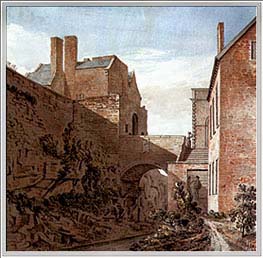 Here
is
a
beautiful
watercolour
of
the
final days of the medieval
Northgate
by Moses
Griffith (1747-1819).
The
stone
bridge
seen
crossing
the
canal
cutting
is
still
in
use
today
but
protective
iron
railings
have
since
been
added.
Notice
how
the
wall-top
walkway
went
round
three
sides
of
the
Northgate.
On
the
far
left,
you
can
see
the
diagonal
line
where
the
large
weathered
blocks
of
the
2nd
century
Roman
wall
ends
and
the
medieval
work
begins,
much
as
we
see
it
today. Here
is
a
beautiful
watercolour
of
the
final days of the medieval
Northgate
by Moses
Griffith (1747-1819).
The
stone
bridge
seen
crossing
the
canal
cutting
is
still
in
use
today
but
protective
iron
railings
have
since
been
added.
Notice
how
the
wall-top
walkway
went
round
three
sides
of
the
Northgate.
On
the
far
left,
you
can
see
the
diagonal
line
where
the
large
weathered
blocks
of
the
2nd
century
Roman
wall
ends
and
the
medieval
work
begins,
much
as
we
see
it
today.
This
writer,
for
one,
had
thought
that
the
Roman
wall
had
formerly
existed
beyond
this
point,
joining
with
the
medieval
gate,
and
that
it
had
been
cut
back
to
its
present
extent
when
the
gate
was
replaced
in
1808.
This
painting
shows
this
not
to
have
been
the
case.
It
may
have
been
an
oversight
by
the
artist,
but
he
was
60
years
old
when
the
old
gate
was
demolished, had a keen eye
and
presumably
knew
it
well.
The
other
side
of
the
canal,
where
a
utilitarian
electricity
substation
now
stands,
was
occupied
by
the House
of
Correction,
seen
on
the
right
of
the
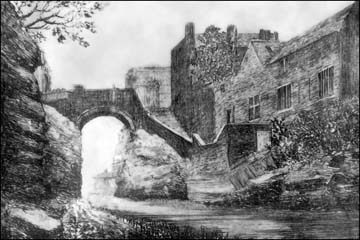
picture- and more clearly, in the anonymous black and white drawing above- where 'petty'
crimes were
punished
by
confinement
and
hard
labour. In 1693, it was ordered that three apprentices, Joseph Harrison, John Litherland and George Eaton, were to be "committed to the House of Correction, and be there severally whipped for their disorderly behaviour within the hearing of this court and continue there until further notice".
The punishment seems to have had a beneficial effect as all three are recorded as being admitted as Freemen of the City in later years. One Richard Geary Smith was sentenced to one month's stay in the House of Correction on March 13, 1799, for being a 'rogue and vagabond'. On January 19th of the same year, Samuel Starkie received a month's sentence for deserting his wife and child, therefore leaving them chargeable on the Parish. Starkie also had to pay 2/6d to his wife or the Parish before he could be discharged.
The House of Correction also served as a sort of workhouse; in 1685, Ann Mynshull left in her will "rents for the maintainance of poor freemen's children at work in a house called the House of Correction standinge neare unto the Northgate".
Beyond
this at the top of the steps,
a
corner
of
the Bluecoat
School is
just
visible.
We
will
learn
much more
about
this
in our next chapter.
The
old Northgate
saw
much
action
during
the
Civil
War Siege
of
Chester in
1645-6.
Most
of
the
buildings
standing
beyond
it
outside
the
city
walls,
if
not
burned
by
the
besiegers
were
deliberately demolished
by
the
townspeople
themselves
so
as
not
to
afford
shelter
to
Parliamentary
snipers.
The
city's
principal
entrance,
the Eastgate had
been
blocked
with
earth
and
rubble
as
a
defensive
measure,
so
the
Royalist
defenders
used
this
gate
when
sallying
forth
to
attack
their
foes
surrounding
the
town.
 More happily, a century later, a 1750 edition of the long-defunct news sheet, the Chester Courant, gave notice of a series of plays to be performed "for every night during the Fair-Week at the theatre near to the Northgate". We now have no clue where this theatre was located. More happily, a century later, a 1750 edition of the long-defunct news sheet, the Chester Courant, gave notice of a series of plays to be performed "for every night during the Fair-Week at the theatre near to the Northgate". We now have no clue where this theatre was located.
Also, in an August 1750 edition of the Courant, appeared the following announcement, "Notice of Benefit Performances. For the benefit of the prisoners in the Northgate and the Castle, on Thursday next will be presented "The Suspicious Husband" with a musical entertainment called "The Chaplet".
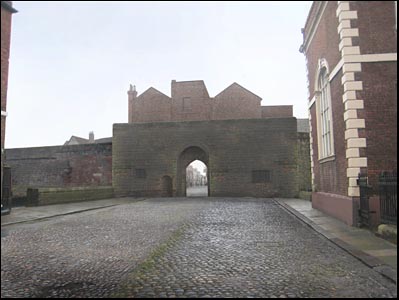
The
terrible medieval
Northgate
was
eventually replaced by
the
structure
upon
which
we
now
stand,
a miniature masterpiece of Neo-Classicism
designed
by Thomas
Harrison (1744-1829), a prolific architect whose works we will frequently encounter throughout our stroll around Chester, and
built
in
1808-10,
the
last
of
Chester's
ancient
fortified
gates
to
be
so
replaced.
On
the
north
side
is
the
inscription-
and
a
test
for
your
Latin:
PORTAM
SEPTEMTRIONALEM
SUBTRACTA
A
ROMANIS
VETUSTATE
JAM
DILAPSAM
IMPENIS
SUIS
AB
INTEGRO
PRESTITUENDAM
CURAVIT
ROBERTUS
COMES
GROSVENOR,
A.R.
GEORGII
TERTII
LI.
"The north gate built by the Romans being now about to disintegrate, Robert Earl Grosvenor has had it entirely restored at his own expense in the 51st year of the reign of George III."
And
on
the
south
appears
the
following:
INCHOATA
GULIELMO
NEWELL,
ARM,
MAI,
MDCCCVIII.
PERFECTA
THOMA
GROSVENOR,
ARM,
MAI.
MDCCCX.
THOMA
HARRISON,
ARCHITECTO.
'Gulielmo' (William) Newell served as Mayor of Chester in 1808-9.
 Built of finely cut grey Runcorn sandstone, this
new
arch
was
commisioned
by Robert,
2nd
Earl
Grosvenor,
when
he
became
Mayor
of
Chester
in
1807-08.
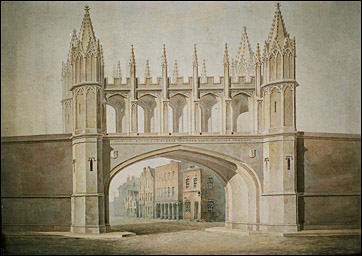
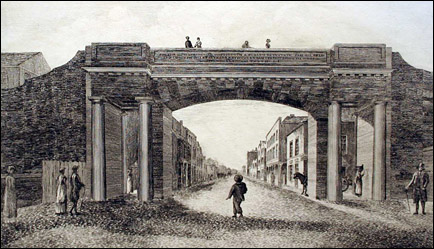
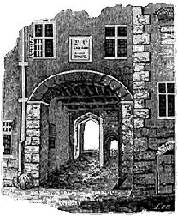
Grosvenor initially wanted a 'Gothic' design so Harrison produced drawings of a "pretty confection" (illustrated right) with a parapet of arches carrying a vaulted passage over the road. He also, however, pointed out that the new gate would stand on the site of a Roman predecessor and was located close to an impressive surviving stretch of Roman wall and so persuaded Earl Grosvenor of the merits of an alternative design which, with its Doric columns, paid homage to Chester's Roman origins. Built of finely cut grey Runcorn sandstone, this
new
arch
was
commisioned
by Robert,
2nd
Earl
Grosvenor,
when
he
became
Mayor
of
Chester
in
1807-08.
Grosvenor initially wanted a 'Gothic' design so Harrison produced drawings of a "pretty confection" (illustrated right) with a parapet of arches carrying a vaulted passage over the road. He also, however, pointed out that the new gate would stand on the site of a Roman predecessor and was located close to an impressive surviving stretch of Roman wall and so persuaded Earl Grosvenor of the merits of an alternative design which, with its Doric columns, paid homage to Chester's Roman origins.
Left: Harrison's new Northgate in 1815
Harrison duly presented his proposals to the City Council's Assembly Committee,
but, when a vote was taken, only two were in support, the other ten preferring a copy of Joseph
Turner's Watergate,
built
twenty
years
earlier, in 1789
(Turner had also, in 1782, designed the replacement Bridgegate). Mr Anderson, the contractor who was supplying the stone for the project, said that he could build Turner's design for £280 rather than the £350 which Harrison estimated his would cost. Money considerations aside, there were also hints in the Minutes and in the ensuing public controversy that that some people considered Harrison a "pushy outsider" and party politics also enterered into the row, some supporting the recently-elected tory MP and others the city's other MP- Earl Grosvenor's own brother- who was a Whig.
Within a fortnight, Anderson had commenced the foundations for the Turner design but strong opposition was already being expressed in the city to the idea of a copy of an 'old-fashioned' gate when a more modern alternative was available. Grosvenor's faction, who were willing and able to pay the higher price, were eventually successful and the new gateway was built to Harrison's design. It was modified somewhat during the construction process; Harrison had wanted fluted columns on each side of the arch, rather than the plain Doric columns we see today, on the grounds that they were "more authentically Greek" but had been persuaded to drop the idea by the Town Clerk, who feared that the delicate flutings would be damaged by the mob "at a time of disputed elections". The modifications resulted in a more severe appearance that gained something of the "quiet simplicity and quiet grandeur" of his Shire Hall portico at the Castle, erected a few years earlier.
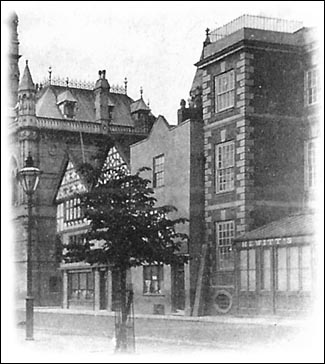 The
Northgate
hasn't
changed
much
since it was built 200 years ago.
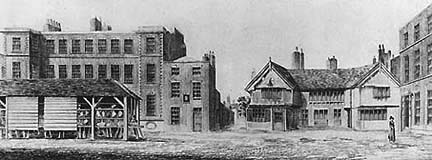
The engraving above shows it in 1815, looking exactly as it does today. In stark contrast, the Market Square (or Town Hall Square, as it is generally known now) has altered a great deal. To illustrate the point,
below
is
an
interesting
old
etching
by George
Batenham showing
the
area
as
it
appeared
around
1817, a decade after the gate was rebuilt.
Virtually
all
the
buildings
shown
have
now
vanished. The
Northgate
hasn't
changed
much
since it was built 200 years ago.
The engraving above shows it in 1815, looking exactly as it does today. In stark contrast, the Market Square (or Town Hall Square, as it is generally known now) has altered a great deal. To illustrate the point,
below
is
an
interesting
old
etching
by George
Batenham showing
the
area
as
it
appeared
around
1817, a decade after the gate was rebuilt.
Virtually
all
the
buildings
shown
have
now
vanished.
The
large
Georgian
house
on
the
extreme left
was
the
city
residence
of
the
Massey
Family
of
Moston. Next door, the family of Sir Hugh Cholmondeley, who owned a very large amount of property in various parts of Cheshire, owned a grand town house which formed the centre section of the buildings between Princess Street and Hunter Street. This house was in the occupation of the Chamberlaine family in the early years of the 19th century and later in that century the premises were occupied by William Hewitt, a coach builder- you can see the premises with his name above the door on the right of this rare old photograph, which also shows the long-vanished Elephant & Castle Inn next door. (go here to learn much more about this and hundreds more of the lost pubs of Chester). About the year 1900 they were taken over by a similar firm and re-built. They were rebuilt once again on a grander scale in 1913 to a design by Philip Lockwood for the Westminster Coach and Motor Car Works and this remains with us today as the facade of Chester Library. This was, controversially, due to be demolished as part of the Northgate Redevelopment Scheme, the elegant terracotta facade would then have formed an entrance into the promised new public square and a new, brutalist gass-and-steel library was to have been erected where the ghastly Forum Council Offices and Market Hall now stand. All that seems to have changed, however, as money men and politicians play their game. At the time of this most recent re-editing, Summer 2011, the massive shopping development has failed to materialise- and its site has been landscaped to form St. Martin's Park- the cinema remains closed and we still have no theatre or Arts Centre. Our valued library, however, remains for the moment just where it was.
 The
site
of the old mansion was replaced in the 19th cenury by a fine building in a similar style which is
now
occupied
by
the Shropshire
Arms public
house and a florist's shop.
The
fine half-timbered
house
to its right was to be demolished shortly after this print was made. Its
last
tenant
was
the
artist
James
Hunter,
who
gave
his
name
to
the
adjoining
lane, Hunter's
Passage-
later widened and known
since the 1890s as Hunter
Street.
In its place rose
the imposing Northgate House, a private residence which was later used as offices and later still as lodgings for the judges at Chester Assizes. This in turn was demolished and the handsome Grade II listed Art Deco Odeon
Cinema was built here in 1936. Before its construction commenced, an archaeological dig took place, conducted by the great Professor Robert Newstead. This unearthed some interesting Roman and medieval remains, some of which were put on show in the upper lounge and may still be seen there today. The
site
of the old mansion was replaced in the 19th cenury by a fine building in a similar style which is
now
occupied
by
the Shropshire
Arms public
house and a florist's shop.
The
fine half-timbered
house
to its right was to be demolished shortly after this print was made. Its
last
tenant
was
the
artist
James
Hunter,
who
gave
his
name
to
the
adjoining
lane, Hunter's
Passage-
later widened and known
since the 1890s as Hunter
Street.
In its place rose
the imposing Northgate House, a private residence which was later used as offices and later still as lodgings for the judges at Chester Assizes. This in turn was demolished and the handsome Grade II listed Art Deco Odeon
Cinema was built here in 1936. Before its construction commenced, an archaeological dig took place, conducted by the great Professor Robert Newstead. This unearthed some interesting Roman and medieval remains, some of which were put on show in the upper lounge and may still be seen there today.
Also soon after the print was made,
the
wooden
stalls
of
the meat
shambles on
the
far
left
of
the
picture
were
replaced
by
a
stone
and
brick
market
building,
shown
in this fine
illustration
of
the
old Exchange.
It
is
recorded
that,
in
1581,
the
city
magistrates
bought
the
old
Shire
Hall
at
the Castle "for
six
Cheshire
cheeses",
and
had
it
moved
to
the
Market
Square,
where
it
was
first
served
as
a
granary,
and
was
then
appropriated
by
the
city's
butchers, becoming
adapted to form the
flesh
shambles.
The
house
on
the
far
right
is the once-grand Folliot
House,
built in 1778 by the merchant W H Folliot, who appears in Cowdroy's Directory in 1789. It later became
for a time the
home
of
the
architect and designer of the Northgate, Thomas
Harrison. Though
now
converted
to
offices (home to the Citizen's Advice Bureau and other social services), closely
hemmed-in
by
commercial
premises and robbed of its extensive gardens,
it is
the
only
building
in
the
illustration
that
remains with us
to
this
day, albeit in a brutally truncated form, as shown by the photographs below...
|
|
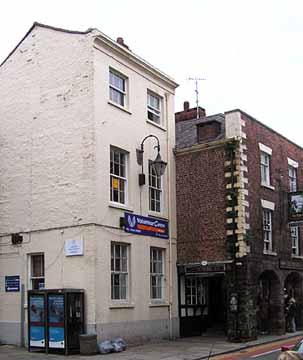 |
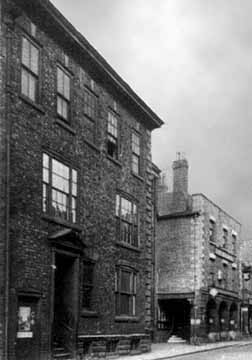
The picture on the left was taken during the Second World War when when the house served in the unglamorous but vital role of a storage depot for ARP (air raid precautions) equipment such as respirators and waterproof garments. Training exercises for the AFS (Auxilliary Fire Service) volunteer firemen were also carried out here. (The main fire station was a short distance up the street, out of shot to the right. See below..)
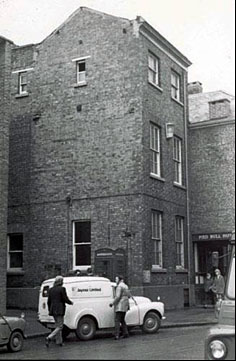
At an undetermined date since, the fine old Georgian mansion was unceremonially 'chopped in half'- the bricked-in shapes of former interior windows and doors can still be clearly seen on the blank wall nearest to the camera in the later views. Our middle photograph shows it like this in the late 1960s. Note the changed arrangement of the side windows between this and the modern view. The space between the house and the currently closed-down Odeon Cinema is now occupied by a mundane bookmaker's premises. However, the near future may bring exciting changes to old Folliot House and its surroundings as this artist's impression on the next page shows...
 The ancient Pied Bull public house next door looks exactly the same except for the reduction in height of its tall chimney. We will learn more of it and other neighbouring inns in the third part of our wanderings around Northgate Street... The ancient Pied Bull public house next door looks exactly the same except for the reduction in height of its tall chimney. We will learn more of it and other neighbouring inns in the third part of our wanderings around Northgate Street...
Thomas Harrison was a prolific architect here in Chester- in addition to the Northgate, he was responsible for the great Grosvenor Bridge, the rebuilding of the Castle and its (now-demolished) County Gaol, the Commercial Newsrooms at the further end of Northgate Street, the refacing of St. Peter's Church after the removal of the Pentice at the Cross and much else. Elsewhere, his most noted surviving buildings include the Skerton Bridge and the recently-closed County Gaol at the Castle in Lancaster, the Portico Library in Manchester and Europe's first lending library, the Lyceum and the rebuilt tower of the Parish Church of Our Lady & St. Nicolas in Liverpool.
The
attractive
timber
building
next
to
the former Blue Bell
Inn was
built
in
1911
as
a
fire
station,
designed
in the Vernacular Revival style by James
Strong,
a
pupil
of
John
Douglas, complete with oriel windows beneath picturesque overhanging gables- in Chester, even the fire station had to be a half-timbered building!
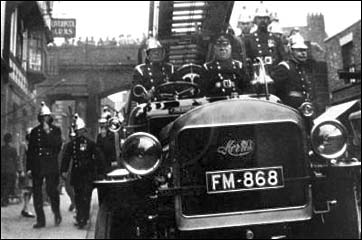
It was designed to house three horse-drawn fire engines and later, motorised ones such as the example shown in our picture. However, unable to accomodate larger modern appliances, the station
closed
in
1970
and
served
for a while as
retail
premises,
but
has now
been
transformed
into
a
smart French
restaurant.
 When the firemen moved to their new station on nearby St. Anne Street, they left behind Jack, the resident ghost. Jack used to be seen sitting on the engines, an old fireman with whiskers, dressed in an old-fashioned uniform and a brass helmet... When the firemen moved to their new station on nearby St. Anne Street, they left behind Jack, the resident ghost. Jack used to be seen sitting on the engines, an old fireman with whiskers, dressed in an old-fashioned uniform and a brass helmet...
An
earlier
fire
station
of
sorts,
known
as
'The Engine
House' existed
further
up
the
road
in
the
late
18th
century.
The
1792
directory
refers
to
it
as "a
neat
building,
with
fluted
columns
and
a
rich
cornice,
of
the
Corinthian
order.
The
fire
engines
are
kept
here
at
the
expense
of
the
Corporation,
and
the
keys
at
the
Exchange
Coffee
House,
also
by
persons
in
different
parts
of
the
city."
Fourty-odd
years
later, Joseph
Hemingway noted: "After
King
Street
on
the
left,
an
open
space,
used
as
a
potato
market,
is
discovered.
At
the
extremity
of
this
area,
a
good
brick
building
has
been
erected,
and
the
upper
part
converted
into
a
reservoir,
which
is
constantly
filled
with
water
to
supply
the
city
with
that
necessary
article,
and
to
be
in
readiness
in
case
of
fire.
The
apartments
beneath
are
occupied
as
depositories
for
the
fire
engines".
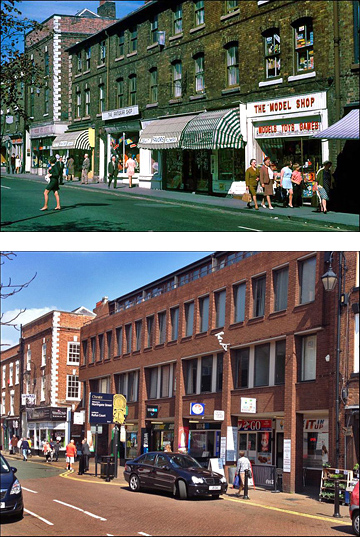
We remarked earlier, with reference to Centurion House, that Northgate Street had otherwise largely managed to escape the attention of the planners and developers that have brought (and continue to bring) so much mediocre architecture to our beautiful city centre. On the right we see two views of the section of the street between the two Abbey Gateways, taken in the 1960s and today. The terrace of 19th century houses, whose ground floors were later converted to shops, have been replaced by a brash development of shops and offices by the name of Gateway House.
The University Cathedral Free School also now operates out of this utilitarian building, following the surprise failure of its plan to take up much more prestigious premises in a fine mid-18th century house in nearby Abbey Square (which nontheless continues to feature prominently on the school's website logo..)
More Dodgy Developments
 In 2005, the local press reported that the days of the St. Anne Street fire station were apparently numbered as plans were afoot for the building to be demolished- together, scandalously, with the award-winning Northgate Arena next door, a replacement for which was to be built at the Greyhound Retail Park on the edge of the city. On its site it was proposed to erect a Hilton Hotel, of all things, even more 'luxury' apartment blocks- plus an inevitable 'sweetener' in the form of Extra Care housing for the elderly. In 2005, the local press reported that the days of the St. Anne Street fire station were apparently numbered as plans were afoot for the building to be demolished- together, scandalously, with the award-winning Northgate Arena next door, a replacement for which was to be built at the Greyhound Retail Park on the edge of the city. On its site it was proposed to erect a Hilton Hotel, of all things, even more 'luxury' apartment blocks- plus an inevitable 'sweetener' in the form of Extra Care housing for the elderly.
Expecting the worst, Chester's people were pleasantly surprised when our councillors, being advised that the plans were worrying on many counts, wisely rejected the planning application. The plot reared its head once more, however, in November 2007 when aspiring developer, Steeltower Ltd, headed by one Patrick Davies, submitted an 'amended' version of their proposals.
An unconvinced, and unnamed, local developer was quoted in the Chester Chronicle as saying, "I am a bit confused. I don't understand where the land value would be created. How are you going to generate the millions to pay for all these goodies?" (What goodies would they be then, we wondered?)
Concerned local individuals, such as
City Councillor Ruth Davidson and Geoff Alderton, took steps to ensure that the Northgate Arena was protected from predatory attacks such as this by being made a listed building. English Heritage, thought differently however, saying that the building "lacks the high level of architectural quality necessary", that its styling is "typical rather than exceptional" and that "its interior has been compromised by later alterations". We would disagree strongly- and also remind you that these are the people that, just across town, have for years fought tooth and nail to defend a rotting Victorian ex-convent that happens to stand on top of the largest Roman military amphitheatre in Great Britain...
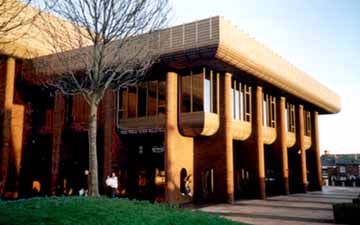
 The Northgate Arena stands on the site of the old Northgate railway station which closed in 1969. It was designed by the Building Design Partnership, a design we personally like very much. It is managed by the Chester and District Sports and Recreation Trust (CADSART), a non-profit making charitable trust. In January 2008, it beat over 450 other entrants to be named the best leisure centre in the UK by the Association for Public Service Excellence (APSE). Will this stunning achievement finally put paid to SteelTower's aspirations? Certainly, to the relief of all, nothing more has since been heard from them and a new 'Doubletree by Hilton' hotel has instead been recently opened at the historic Hoole Hall on the edge of Chester. The Northgate Arena stands on the site of the old Northgate railway station which closed in 1969. It was designed by the Building Design Partnership, a design we personally like very much. It is managed by the Chester and District Sports and Recreation Trust (CADSART), a non-profit making charitable trust. In January 2008, it beat over 450 other entrants to be named the best leisure centre in the UK by the Association for Public Service Excellence (APSE). Will this stunning achievement finally put paid to SteelTower's aspirations? Certainly, to the relief of all, nothing more has since been heard from them and a new 'Doubletree by Hilton' hotel has instead been recently opened at the historic Hoole Hall on the edge of Chester.
A second threat to the Northgate Arena occured soon after when a madcap plot to relocate West Cheshire College to its car park was announced (together, of course, with the flogging off of its original attractive site in Handbridge for housing). After massive objections and the wasting of lots more money and words, this idiocy, too, thankfully came to nothing.
Most recently, in September 2010, we're starting to learn of yet another plan to provide "state of the art" leisure facilities elsewhere in the city and get rid of the "ageing" Arena (an ironic description in a city of truly 'ageing' buildings- are they therefore for the chop too? Nothing would surprise us). These include such indispensables as a 'regional diving centre' and a 'centre for swimming development', whatever that may be. How have we managed without so far? Some of the proposed new developments have been publicised as being "in the green belt", as if that was somehow a good thing.
A sweetener to all this would be the setting aside of money for the redevelopment of the much-loved John Douglas City Baths in Union Street- unlike the Arena, a listed building. Note the term 'redevelopment' as opposed to 'restoration'- another one for those who care about this city to keep a watchful eye upon...
A great deal of local upset has recently been caused by the appearance of some truly awful new buildings in the immediate vicinity of the Arena, most notably a vast, ugly and inappropriately-situated Travelodge hotel. Can we assume that the Arena's site has been quetly earmarked for more of the same, God help us? Watch this space.
• A stunning panoramic movie of Northgate Street may be seen at Chester 360º
On to part II of our exploration of Northgate Street...
Curiosities from Chester's History no. 1
(To help put the events listed here and on the following pages into context,
we have also included the reigns of the Kings and Queens of England and a
selection of major world events- these latter are shown in blue). Links to further reading are also provided.
- BC
55
First,
short-lived,
Roman
expedition
to
Britain
by Julius
Caesar.
- BC 54 Caesar's second invasion of Britain. British forces led, this time, by Cassivellaunus. Despite early Roman advances, the British continued to effectively harass the invaders. A deal struck with the Trinovantes, tribal enemies of Cassivellaunus, and the subsequent desertion of other British tribes, finally guaranteed the Roman victory. Caesar's first two expeditions to Britain were only exploratory in nature, and were never intended to absorb Britain into the Roman sphere at that time.
- 54 BC-43 AD - Roman influence increases in Britain as a direct result of trade and other interaction with the continent and despite the absence of a military presence.
- 7BC Birth of Jesus Christ in Bethlehem
- AD 5 Rome acknowledges Cunobelinus (Shakespeare's Cymbeline), King of the Catuvellauni, as king of Britain.
- AD 43 The Romans, under Aulus Plautius, land at Richborough in Kent for a full-scale invasion of the island. In the same year, the
Emperor Claudius visited
the
site
of
Chester
when
campaigning
against the Welsh.
London
was
founded
and
the
British
under Caractacus were
defeated
at
the
Medway.
- AD
45
St.
Paul
sets
out
on
his
missionary
travels
- AD
48
The
Roman
General Ostorius
Scapula made
camp
here
as
part
of
his
expedition
into
the
territory
of
the Deceangli (N E
Wales).
They appear to have surrendered with little resistance, unlike the Silures and the Ordovices who put up a long and bitter resistance to Roman rule. The
Romans
learned
the
use
of
soap
from
the
Gauls
around
this
time.
- AD
58-60 Suetonius
Paulinus attacks
the
Ordovices
and
decimates
the Druids on the island of
Anglesey.
- AD 61 Boudica, queen of the Iceni, led her uprising against the Roman occupiers, but is defeated and killed by the Roman governor, Suetonius Paulinus.
- AD 63 Joseph of Arimathea came to Glastonbury on the first Christian mission to Britain.
- c.
AD
70
The
Legion
II Adiutrix
Pia
Fidelis ('dutiful
and
faithful')
were
posted
to
Britain
and
within
four
years
had
commenced
the
construction
of
their
fortress
in
timber
and
turf
at
what would become the future site of Chester. AD 79 is generally given as the 'official' date for this. Revolt
of
the
Jews
against
Rome;
Jerusalem
captured
and
destroyed.
- c.AD 75-77 The Roman conquest of Britain is complete, as Wales is finally subdued; Gnaeus Julius Agricola is imperial governor (to AD 84).
- AD 79 Eruption of Mount Vesuvius on August 23-24. Pompeii destroyed. The Colloseum opens in Rome.
- AD
86
Legion
II
are
posted
to
the
Danube
and
replaced
in
Chester
by
XX
Legion Valeria
Victrix ('strong
and
victorious')
under
Julius
Agricola.
They
were
to
remain
here
until
until
c.
AD
395.
(The
last
Roman
troops
left
Britain
in
436)
- c.
AD
102
The fortress
and amphitheatre rebuilt
in
high-quality masonry.
- c AD 120-165 Much of the XXth Legion were posted north to build and garrison the Hadrianic and Antonine frontiers of the province; a skeleton garrison remain in Deva
- c AD 160 A major rebuilding and expansion of the fortress commences upon the XXth Legion's return from the north.
- AD 209 St. Alban, first British martyr, was killed for his faith.
- AD 311 The Edict of Toleration proclaimed at Milan, in which Christianity is made legal throughout the empire. In 314, three British bishops, for the first time, attend a continental church gathering, the Council of Arles.
- c AD 380 The Romans abandon Deva as
Magnus Maximus takes all of the Legions out of Britain as part of a revolt against Rome. They never return.
- c 475 In legend, Arthur fights his ninth battle at 'the City of the Legions'- likely Chester.
 476
End
of
the
Western
Roman
Empire.
First
Shinto
shrines
appear
in
Japan. 476
End
of
the
Western
Roman
Empire.
First
Shinto
shrines
appear
in
Japan.
- c AD 500-600 Chester forms part of the Welsh kingdom of Powys.
- 537 Arthur,
King
of
the
Britons,
reputedly
killed
at
the Battle
of
Camlan
- c AD 600 Chester and the surrounding area absorbed into the English kingdom of Mercia.
- c.
603 Augustine, the first Archbishop of Canterbury, meets
with
Celtic
bishops "in
the
city
of
the
Legions".
The Annales
Cambrie (Annals
of
Wales)
mention
a
Synod
of
The
City
of
the
Legions
in
a
year
which
might
be
603
or
606 (they
follow
an
eccentric
chronology
all
of
their
own,
and
it's
often
difficult
to
place
an
event
into
the
correct
calendar
year).
This
Synod
is
the
one Bede mentions
when
describing
how
the
British
church
rejected
Saint
Augustine's
authority.
In
Bede-
who
refers
to "The
City
of
the
Legion,
which
is
called
Carlegion
by
the
Britons
and
Legacaistir
by
the
English"-
this
then
becomes
the
cause
of
the Battle
of
Chester (in
the
year
613
or
616),
when
the
monks
from
Bangor-is-y-Coed (Bangor-on-Dee),
who
had
prayed
and
chanted
in
support
of
the
enemy,
were
slaughtered
by
the
pagan Aethelfrith (reigned
592-616).
- 620 Edwin,
King
of
Northumbria,
Deira
and
Bernicia
(616-632AD)
gathered
a
large
fleet
at
Chester
with
which
he
attacked
the
isles
of
Anglesey
and
Man,
capturing
both
of
them.
- 622
Mohammed's
flight
from
Mecca
to
Medina.
Year
one
in
the
Moslem
calendar
- 660 King Wulphere founds a church and convent dedicated to Saints Peter and Paul on the site of the present Cathedral
|
 You're proud to be in business in Chester so tell the world-