"All innkeepers- they that have signez and they that have no synez, shall have a lanthorn with candyll burning every night from first night to VIII on the clocks from the feast of All Saints to the Purification of Our Lady". Ruling of the Mayor of Chester 1503
Dee Banks: The White House. The White House, and the nearby Red House, both started trading in the mid-19th century and were probably great rivals in trade. The White House was built in 1868 by a Mr Edward Tasker, the first licencee, The same gentleman also built, in 1853, The Bars Hotel, Foregate Street, later known as Tiffany's. In 1871 the licencee was still Edward Tasker, in1880 Joseph Nuttall. In February 1889, Mrs Mary Bulger took over the tenancy of the White House for the princely sum of £250 with a rent of £40 p.a.
 Reader Mike
Lawton
wrote
to
tell
us
that
"my
Great
Grandparents
Alfred
and
Sarah
Jane
Brentnall
(ne
Lloyd)
ran
the
pub
in
the early
1900s
and
I
had
never
seen
a photo before.
They
had
seven
daughters
and
one
son
(also
Alfred)
and
apparently
the
girls
regularly all
trouped
down
to
Hever
Castle
at
the
invitation
of
Lord
and
Lady
Aster
to
dance
at
the
balls.
Why
I
have
no
idea. Alfred
worked
as
a
foreman
for
the leadworks and
was
found
leaning
on
a
bench
outside
the
White
House
Pub.
They
thought
he
was
asleep
but
he
had
died!" Reader Mike
Lawton
wrote
to
tell
us
that
"my
Great
Grandparents
Alfred
and
Sarah
Jane
Brentnall
(ne
Lloyd)
ran
the
pub
in
the early
1900s
and
I
had
never
seen
a photo before.
They
had
seven
daughters
and
one
son
(also
Alfred)
and
apparently
the
girls
regularly all
trouped
down
to
Hever
Castle
at
the
invitation
of
Lord
and
Lady
Aster
to
dance
at
the
balls.
Why
I
have
no
idea. Alfred
worked
as
a
foreman
for
the leadworks and
was
found
leaning
on
a
bench
outside
the
White
House
Pub.
They
thought
he
was
asleep
but
he
had
died!"
In 1910, Kelly's Directory gives the licencee as Mrs Annie Harvie- who is recorded as still being there in 1942! The 1952 edition of the same directory lists the landlady as Mrs. Annie Clark- was this the same venerable licencee with a new, married, name? The White House was, sadly, closed and demolished in 1971 and its site is now occupied by a bland block of flats, albeit ones with splendid riverside views.
 Unlike its neighbour, The Red House (8 Dee Banks) is still with us, not as a the traditional pub it long was but as an 'upmarket' bar / restaurant. The first positive reference to the Red House goes back to Slaters Directory of 1855 (licencee George Fryer). However, it is likely that it was a beer-house some five or six years before this. The tithe map of 1846 shows that a Mr John Parry owned a cottage and riverside garden on this site. In 1850, Mrs Mary Parry (his widow?) ran the Dee Banks Summer House, listed as a tavern in 1850, in 1855 comes the first positive reference to the Red House, when Mr Fryer, a farmer from Huntington, was the licencee. He also ran, on Wednesdays and Saturdays, a stall in the Market Hall, obviously a versatile gentleman. Unlike its neighbour, The Red House (8 Dee Banks) is still with us, not as a the traditional pub it long was but as an 'upmarket' bar / restaurant. The first positive reference to the Red House goes back to Slaters Directory of 1855 (licencee George Fryer). However, it is likely that it was a beer-house some five or six years before this. The tithe map of 1846 shows that a Mr John Parry owned a cottage and riverside garden on this site. In 1850, Mrs Mary Parry (his widow?) ran the Dee Banks Summer House, listed as a tavern in 1850, in 1855 comes the first positive reference to the Red House, when Mr Fryer, a farmer from Huntington, was the licencee. He also ran, on Wednesdays and Saturdays, a stall in the Market Hall, obviously a versatile gentleman.
In 1871 Edward Jones was the proprietor. In the 1891 Returns of Licenced Houses of Cheshire, it is stated the licencee was a Mr Tom Hague, and the owner Mr James Parry of The Bars Hotel, Foregate Street (note the name Parry as owners again). In 1910 Philp Kelly was the licencee, in 1919-20 Mrs M Shaw, in 1934 A Blake, in 1942 George Cunningham and in 1952 his widow, Mrs Margaret Cunningham (Kelly's Directory).
Until the end of 2005, the Red House was a popular and characterful riverside pub- a 'bit rough round the edges' but nontheless with decent beer and a beautiful garden accessable both by road and by river.
In June 2006, however, it had a huge glass box added to its rear and was transformed into an uber-posh bar/restaurant. Its press release at the time reassured locals that "they would still be welcome to pop in for a pint". This has apparently since proved not to be the case. This writer was a regular visitor to the Red House when the children were growing up. They regularly got soaked, fooling about on the riverbank at the bottom of the garden there. We miss it.
"It is disgusting to note the increase in the quantity of coffee used by my subjects and the amount of money that goes out of the country in consequence. Everybody is using coffee. If possible, this must be prevented. My people must drink beer." Frederick the Great
Dee Side: The Chester Trades Directory records The Packet House Tavern trading here
in 1840, licencee Charles Hickson. Where was it?
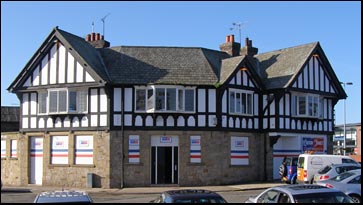 Delamere Street: The Northgate Arms (actually no 3 Victoria Road, which was curtailed by the Ring Road), is a large pub lying between the shabby mess that is today's Delamere Street and the St. Oswald's Way stretch of the Inner Ring Road, was seen to be closed and boarded up as recently as July 2007. It must have been a well-situated thriving pub once, before the coming of the ring road and the demise of Northgate Railway Station and the Cattle Market. Those days are long gone, alas, and it would frankly have been no surprise if its isolated and unattractive situation hadn't led to its closure sooner. Rumour has it that the pub and its neighbouring buildings are soon to be demolished as part of the redevelopment of the adjoining Delamere Street bus station site. Indeed, it is currently being utilised as the site office for this work. Its landlord in 1934-5 was W J Thelwell.
Peter Kinsey was licencee 1991 to 1993 (he had earlier been at the still-thriving Boot Inn, Eastgate Row North, from 1984-90). Delamere Street: The Northgate Arms (actually no 3 Victoria Road, which was curtailed by the Ring Road), is a large pub lying between the shabby mess that is today's Delamere Street and the St. Oswald's Way stretch of the Inner Ring Road, was seen to be closed and boarded up as recently as July 2007. It must have been a well-situated thriving pub once, before the coming of the ring road and the demise of Northgate Railway Station and the Cattle Market. Those days are long gone, alas, and it would frankly have been no surprise if its isolated and unattractive situation hadn't led to its closure sooner. Rumour has it that the pub and its neighbouring buildings are soon to be demolished as part of the redevelopment of the adjoining Delamere Street bus station site. Indeed, it is currently being utilised as the site office for this work. Its landlord in 1934-5 was W J Thelwell.
Peter Kinsey was licencee 1991 to 1993 (he had earlier been at the still-thriving Boot Inn, Eastgate Row North, from 1984-90).
Duke Street: Alan Speed of Neston recently wrote to us as follows: "I remember visiting in the mid 1970s a very small pub on the right hand side of Duke Street (as you travel up from Lower Bridge Street), I recall that it had a tiny public bar or snug at the front with wooden 'pew' type seats for which you were served through a hatch in the corridor outside. My only other recollection was that it was run at the time by a very old lady. I doubt that it is still there but I cannot for the life of me remember what it was called, any ideas?"
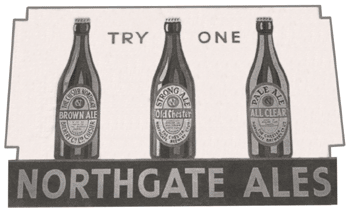 The puzzle was solved when reader Colin Matthews wrote, "His description is exactly right. It was run by two old ladies who were sisters. Its entrance was just a few yards up Duke Street on the right hand side. This was the side entrance of the pub, its front entrance being on Lower Bridge Street. It was in fact The Cross Keys, but its was very different to the present layout of the pub. The entry to the main bar was on Lower Bridge Street, which led you in to a large dark and dingy room, I seem to remember lashings of black paint. The present internal layout of the pub is totally unrecognisable. The puzzle was solved when reader Colin Matthews wrote, "His description is exactly right. It was run by two old ladies who were sisters. Its entrance was just a few yards up Duke Street on the right hand side. This was the side entrance of the pub, its front entrance being on Lower Bridge Street. It was in fact The Cross Keys, but its was very different to the present layout of the pub. The entry to the main bar was on Lower Bridge Street, which led you in to a large dark and dingy room, I seem to remember lashings of black paint. The present internal layout of the pub is totally unrecognisable.
I remember it well. I often went there with fellow art students in the sixties. I was drawn by the sheer quirkiness and oldness of the place and always amused by the way the old ladies grumbled begrudgingly as they served us ‘respectful’ young people, who had just walked into their empty main bar and disturbed their peace. However, they always seemed to have someone in their tiny snug when we went there".
The Cross Keys was listed in Cowdroy's Directory in 1782, its licencee being Peter Maicroft. After a few years of decline and closure, the place is once again thriving today.
“The sway of alcohol over mankind is unquestionably due to its power to stimulate the mystical faculties of human nature.” William James
Eastgate
Street: The Crown & Glove Hotel- 18 Eastgate
Row South, closed c 1920, now Pyke's the Jewellers. The distinctive hanging 'crown & glove' pub sign survives.
It was announced in late March 2007 that, in partnership with Chester Civic Trust, the sign was to be restored and an appeal has been made for details of the sign's origins and memories of the old pub. The sign is said to refer to a time when the monarch could be challenged on his accession but may also bear reference to the wooden glove that for centuries was hung upon the corner of the Pentice opposite (and, after, it was demolished, on the corner of St. Peter's Church) to indicate the start of Chester's fairs and markets.
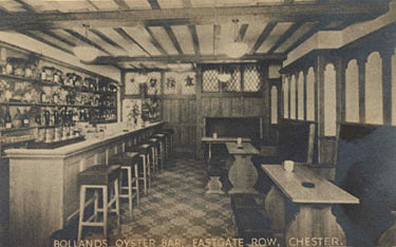 The Crown & Glove Tavern was listed in Cowdroy's Directory in 1789 when the licencee was Thomas Gresty. The landlord in 1818 was William Davies, in 1822-3 M Davies, in 1828 William Mayler, in 1850-71 Thomas Hughes, in 1880 Aaron Rose, in 1902 William Daniels, in 1910-20 William Delmage. The Crown & Glove Tavern was listed in Cowdroy's Directory in 1789 when the licencee was Thomas Gresty. The landlord in 1818 was William Davies, in 1822-3 M Davies, in 1828 William Mayler, in 1850-71 Thomas Hughes, in 1880 Aaron Rose, in 1902 William Daniels, in 1910-20 William Delmage.
 Bollands (actually more of a licenced restaurant), downstairs from which was The
Grosvenor
Oyster
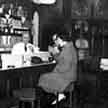
Bar (no. 42, next to Brown's of Chester). Habituee Roland Cutler reminisced about Bollands, "We used to go to Bolland’s for a drink, then across to The Boot and then come back to have a meal in the Horseshoe Bar, where you could get fine ham and eggs for five shillings. It was a monkey run for the men- you found yourself a girl and then went to dance with her in Clemence’s. Anyone who went to the races would go to Bolland’s for oysters beforehand. It was a beautiful bar, and I thought this photo would remind people what it was like. I have heard that the bar is still there intact, but bricked up now." Bollands (actually more of a licenced restaurant), downstairs from which was The
Grosvenor
Oyster
Bar (no. 42, next to Brown's of Chester). Habituee Roland Cutler reminisced about Bollands, "We used to go to Bolland’s for a drink, then across to The Boot and then come back to have a meal in the Horseshoe Bar, where you could get fine ham and eggs for five shillings. It was a monkey run for the men- you found yourself a girl and then went to dance with her in Clemence’s. Anyone who went to the races would go to Bolland’s for oysters beforehand. It was a beautiful bar, and I thought this photo would remind people what it was like. I have heard that the bar is still there intact, but bricked up now."
The barman was Arthur Brenton- the bar was locally known as 'Arthurs Bar'. He worked there until the bar closed, when he moved to the famous Quaintways dance hall- now Rosie's night club.
The original Green Dragon Inn was located at 39 Eastgate Street where Thornton's confectioners is now (a building with a strong reputation for being haunted). The licencee in 1750-54 was Mrs Hall. The Quarter Session Records (Victuallers Recognizances) show that the Thomas Worsley was the Innkeeper in 1785, and the deeds show that it was owned by the Palin family at this time. However, Cowdroy's Directory for that year, 1785 records the licencee as James Murphy. In 1850/1 Donald McGregor was landlord and in 1857 Arthur Banks. The Guild records of "Innholders, Cooks and Victuallers" mentions the Green Dragon twice - firstly Mr John Sife (alias Taylor)- also Sheriff of Chester- was Innholder in 1571, and secondly Hugh Taylor was Innholder in 1613. So the history of the original Green Dragon Inn goes back at least 400 years. It was sold in 1893 to Dicksons the Seed Merchants who occupied premises either side of it at the time. The name was then tranferred to the former Brewer's Arms in Foregate Street (see below).
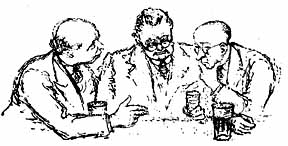
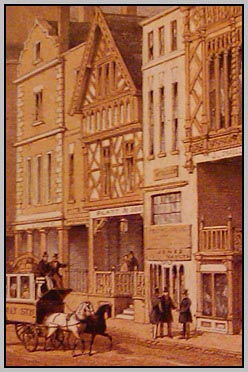 Jones' Vaults was situated on the south side of Eastgate Street, three down from the corner of Newgate Street. You can see it in our illustration, with three gentlemen conversing outside and a very large sign apparently covering part of the first-floor window. Our informant believes that this inn may have formerly been known as The White Swan, but this remains to be confirmed.. Jones' Vaults was situated on the south side of Eastgate Street, three down from the corner of Newgate Street. You can see it in our illustration, with three gentlemen conversing outside and a very large sign apparently covering part of the first-floor window. Our informant believes that this inn may have formerly been known as The White Swan, but this remains to be confirmed..
The Beehive. Licencee in 1750 Mr Hankey. The only other Beehive we know of in Chester was on Hoole Road until it closed in 2011. It is now a hi fi store.
The Rose Tavern- in existence 1750-54 when the landlady was Mrs Matthews.
The Mason's Arms is listed in Cowdroy's Directory in 1782, its licencee being Edward Rowland. He was still there in 1789.
The Phoenix- Landlord 1750-54 Mr Golding. This inn was listed in Cowdroy's Directory in 1789 when the licencee was Jonathan Barth.
The White Horse - recorded as being used as a polling station in 1809.
The Unicorn- licencee 1750 Mr Pemberton.
The Bridgewater Arms (Eastgate Street Row North). Listed in the History, Gazetteer & Directory of Cheshire, 1850 when the licencee was Reginald Joynson (still there in 1855), and in the 1859 Post Office Directory of Cheshire, licencee Mrs M Campbell, who, accrding to Slater's was still there in 1871.
The King's
Arms
Kitchen- Licencee in 1840 C L Thomas, in 1850 Susan Williams, in 1857 R Read, in 1880-1 Barker Jones. He had been at the Alma Hotel in St. Anne Street in the 1860/70s. In 1898 his widow, Mrs Ellen Jones ran the place, in 1902 Edwin Barker, (Barker has gone from Christian to surname!) in 1910-20 Mrs Annie Georgina Kate Roberts, in 1934-6 Thomas Winterbotham, during WW2 Jack Morris. Be sure to read our special feature about this unique establishment here.
The Chequers- landlord in 1782, John Cooper.
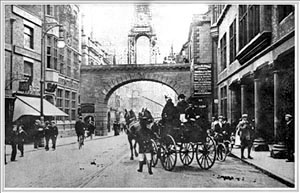 Huxley's
Vaults (south side of the Eastgate, within the Walls. In our photograph, Huxlie's is seen protruding forward of the columned building, Grosvenor Hotel, on the right, just before the Eastgate). For unknown reasons, possibly fortunately, Huxley's was fondly known by its habituees as Dirty Dick's (or, occasionally, Filthy Richard's). It was partly built into the City Walls, along with Newn's Hairdressers. Dating from c. 1770, it had been occupied by John Huxlie and Sons (wine merchants) since at least 1860. It was later owned by the Northgate Brewery and only had a six-day licence, being closed on Sundays. The brewery had converted the upper parts of the pub for living accomodation before the war and this then bore the distinguished address of 'Number 11, City Walls'. Huxley's
Vaults (south side of the Eastgate, within the Walls. In our photograph, Huxlie's is seen protruding forward of the columned building, Grosvenor Hotel, on the right, just before the Eastgate). For unknown reasons, possibly fortunately, Huxley's was fondly known by its habituees as Dirty Dick's (or, occasionally, Filthy Richard's). It was partly built into the City Walls, along with Newn's Hairdressers. Dating from c. 1770, it had been occupied by John Huxlie and Sons (wine merchants) since at least 1860. It was later owned by the Northgate Brewery and only had a six-day licence, being closed on Sundays. The brewery had converted the upper parts of the pub for living accomodation before the war and this then bore the distinguished address of 'Number 11, City Walls'.
We recently received the following letter: "My name is Ian Fry. Yes indeed, 11 City Walls was a private house. My family rented it from the brewery from 1946 to 1959 when I left to live in Australia with my new wife. 11 City Walls has many memories for me."
The Leeds Building Society, and later the Halifax, took over the premises and later it housed a moble phone shop but today it is occupied by Milton's jewellers and pawnbrokers.
A
photograph
of
it
is here). The licencee in 1943 was Dolly Gregg. There is a mystery about the Grade II listed building- if you stand outside the Grosvenor Hotel and look up you can see a brass porthole in the side wall. Legend had it that an old sea captain had it put in many years earlier to remind him of his days at sea...
The White Talbot and The Golden Talbot were situated next to each other "near the Eastgate" and were so called after the rerspective badges and supporters of the Talbot and Grosvenor families. The White Talbot seems to have eventually been incorporated within the Golden, which was advertised in the long-defunct Adam's Weekly Courant of 17th September 1751 as "that ancient and well-accustomed inn which is now fitted up in the neatest manner and held by Thomas Hickman (late agent to the Hon. Colonel Lee deceas'd) where all gentlemen, ladies and others who shall be pleased to make use of the said house may depend on the best accomodations and most civil usage".
This advertisment appeared in the long-defunct Adams's Weekly Courant, April 5th -12th1738, "This is to-give Notice that the Gentlemen of Cheshire, and the Gentlemen of Flintshire, will Weigh upon Monday, the 24th of this Instant April at Chester, Thirty-one Cocks each, for Ten Guineas a Battle, and Two Hundred the Main, and Ten Cocks for Bye Battles; they will be Fought the Four following Mournings, at the WHITE TALBOT Cock-Pit. A good Ordinary will be provided each Day for all Gentlemen and others, at the said WHITE TALBOT Inn, in Eastgate-street".
 J Jackson was the Talbot's licencee in 1781. It appears in Cowdroy's Directory in the following year, 1782 when the licencee was Thomas Jackson. The site was, from around 1785, occupied by The Royal Hotel which in turn gave way to today's Grosvenor Hotel. The Royal Hotel's licencee in 1822-3 was M Willoughby, in 1840 'Willoughby & Son', in 1850 was John Johnstone, in 1855 Elizabeth Johnson, in 1857 D McGregor. This last entry, from the Post Office Directory of Cheshire, gives the address as "Royal Hotel Row, Eastgate Street". J Jackson was the Talbot's licencee in 1781. It appears in Cowdroy's Directory in the following year, 1782 when the licencee was Thomas Jackson. The site was, from around 1785, occupied by The Royal Hotel which in turn gave way to today's Grosvenor Hotel. The Royal Hotel's licencee in 1822-3 was M Willoughby, in 1840 'Willoughby & Son', in 1850 was John Johnstone, in 1855 Elizabeth Johnson, in 1857 D McGregor. This last entry, from the Post Office Directory of Cheshire, gives the address as "Royal Hotel Row, Eastgate Street".
This comment upon the activities of race days dates from 1778, "It may be supposed that cook-fighting and other elegant amusements helped to fill up each day; while in the evening the New Assembly Room at the Talbot, opened only the year before, was the great centre of attraction for the ladies, "everything," according to the papers of the time, "being conducted with the strictest degree of propriety!"
You can see a picture of The Royal Hotel in our lost pubs gallery. (There was also a Talbot Hotel in nearby Newgate Street).
The Mitre Tavern, which was located up in the Row on the corner of Eastgate Street and St. Werburge Lane (now St. Werburgh Street) is mentioned in a will of 1649. A later will of 1679 mentions the same house but refers to it as "being commonly now referred to as The Black Dragon" but a trades list of 1750-54, when the landlord was Mr Maddock, refers to it as still being called The Mitre. It was listed as such in Cowdroy's Directory in 1789 when the licencee was John Hannah, in 1818, landlord William Bellin, in 1822-3 Richard Minchull, in 1850, licencee John Thomas and was still called so in 1857 when the licence was held by Mrs M Thomas. The inn is absent from the 1871 directory, its site being occupied since Victorian times by a grand Neo-Classical bank building, the construction of which caused some unhappiness because it destroyed not only the inn but a section of the ancient Row in which it stood.
In December 1812, Chester's people flocked to The Mitre to see "the most wonderful curiousity the world ever produced" in the form of Miss Sarah Beffin, who, despite entirely lacking arms, "can cut and make any part of her own clothes, sews extremely neatly and in a wonderful manner, writes well, draws landscapes, paints miniatures and many more wonderful things, all of which she performs principally with her mouth". Sarah is buried in St. James' Cemetery, Liverpool Anglican Cathedral.
Eccleston- or rather Figdale. This village was situated in Eaton Park, home of the Duke of Westminster, near the bank of the River Dee, not far from the Machine Lodge (the Eccleston Village entrance to the Park). At the heart of the village was The Boat House Inn with its bowling green, kept about the middle of the 18th century by J. Wild. Its existence was noted in an account of Eccleston Parish in 1771 but, at some point at the end of that century, not only the inn but the entire village was demolished by the Grosvenors and little remains today to show that the place ever existed. There are, however, several stones in Eccleston churchyard to the memory of persons once resident at Figdale- the Davies', Clays', Hughes', Higgins' etc.
"May your glass be ever full. May the roof over your head be always strong. And may you be in heaven half an hour before the devil knows you're dead." Old Irish Toast
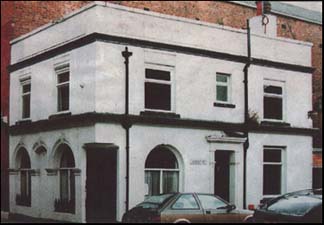 Egerton Street: The Prince Alfred Inn (no 27, corner of Albert Street). Its licencee in 1880 was Hugh Jones, in 1919-20 H Brown, in 1934-5 C S Ford. It is now a private house- illustrated left in 1997- but still looking every inch a pub. Egerton Street: The Prince Alfred Inn (no 27, corner of Albert Street). Its licencee in 1880 was Hugh Jones, in 1919-20 H Brown, in 1934-5 C S Ford. It is now a private house- illustrated left in 1997- but still looking every inch a pub.
The Union Hotel (no. 44). Licencee in 1871-80 (when it was called The Union Inn) John Dutton, in 1902 John Hewitt Boswick, in 1910-1914 Gilbert Gerrard, in 1934-6 Thomas Stones- in whose time it changed from The Union Vaults to The Union Hotel. You can see it and The Prince Alfred on this detail from the 1875 Chester OS map.
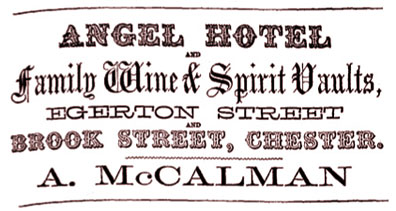
The Angel Hotel (corner of Brook Street) site now occupied by the Chester Lodge Residental Home. The Angel has its own page here.
The Egerton Arms (no 2 Egeron Street). Its licencee in 1850-57 was Edward Egerton (street, pub and landlord- all with the same name!) In 1919-20 J E Jones, in 1934 it was J Moran.
The Iron Bridge Inn (no. 41, see Jacqueline Naylor's interesting letter above). In January 2007, Michelle Day wrote to us, "Hi there from Western Australia. I was doing some family research and came across some information on the Iron Bridge Inn, Egerton Street. My G G Grandparents were the innkeepers there in 1870, George & Martha Pringle, their son Charles William born there Dec 15th, 1869".
The splendidly-named Griffith Griffiths was the licencee back in 1850, J Green in 1857, Hanna Holmes in 1880 and William Smith from 1902 until at least 1914,
1919-30 Mrs M Williamson (when her inn was listed at no 57 Egerton Street in the directory).
We also received this letter recently from Greg Howard, far away in Brisbane, Australia:
"
I came across your excellent 'Chester's Vanished Inns Pubs and Breweries' and venture to ask if you might be able to shed any light on references to an early 1800s inn that I have been unable to locate?
A disreputable ancestor of mine, Thomas Broom, was convicted in Chester in 1830 and transported to New South Wales for life. The crime- “stealing from the person”- took place at an inn in Chester. One of the newspaper articles I found (Chester Chronicle 10th July 1829) refers to "The Wheelwright's Arms public house in Flookersbrook", while another article (Chester Chronicle 17th Sep 1830) refers to "The Wheelwright's Arms, in Egerton Street." Both are in accounts of the robbery that resulted in my ancestor's conviction and transportation. Basically, he and three others befriended a wealthy 70-year old farmer at the Chester Fair, went to the inn with him, slipped some laudanum into his drink, and removed about 60 pounds from his waistcoat. Two were arrested near the scene but Thomas Broom evaded capture for a year. All were transported for life. I should say in his defence that he seems to have lived an exemplary life in Australia. Wondering if you might be able to help with identifying this old inn?"
Ellesmere Port / Great Sutton: In early December 2012, it was reported that the closed and vandalised Sutton Way Hotel on Thelwall Road was to be turned into a Tesco Express. Since 2010, Tesco have converted around 130 pubs into supermarkets of various sizes, aided largely by an absurd 'loohole' in planning law that allows pubs to be turned into retail outlets without planning permission.
We're a little short of entries for this new category covering the Ellesmere Port, Great Sutton etc area. Your contributions are most welcome!
Filkin's Lane: The Boughton Hall. Proprietor in 1942, W E Evans. Anybody know more about this?
"Give me a woman who loves beer and I will conquer the world". Kaiser Wilhelm
Foregate
Street: We got this letter in Feb 2012 from reader Barbera Polglaze and wonder if anyone can assist here with her enquiry:
"In researching my family history, I found that one of my ancestors, James Jones, was, at the time of his death in 1866, an innkeeper at The Leopard Tavern, Foregate Street, Chester. Having searched your pages covering the vanished inns of Chester, I can find no mention of this establishment. Do you happen to know where The Leopard Tavern was situated in Foregate Street?
This is the address given on James Jones's death certificate dated 11th Nov 1866 and his occupation is given as 'innkeeper'. Having trawled through both the 1861 & 1871 census records for Forgate St, I can't find it, so I'm assuming that it was at a corner location & that the official address wasn't Foregate St but the other street at the corner- if you see what I mean. However, that is only an assumption based on failing to find it in the census records".
Well, we think the Leopard Tavern was actually at 43 Foregate Street as James Jones' name appears at that address in the directories between 1857 and 1864, followed by that of Ann Jones in 1868. It appears that there was also a Leopard Inn on Bridge St in 1855, also with the licencee James Jones. It appears that he may have taken the name and the licence with him to Foregate Street. Here's the interesting bit:
James Jones was shown in Louise Rayner paintings to be licencee of The Old Vaults, later famously known as Barlow's, in Bridge Street. An 1853 map also shows James Jones as licencee of the Old Vaults. Also there was a James Jones in 1855 who was licencee of The Leopard Inn on Bridge Street. There was only one James Jones listed for Bridge Street around those years, so our guess is that he ran The Old Vaults, changed its name to the Leopard Tavern (what it was before is currently unknown), and then took the name with him to Foregate Street during 1857. He is last listed in 1864, so this ties in with him passing away in 1866.
Not really a pub (not at all a pub. Cavorting indeed)- but Brannigan's night club closed down in early February 2010. Located in what was the ABC Regal cinema, Brannigan's opened in October 1995.
In early 2012 it was announced that the premises had been acquired by Primark as an extension to their existing clothing store.
Clarke's Vaults. In the directories may be found entries for it from 1864 through to 1902- the liencee went from John Clark in 1864 (although Marie Clarke ran it for a short period of time) through to Henry Fleet and then George Pye in 1902. It was in existence from at least 1862.
The Old Stag's Head Inn (nos. 47 and 49). Landlord in 1942, J B Brennan.
The White Hart was trading in Foregate Street in 1781, licencee Mr Jones.
There was another White Hart in Northgate Street.
 The Wagon & Horses (no 51) appears in The Post Office Directory of Cheshire in 1856 when its licencee was
H Wright. The Wagon & Horses (no 51) appears in The Post Office Directory of Cheshire in 1856 when its licencee was
H Wright.
The Brewer's Dray.
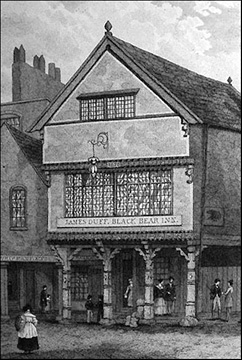
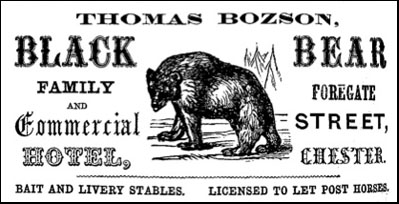
The Black Bear Inn- mentioned in a 1749 edition of the Chester Courant. It was listed in Cowdroy's Directory in 1789, when the licencee was J Hammond, in the Chester Trades Directory in 1822-3 Licencee Richard Harrison, in 1840 Ralph Hickson and in 1850 James Duff, and the 1859 Post Office Directory of Cheshire, licencee John Hughes, who had been there in 1855 according to Slater's Directory. The inn does not appear in the 1871 directory. Our illustration (right) shows how it looked in 1851, with James Duff's name above the door.
The Freemason's Tavern appeared in Pigot's Directory 1818-20 and also a later directory, 1822-3, when the licencee was Jas Davies.
The Elephant & Castle- the west side of St. John's Lane, as modern St. John Street was once called, formed part of the possessions of the Fraternity of St. Anne, whose house stood in St. John's churchyard. On this land, "close to the Eastgate" stood, at least as late as 1650, an inn called Ye Maydenhead. This seems to have given way to a hostelry on the same site by the name of The Elephant & Castle (not to be confused with one of the same name which formerly stood next door to the still-thriving Coach & Horses- now Coach House- in Northgate Street) which was equipped with its own cockpit and is mentioned in the trade directory for 1782.
In 1752, Joseph Beckett advertised that he had moved from the Elephant & Castle to the nearby Blossoms Inn, where he took over the Chester to Liverpool coach service. The inn's last landlord was William Hancock. Around 1793, Messrs Williams & Co, bankers, acquired the site and demolished it and all the other buildings between the Eastgate and St. John Street. A wide strip of land was presented to the corporation for the road widening and they built their new bank on the remainder- remembered today by 'Old Bank Buildings'.
The aforementioned Blossoms Inn was presumably connected with, and possibly the ancestor of, today's Blossoms Hotel on the corner of Foregate and St. John Streets. It was listed in Cowdroy's Directory in 1789, when the licencee was Samuel Turner. Its licencee in 1822-3 was Ann Hughes, in 1840 Jane Peacock, in 1850 John Brock, in 1855 H Cutter. The Blossoms Hotel itself is listed in the 1859 Post Office Directory of Cheshire, when its licencee was, presumably, the same H Cutter. In 1871 Samuel Stephenson was in charge of the hotel.
A word about the inn's name. Blossoms as an inn name came into use at the Reformation. The signs of inns in the vicinity of churches dedicated to St. Lawrence the Deacon commonly displayed his portrait surrounded by a wreath of flowers. After the Reformation, the idolatrous image of the saint was obliterated but the 'blossoms' remained. This does not explain the Chester inn name as there was no church here dedicated to St. Lawrence but the Chester-London coach service had its terminus at the Blossoms Inn in St. Lawrence Street, close to the Church of St. Lawrence Jewry.
The Union Tavern (40 Foregate Street). The licencee in 1822-3 was John Hughes. It is listed in Pigot's Directory for 1828/9 when the licencee was Sarah Hughes, in 1840 David Williams, in the Chester Trades Directory in 1850, landlord William Bosley, Slater's in 1855, proprietor Catherine Boseley, and the Post Office Directory of Cheshire in 1856, licencee Mrs M Davies.
Melody Mounfield wrote from British Columbia, Canada to tell us "My great grandmother, Lydia Newnes, put her address as The Union Vaults, Forgate St. Chester, on her marriage registration in January 1888. Could it have been the Union Tavern?"
The inn later appears in Kelly's Directory for 1902 when its licencee was Peter Brown.
The Eastgate Tavern (no. 2 Foregate Street) was listed in the Chester Trades Directory for 1850 when the licencee was John Williams. The Post Office Directory for 1857 shows the same landlord but a slight change of name- to The Eastgate Inn.
The Ship - recorded as being used as a polling station in 1809
The Dolphin & Anchor - also recorded in a list of polling stations in 1809
The Black Lion - also recorded in the above list.
The Red Lion was owned by Alderman and Justice of the Peace Charles Walley who was the Royalist Mayor of Chester at the time of its surrender to Parliamentary forces at the end of the great seige in 1646.
The Black Greyhound Inn- recorded in a will of 1656 as existing on the south side of Foregate Street. Another Greyhound Inn was recorded as trading in Bridge Street in 1850 and The Greyhound in the village of Saughall reopened in Summer 2011 after a period of closure and refurbishment.
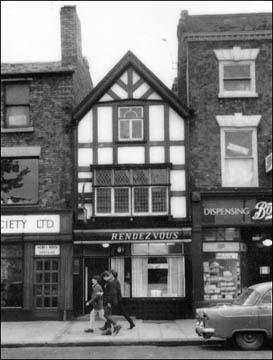 The Shakespeare Inn (no. 92/104). The proprietor of the Queen's Park Brewery, William Richards owned the Shakespeare, presumably an outlet for his beer, until 1882 when he sold it to the Lion Brewery Company. The Shakespeare Inn (no. 92/104). The proprietor of the Queen's Park Brewery, William Richards owned the Shakespeare, presumably an outlet for his beer, until 1882 when he sold it to the Lion Brewery Company.
The landlord in 1840 (when it was called The Shakespeare Tavern) was Charles Crosbie, in 1850 Joseph Johnson, in 1855 William Sparks, in 1857 Mrs J Sparks, in 1871 John McCreary, Royal Oakin 1880 Alexander Keith, in 1898 Patrick Perkins, who was still there in 1902. In 1910-1920 it was Hugh Flood and in 1934 J Vickers, in 1936 Harry Wilkes.
Our photograph was taken when the pub had closed and been replaced by the Rendezvous Cafe. Today, Asia Tandoori occupy the building. A larger version of the picture is in our gallery.
The Queen's Head Hotel- 137 Foregate Street and 1 Seller Street. Along with the Ring O' Bells and Grosvenor Park Hotel was demolished to make way for the Inner
Ring Road. Their site is now occupied by the Grosvenor Court offices and the City Road roundabout. Pictures of the Queen's Head may be seen in our gallery.
The licencee in 1840 was Elizabeth Meakin. It was listed in the Chester Trades Directory in 1850 when the licencee was John Shaw and the Post Office Directory of Cheshire in 1857, licencee T Walker, in 1934 L Henderson.
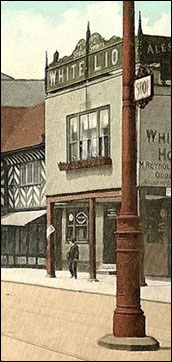
The White Lion Hotel (no. 79, illustrated below left) The inn may have been in existence before 1781, possibly under a different name, but it was first recorded as The White Lion when a brewer and churchwarden of St. John's, John Peers, took it on in that year.
The landlord in 1818-23 was George Truss, between 1840 and 1860 Samuel Lloyd. His inn is listed in the 1840 directory as follows: "White Lion Inn ( Heart of Oak Lodge of Independent Odd Fellows)". What was this? In 1871 George Smith was the licencee, still there in 1880, and the landlady in 1898 was Mrs Mary Jane Nicolson. The licencee in 1902 was Thomas Reynolds, in 1910 Mrs Maria Reynolds, in 1914 Mrs Edward Partin, in 1919-20 Mrs E S Done. It was recorded as being used as a polling station in 1809.
Chester suffered very little damage during WW2 but the White Lion was unlucky, for it was bombed out of existence and a mundane retail premises later arose on its site- the last time we looked it was New Look, a clothes shop. There is more about the White Lion on its own page in our gallery here.
 The Three Black Birds- existing in 1777. The Three Black Birds- existing in 1777.
The Bird in Hand. This inn was listed in Cowdroy's Directory in 1789 when the licencee was given as simply "Edwards".
The Roebuck Inn- recorded in a list of polling stations in 1809 and listed in Pigot's Directory 1818-20, licencee Thomas Bleades and in the same directory for 1828 when the landlady was Sarah Venables. Between them, in 1822-3, when the name was spelled The Roe Buck, the licencee was T Endain.
The Bars Hotel (no. 148 Foregate Street). Landlord in 1898 Ben Pearson, in 1902 Mrs Hannah Maria Pearson, in 1914 Mrs G C Berry, in 1934-5 R W Pritchard, in 1942 E W Pritchard. It later became Cindarella Rockafella's, with it's 'monk's retreat' and impressive facade- which could easily have been preserved but was demolished to make way for even more yuppy apartments. Reader JD wrote to tell us, "One of the pubs I can vaguely remember a few years ago was The Schooner Inn which was next door to Cinderella Rockerfellas. If I remember correctly it changed to The Sports Bar which was at its busiest on a Sunday night".
Reader Hoolite also recalled, "Oh, yes, I remember The Sports Bar alright. Lots of neon and chrome in the 'Amercian' tradition, a couple of pool tables, long bar on the right hand side as you walked in. Guaranteed major ruckus on most nights, being positioned right next door to Cinders, which was the first club I ever went into being about 16- they weren't too choosy".
Keith Ellis told us "Before it was Cinderella Rockerfella's it was Tiffany’s- three floors of music, flashing lights and in the centre of the ground floor dance area, a large false tree with florescent leaves (20-25ft tall, the tree, not the leaves). The first floor was a balcony that overlooked the lower dance floor in what I think you would call today an atrium style and on the top floor was yet another disco and also a dining area". More information can be found under The Bars...
The Bear's Paw (no. 21, corner of Frodsham Street. The 1859 Post Office Directory of Cheshire says no. 17 however). Landlord in 1818-22 John Lawson, in 1828 George Halley, 1840-50 Robert Bentley, in 1855-8 Alex Street, in 1871 Grace Street, in 1880 John Taylor, in 1898 Fred Jones, in 1902-10 Edward Stanley Dawson, in 1914 John Frederick Davies, in 1934-5 T Ratcliffe, in 1936 Joseph Bond, in whose time the place was listed as Ye Olde Bear's Paw Inn. An ancient pub demolished to make way for an exceedingly utilitarian building currently housing a jeweller's
shop. According to the staff who work there today, it has managed to retain its ghost, 'George', however, who is regularly to be seen wandering through walls in the first floor stockroom (and wondering what becameof his local?) The staff, in fact, refer to this as George's Room..
After demolition, the licence- and name- was transferred to a new pub in Dickson's Drive, Newton.
You can see a photograph of the old pub under Frodsham Street....
“Of course one should not drink much, but often.” Henri de Toulouse-Lautrec
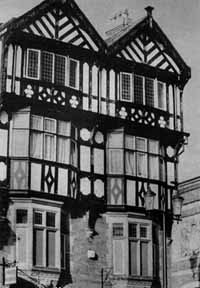 The Brewer's Arms (no. 61). Listed in Pigot's Directory for 1818-20 when the licencee was William Posnett and in 1828/9 when it was John Huxley (who was there in 1822), in the Chester Trades Directory 1850, licencee Robert Potts (he had been there in 1840). Henry Wright is listed as licencee in Slater's Directory 1855 and the same for 1871 and 1880 shows John Stuart in charge. In 1893 the final landlord was John Culshaw. Soon after, the inn was renamed as The Green Dragon Inn ("commercial & family inn", nos. 59 & 61, Illustrated left). The original Green Dragon Inn was, for at least four centuries, located at 39 Eastgate Street where Thornton's confectioners is now (see above). It was sold in 1893 to Dicksons the Seed Merchants who occupied propery either side of it at the time and the licence and name transferred to premises in Foregate Street.
This inn had earlier been known as The Brewer's Arms and even earlier as The Wagon & Horses. It was recorded as such in 1857 when its licencee was Harry Wright. He was still in charge when the inn became The Brewer's Arms in 1864. The Brewer's Arms (no. 61). Listed in Pigot's Directory for 1818-20 when the licencee was William Posnett and in 1828/9 when it was John Huxley (who was there in 1822), in the Chester Trades Directory 1850, licencee Robert Potts (he had been there in 1840). Henry Wright is listed as licencee in Slater's Directory 1855 and the same for 1871 and 1880 shows John Stuart in charge. In 1893 the final landlord was John Culshaw. Soon after, the inn was renamed as The Green Dragon Inn ("commercial & family inn", nos. 59 & 61, Illustrated left). The original Green Dragon Inn was, for at least four centuries, located at 39 Eastgate Street where Thornton's confectioners is now (see above). It was sold in 1893 to Dicksons the Seed Merchants who occupied propery either side of it at the time and the licence and name transferred to premises in Foregate Street.
This inn had earlier been known as The Brewer's Arms and even earlier as The Wagon & Horses. It was recorded as such in 1857 when its licencee was Harry Wright. He was still in charge when the inn became The Brewer's Arms in 1864.
The licences of the house under its various names were, in 1822-3 J Johnson, in 1840 Robert Nickson, in 1857 Harry Wright, in 1902 Thomas Montgomery, in 1910 Samuel Alfred Haswell, in 1914 John William Dawson, in 1919-35 J Dawson, in 1936 W A Pyecock.
The Green Dragon was known, due to its popularity with US servicemen during WW2, as The American Embassy. The Greenald's Brewery logo, the date- 1920- and two dragons carved in stone still exist on the frontage. If you stand on the corner of Love Street and look up, the pub's name can still be seen painted on the gable end of the roof. Electrical retailers Curry's took over the building for a few years but a branch of Abbey National Building Society occupies it today. You can see some more photographs of it- and the original Brewer's Arms- in our old pubs gallery.
The Jolly Brewers "by Ball Court-yard" was mentioned in the Chester Chronicle, 5th October 1849, when it was let, with out-buildings, to Mr Robert Turner, brewer.
'Ball's Court was next door to the Little Nag's Head Inn (see below).
The Swan Hotel (no 60, illustrated below and in our gallery), known as Eddie Davies'- "The hotel with the famous fim performing parrots". Also a regular favourite with American servicemen. One John Deane, prebendary of Lincoln and rector of St. Bartholemew the Great in Smithfield, London, in need of investment properties to help fund a school he was founding in his birthplace, Northwich, purchased an inn in Foregate Street by the name of The Swan in 1557. The inn and surrounding land had formed part of the dissolved estates of The Fraternity of St. Anne's, a little-known religious foundation that formerly existed in the vicinity of St. John's Church. The inn was later recorded as existing in 1615. Most of the buildings in the street were burned to the ground during the Seige of Chester in 1645-6 and the later Swan rose upon the site of its destroyed earlier namesake. Its licencee was Thomas Bulkeley who died in 1783 "after many years being master of the house". He appears in the 1781 trades directory.
The landlord in 1840 was James Jones, in 1850-55 Evan Roberts, in 1857-60 Robert Rider, in 1871-3 John W. Massey, when the place was described in the trade directory as a 'Spirit Vaults'. In 1880 it was William Clark (its address was given as no 52 Foregate Street at this time). In 1902 the licencee was A Q Roberts, in 1910 Samuel H Janion, in 1914 Edward Eccles, in the1919-20 directory, the licencee is given as simply 'Davies' but by 1934 W E Davies (the same man?) was in charge.
Its site- and that of the neighbouring Classic cinema- were, until its sad demise in 2009, occupied by a branch of Woolworth's- and now Primark. See a photograph of them just before demolition in our 'History of Chester Cinema' here).
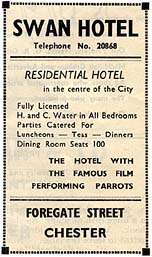 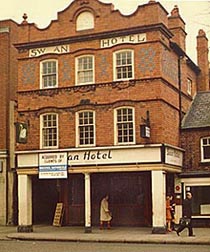 Referring again to those parrots, reader Paul Adamson told us, "The Steward’s wife at Chester Golf Club in the Sixties was Mrs Amy Cartledge. She was an animal lover and amongst her menagerie was an old parrot. Often standing delicately on one leg with an inscrutable look he would come out with the most appalling language. Embarrassment would abound as its owner tried to explain that you hadn’t heard what you thought you had heard. Only to have her efforts dashed as he forcefully repeated his epigram. I was astonished to learn at the time that captive birds such as this can enjoy a similar, if not longer, life expectancy than human beings. Apparently, as a younger, more impressionable bird, he had spent the war years in a cage on the bar of the Swan Hotel in Foregate Street. I understand that Churchill once mischievously taught a parrot to swear and it seems that the young GIs who used to frequent the Swan during that dark period must have had the same idea!" Referring again to those parrots, reader Paul Adamson told us, "The Steward’s wife at Chester Golf Club in the Sixties was Mrs Amy Cartledge. She was an animal lover and amongst her menagerie was an old parrot. Often standing delicately on one leg with an inscrutable look he would come out with the most appalling language. Embarrassment would abound as its owner tried to explain that you hadn’t heard what you thought you had heard. Only to have her efforts dashed as he forcefully repeated his epigram. I was astonished to learn at the time that captive birds such as this can enjoy a similar, if not longer, life expectancy than human beings. Apparently, as a younger, more impressionable bird, he had spent the war years in a cage on the bar of the Swan Hotel in Foregate Street. I understand that Churchill once mischievously taught a parrot to swear and it seems that the young GIs who used to frequent the Swan during that dark period must have had the same idea!"
The Chester artist Jill Pears told us "Both of my elder sisters were married in 1966 and they had their wedding breakfasts at The Swan Hotel. In remeber there was a low-beamed ceiling with fancy wall lights and my sister and I in our bridesmaid's dresses and all the food and wedding cake laid out on lovely white-clothed tables. It was replaced by C&A's, then Woolie's and now Primark".
Across the road, a large inn, The Saracen's Head was purchased by John Deane at the same time as the old Swan. Severely damaged during the Civil War, its remains served as a common ale-house until, by 1725, being used as a private house. It was demolished and the site redeveloped three years later. The inn was located in, and gave its name to, a vanished Row, the Saracen's Head Row, which now forms numbers 41-45 Foregate Street. It was first mentioned in a legal document in 1591 when "a jury present le foule way in le Rowe ad Sarasen's Head".
An inquisition held before the Bishop of Chester and others at Chester Castle in August 1630 heard that "the house in Foregate Street now in the tenure of Peter Marshall is parcell of the lands purchased by Sir John Deane, clerk, & by him assigned unto feoffees in trust amongst other lands to & for the use of the free grammer schoole in Witton neere Northwich in the said county of Chester and hath bene commonly reputed & taken to be parte & parcell of the Sarazens Head & therewith by the said feoffees set, let, occupied & enioyed, & was parte of the dissolved monastery of St. Annes in Chester." It was ordered that the rents, profits & issues of the house should be paid to Witton School in future.
The Horse & Groom- mentioned in the Cheshire Sheaf as existing in 1736.
The Drum Major- recorded as being used as a polling station in 1809 .
The Wellington Tavern appears in Pigot's Directory 1818-20, licencee J Jackson, in 1822 John Shone.
The Royal Oak Inn (no. 44 Foregate Street) This inn was listed in Cowdroy's Directory in 1789 when the licencee was Mrs Faulkener. The licencee in 1818-23 was John Morris, in 1828 Elizabeth Morris, in 1840 John Ward, in 1850-57 Thomas Sudlow, in 1871-80 (when it appears in a Cheshire directory as no 34) Margaret Holland, in 1902 Henry Cross, in 1910 William Tidswell, in 1914-20 Peter Lawson, in 1942 James Eugene Kimpton.
On the same site formerly stood an inn by the name of The Sign of the Crow which was first mentioned in documents in 1580 when the landlord was William Cotgrave- who was also a fishmonger.
A carved date, 1607, appeared on the front of the second building and its name had changed to The Royal Oak by 1703. The entire inn was once again rebuilt in 1920 and this date, together with the construction date of the first inn- mysteriously altered to 1601- was inscriped on the facade.
The pub sadly closed down in the 1980s and later became a branch of the electrical retailers Dixon's, and then Curry's, which in turn closed in 2009. In May 2011, it was announced that the premium grocery chain Waitrose was to establish a convenience store within the old pub, this in addition to its planned full sized store on the site of the Boughton Retail Park not too far away on the banks of the Shropshire Union Canal. Through all these changes, this fine building has happily retained the old pub name and carved oak tree on its frontage. You can see some photographs of it, both as a pub and as Curry's, in our gallery.
Chester historian Frank Simpson wrote in 1926 that at one time there were no less that five public houses adjoining each other on this spot. Another Royal Oak was trading in Shipgate Street in 1828.
The Golden Lion Inn (no 24): This inn was listed in Cowdroy's Directory in 1789, when the licencee was Joseph Boyer. The licencee in 1818-20 was John Woodfine (one directory spells it Woodfive) Soon after, in 1822 we have a record of a lady operating a coach service from the Golden Lion: "Mary Booth & Co." In 1840 Thomas Bentley was the licencee, in 1840 William Tempest (this directory entry says 'Golden Lion and Turf Hotel'), in 1850 William Foulkes, in 1857 T Phillips, in 1880 Thomas Watkins, in 1898 Miss Ellen Watkins (Thomas's daughter?), in 1902 Miss Alice Beck Watkins (another daughter?) who was still there in 1914 (when she was listed as 'Mrs'). W J Milton is recorded in the trades directories as having the inn in 1919-20.
240 years earlier, in 1658, the will of Thomas Heath stated, "my messuage in Forrest street (former name of Foregate Street) called The Golden Lyon, to my wife for life".
 An inn trading in Foregate Street called The Little Golden Lion was recorded in Pigot's Directory in 1828 when the licencee was William Phillips, and in the History, Gazetteer & Directory of Cheshire in 1850 when the licencee was Thomas Phillips. Where they the same inn? An inn trading in Foregate Street called The Little Golden Lion was recorded in Pigot's Directory in 1828 when the licencee was William Phillips, and in the History, Gazetteer & Directory of Cheshire in 1850 when the licencee was Thomas Phillips. Where they the same inn?
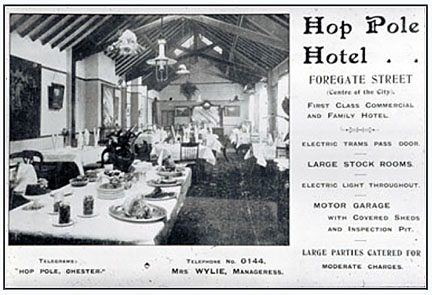
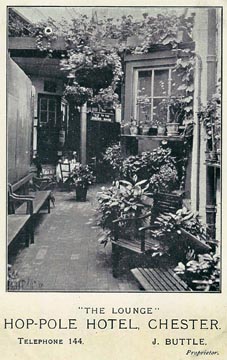
The Hop Pole Hotel (no 13) is first mentioned in 1642 when it was built by Alderman Edwards and also called The Globe Tavern. This, however was soon afterwards destroyed during the Civil War seige and rebuilt a decade or so later bearing the same name (it was recorded as such 1n 1725), which it would retain until 1782 when its name was changed to The Hop Pole Inn, the licencees at the time being John Axon and William Hassall. The inn was recorded as such in Cowdroy's Directory in 1789 when the licencee was still John Axon, apparently now alone. Curiously, a second entry for the inn appears in this directory, giving the licencee as John George. The licencee in 1822-3 was Daniel Williams, in 1828 David Williams, between 1850 and 1860 (when it was called The Hop Pole Commercial Inn) Mrs Elizabeth Bell, in 1873 A. C. Lockwood, in 1898, Thomas Wooliscroft, in 1902 James E Riley, in 1919-20 James Buttle.
The first edition of Thomas Hughes' Stranger's Handbook to Chester (1870) refers to the Hop Pole as "a superior traveller's inn". In 1921, shares were offered for a proposed Scala cinema on the site of the inn- which was never built. The licence was withdrawn nontheless and the building became part of the premises of Stead & Simpson. Visit the Hop Pole's own page in our vanished pubs gallery..
 The City Vaults. We presently know nothing about this place except that it existed... The City Vaults. We presently know nothing about this place except that it existed...
Unlike today, Boughton and Foregate Street formed part of the same stretch of road and the boundary between them was far from clear, as consequently was the address of some of the area's inns. The Exchange Vaults, for example, which was at 165 Foregate Street, the very last house on its north side, somewhere around where Bar 69 is, mid way in between City Road and Russell Street- considered part of Boughton today.
The landlord in 1871 (and probably earlier) to his death in 1874 was John Dodd. It appears in the 1878 Post Office Directory, when the licencee was Henry Lunt, who was still there in 1880 (Slater's Directory of N and S Wales etc). The place had the address 147 Foregate Street at this time. By 1883 its street number had changed to 165 and Emma Lunt was in charge (Slater's Directory of Cheshire and Liverpool). John West was landlord in 1893-1894 (Chester Directory) and still in charge in 1896 (Kelly's Directory of Cheshire). In 1902, Elizabeth West had taken over and the street number had changed yet again, to 169 (Kelly's Directory of Cheshire) and in 1910-20 Matthew Frow was there.
The Wheatsheaf- mentioned in a 1750 Chester Courant.
Thorman's Vaults.
The Angel was listed in Cowdroy's Directory in 1789 when the licencee was Robert Huxley. Pugin's Directory for 1818-20 lists John Phoenix as landlord. William Posnett was in charge in 1822-3. Another Angel was in Brooke Street.
The Grosvenor Park Hotel ('Dick Scott's'- no. 153, corner of City Road)- much more about this pub under City Road and in our gallery..
 The Ring O' Bells was situated at the end of Foregate Street- no 151- next door to the Grosvenor Park Hotel. It appeared in Cowdroy's Directory in 1789 when the licencee was Simon Hawkins. Its licencee in 1818-23 was Elizabeth Catherall, in 1828 Thomas Bithell, in 1840 William Walker (who was also a mason), in 1850 Elizabeth Chadwick, in 1855-7 Mrs Elizabeth Greenall, in 1880 Joseph M Wright, in 1902 John Walter, in 1914-20 John Walker, in 1934- apty- Mrs Mary Bell, in 1936 Miss Doris S Hill. It was demolished to make way for the Inner Ring Road. The site is now occupied by the Grosvenor Court offices and the City Road roundabout. The Ring O' Bells was situated at the end of Foregate Street- no 151- next door to the Grosvenor Park Hotel. It appeared in Cowdroy's Directory in 1789 when the licencee was Simon Hawkins. Its licencee in 1818-23 was Elizabeth Catherall, in 1828 Thomas Bithell, in 1840 William Walker (who was also a mason), in 1850 Elizabeth Chadwick, in 1855-7 Mrs Elizabeth Greenall, in 1880 Joseph M Wright, in 1902 John Walter, in 1914-20 John Walker, in 1934- apty- Mrs Mary Bell, in 1936 Miss Doris S Hill. It was demolished to make way for the Inner Ring Road. The site is now occupied by the Grosvenor Court offices and the City Road roundabout.
In common with numerous other Chester pubs, the original bulding had been demolished during the 19th century and replaced with a fancier new one, but retaining the old name and licence. See some photographs of the old and new Ring 'O' Bells here.
The Eagle and Child- mentioned in a 1751 Chester Courant as being "on the south side of Foregate Street".
 The Old Nag's Head (nos 47 & 49)
was owned in 1787-88 by Aaron Miller, who unfortunately went bankrupt. According to a notice in Adams’s Weekly Courant (1st January 1788): The Old Nag's Head (nos 47 & 49)
was owned in 1787-88 by Aaron Miller, who unfortunately went bankrupt. According to a notice in Adams’s Weekly Courant (1st January 1788):
"To be sold by Auction, By order of the Assignees of Aaron Miller, a Bankrupt, at the Nag’s-head Inn, in the City of Chester, on Monday the 7th Day of January, 1788, at six o’Clock in the Evening, subject to such Conditions as shall be produced. ALL that well known and accustomed INN, called The Nag’s-head, situate on the North Side of Foregate-street, in the said City, with the Brewhouse, Stables, and Appurtenances thereunto belonging; now in the Occupation of John Hammond".
This inn was listed in Cowdroy's Directory in 1789, when the licencee was J Walley. The licencee in 1822-3 was Joseph Gresty (but another directory says John Kearsley), in 1840 George Baxter, in 1850 William Birmingham, in 1857 W Sandfield, in 1880 Joseph Rydings, in 1914 George William Walker, in 1910 H E Ostle, in 1919-20 G Walker, in 1934-6 T H Smith. The Old Nag’s Head had been bought by Peter Walker in 1905 and transferred within Allied Breweries to Ind Coope (West Midlands) in 1965. It closed in the 1970s. Today, the building's fine carved wooden facade thankfully survives, but the old pub itself together with the lane behind it, Crown Court with its cottages and industrial premises, have all vanished beneath the extensive premises of Boots the Chemist. You can see some photographs of it as it appears today in our old pubs gallery.
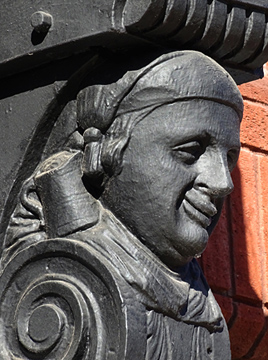
Left: a happy drunk carved onto the facade of the Nag's Head
Across the road from, and not to be confused with,
the Old Nag's Head, in 1812 the grocer's shop of Mr Joseph Bellis was sold and became an inn by the name of The Little Nag's Head. It was next door to Ball's Court. In 1850 to at least 1857 the licencee was John M Jones and in 1871 his widow Elizabeth Jones. It traded as an inn until 1878 when it was converted by the
Marquis of Westminster into Chester's first Cocoa House. The following poem, penned by one "Old Lady of the Parish", commented favourably
upon the change:
'Old Nag' thy head for many a year
Brewed mischief with its gin and beer;
Henceforward we prefer thy tail,
In hopes that temperance may prevail.
And there are heads of restless power
Still brewing mischief hour by hour;
What wonder, if a wish prevails
That all such heads were turned to tails. |
|
Originally the brainchild of the Society of Friends- the Quakers- cocoa houses came about due to pious concern that Chester's working men were preferring to spend their time and money in warm and cosy pubs and 'gin palaces' rather than staying in with their families in their cold, damp homes- or even going to church. Interestingly, prominent among those reforming Quakers were the Cadbury and Fry families- chocolate manufacturers! Their concern, evidently, was as much about profits as moral improvement..
The Chester Cocoa House Company Ltd acquired a number of premises over time in addition to the Little Nag's Head. These included the still thriving- Falcon Inn, a splendid 17th century building in Lower Bridge Street, which became as a Grosvenor-sponsored cocoa house in the same year as the Little Nag's Head, 1878. There was also a business known as The Market Stall in Northgate Street and The Railway Cocoa Rooms in Brook Street.
Despite energetic support from the Chuch and such worthies as the Grosvenor family, the movement proved eventually to be something of a failure. Quite how long the cocoa craze lasted locally is unsure, but by twenty years layer, 1898, the Nag's Head had reverted to the sale of stronger drink when Mr Charles Cordery became the licencee. He was still there in 1922.

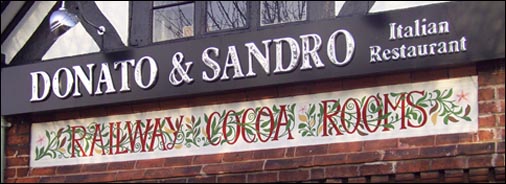
Chester's only surviving
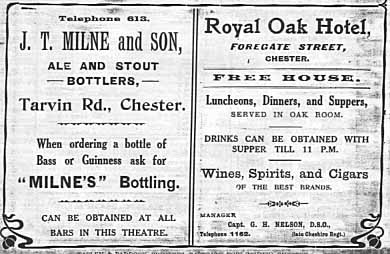
cocoa house signs- and very fine ones they are (see aboove) - are beautifully preserved on the facade of what was until recently Donato & Sandro's Italian Restaurant, and now a bar / restaurant (and a favourite of ours), Kash, in Brook Street- the former Railway Cocoa Rooms. Go here to see an advertisment for The Chester Cocoa House Company Ltd.
• See also entries under The Bars- a continuation of Foregate Street...
"He was a wise man who invented beer." Plato |
 If you're enjoying your visit to our site, please consider donating a small sum to help us keep it online and growing for the benefit of all who love Chester. Simply click the button and enter your contribution, no matter how small. It's safe and easy- you don't even need a PayPal account. We thank you!