A
Virtual
Stroll
Around
the
Walls
of
Chester
'The Honorable Incorporation of the King's Arms Kitchen'
Reminiscences by 'a frequenter' 1881-97
When
the
Chester
King's
Arms
Corporation
came
into
existence
it
is
difficult
to
ascertain,
but
the
official
minutes
at
present
preserved
go
no
further
back
than
1770.
To
become
a
member
it
was
necessary
to
be
proposed,
seconded
and
elected
by
a
certain
number
of
members,
and
even
then
a
man
could
not
regard
himself
as
a
member
of
the
Honourable
Body
unless
he
qualified
by
the
payment
for
glasses
round
for
all
members
present,
and
the
making
of
the
following
declaration:
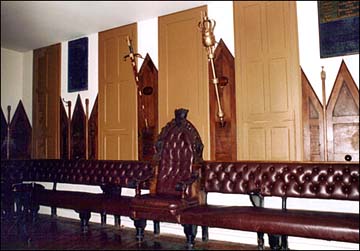
There
is
the
Mayor's
chair
with
Sword
and
Mace,
a
replica
of
the
city's
regalia
and
boards
round
the
room
contain
the
names
of
the
Mayors
and
Sheriffs
of
this
'mock
corporation'
with
special
seats
for
them
as
well
as
the
Town
Clerk,
the
Recorder
and
other
officials.
Beautiful
oak
panelling
surrounds
the
room,
diamond
headed
in
shape,
and
it
is
said,
quite
truly
I
believe,
that
it
came
from
the
old
pew
doors
of St.
John's The entrance to the King's Arms Kitchen and the narrow passageway that led to it from Eastgate Street- photographed by the author long after the pub closed. In
the
centre
of
the
roof
is
a
circular
panel
with
the
words
Persevere
under
the
Rose,
implying
that
whatever
took
place
in
that
room
was
to
be
considered
secret.
On
each
side
of
the
fireplace
is
a
cupboard
for
the
keeping
of
'churchwardens',
long
clay
pipes,
each
member
who
indulged
in
the
fragrant
weed
marking
it
with
his
monogram,
and
replacing
it
until
wanted
again.
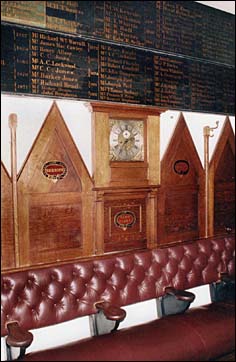
There
is
also
a
clock,
underneath
which
is
a
space
about
a
yard
square,
which
is
pointed
out
as
the
actual
spot
where
King
Charles
hid
himself
after
witnessing
from
a
tower
on
the
City
Walls
the
defeat
of
his
army
at
the
Battle
of
Rowton
Moor,
three
miles
out
of
Chester.
On
this
(Phoenix)
tower
a
tablet
states: "King
Charles
stood
On
this
tower
on
Sept.
24th,
1645,
and
saw
his
army
defeated
on
Rowton
Moor." The
'Mayor'
for
the
time
being
was
supposed
to
be
responsible
for
the
conduct
of
the
room.
He
did
not
necessarily
occupy
the
chair
every
night,
and
sometimes
if
a
stranger
found
hls
way
into
the
precints
he
was
urged
to
occupy
the
seat,
the
penalty
for
which
was "drinks
all
round",
which
was
invariably
paid.
Being
a
musical
house,
much
frequented
by
those
"in
choirs
and
places
where
they
sing",
it
was
a
very
ordinary
thing
to
find
sufficient
talent
to
sing
trios
such
as
"Life's
a
bumper",
"Fair
Flora
decks",
"With
a
jolly
full
bottle"
and
quartettes
such
as
"By
Celia's
Arbour," "When
Evening's
twilight," "As
the
moments
roll," "Strike
the
Lyre," "Here's
Life
and
Health,"
as
well
as
songs.
This,
I
say,
might
occur
on
any
'ordinary
night',
but
it
was
invarably
so
on
'birth
nights'.
I
should
explain
that
on
the
mantelpiece
was
a
tablet
on
which
was
recorded
the
name
of
any
member
whose
birthday
occurred
in
the
current
month,
and
it
was
customary
for
any
such
member
to
say
as
a
fore-word,
"I
hope
you
will
turn
up
in
good
numbers
to
support
me
on
my
birthday."
At
nine
o'clock
it
was
the
custom
to
hand
round
the
"Infirmary
Box,"
when
it
was
the
member's
privilege
to
stand
drinks
round,
and
contribute
a
shilling
to
the
box;
and
each
member
a
copper
or
two.
In
this
way
the
year's
total
to
the
Infirmary
funds
generally
realised
about
£8. Photographed here in 1948, this wooden sign on the Eastgate for many years directed visitors down a dark passage to the Kitchen's entrance. The Mayor (Mr Chas. Stanyer), after consulting the members asked to see the landlord, who sent a message back that he was busy at the bar. The Mayor then said: "Gentlemen will you all rise and follow me out of the room, never to enter again?" This was considered too drastic, so two of the members (Mr. Humphreys being one) were deputed to acquaint the landlord with the gravity of the situation. Ultimately he came in and pointed out that it was a rule of their own making that soldiers in uniform were not to be served, and that he was only carrying out their instructions. If they cared to waive their rule he would be only too pleased to serve them. This explanation was considered satisfactory, and it was decided to send a letter of apology to the three N.C.Os. A happy ending to an unpleasant incident. A stranger who happened to be present, as he left the room, remarked to the Mayor: " I have been an interested listener, and am glad you came to the decision you have, for I noticed the motto over the doorway, 'God Save the King,' and had you not done so I was going to suggest that you altered the words to 'God Save the King without soldiers.' " This broke down another barrier. Many members of the Kitchen, who attended the room nightly, were also volunteers, and after attending drill in uniform, had to be content with a drink at the bar; after this the penalty was relaxed. In
addition
to
the
singing
mentioned
on
birth-nights,
we
had
many
members
who
could
sing
songs
and
recite.
Mr.Stanyer
was
a
marvellous
entertainer.
He
could
recite
Shakespeare
from
memory
by
the
yard-
whole
scenes
from
several
plays:
could
whistle
the
melody
and
sing
the
bass
part
of
a
hymn
or
glee
at
the
same
time.
Had
the
largest
fund
of
anecdotes
(local
experiences)
of
any
man
I
ever
met.
Had
the
largest
collection
of
music
of
any
private
imdividual
in
the
city
or
county.
Had
two
pipe
organs-
a
Snetzler
and
a
Willis,
and
always
raised
his
hat
at
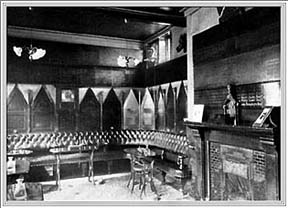
The first of three colour photographs illustrating how the fixtures and fittings of the old Kings Arms Kitchen appear in their new home in the Grosvenor Museum. THE CHAMPION'S CHALLENGE TO THOSE WHO DO NOT OBEY THE MANDATE OF THE WORSHIPFUL MAYOR "Sir,
I
am
commanded
by
the
Worshipful
the
Mayor
to
demand
your
presence
before
the
Court
assembled,
and
in
failure
of
compliance
my
Esquire
will
announce
to
you
my
challenge."
The
Esquire
then
throwing
down
the
gauntlet
shall
say: He then again throws down the gauntlet and proceeds: "I see you look pale, (The Esquire then seizes the delinquent by the collar and carries him before the Mayor, followed by the champion.) During all the years I frequented the Kitchen, a very distinctive feature was the quietness of the conversation, even lf the room was full. There was no cross-talking, no noisy discussion about football, cricket, politics or religion, and the same peculiarity exists to-day, the old traditions of the room being faithfully observed. Licencees: To date, we have traced the following licencees of the King's Arms Kitchen: In 1850 Susan Williams, in 1880-1 Barker Jones. He had been at the Alma Hotel in St. Anne Street in the 1871. In 1898 his widow, Mrs Ellen Jones ran the place, in 1902 Edwin Barker, (Barker has gone from Christian to surname!) In 1914 Mrs Annie Georgina Kate Roberts was in charge, during WW2, Jack Morris. Can you help us with any more? In October 2002, this interesting- but sadly anonymous- reminiscience of the Kitchen appeared in the letters pages of the Chester Standard: We received this letter from Eddie McNulty in February 2008.. |
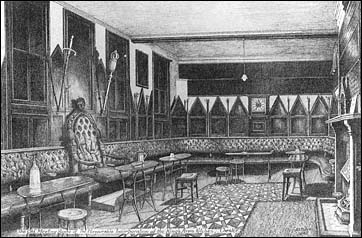
 s you look at the Eastgate from within the Walls, on the left-hand side, immediately next to the gate is a narrow passageway. At the end of this, in what is now the premises of a bank, formerly existed a public house called the King's Arms Kitchen, also known as Mother Hall's.
 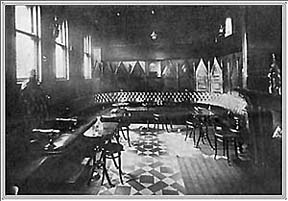 The fittings of the room where this worthy institution met, complete with wood panelling upon which was inscribed the succession of member's names, was preserved when the pub closed in 1978, and was transferred to the
  My
recollection
of
the
room
dates
back
to
1881
when
I
went
with
Mr.
John
Humphreys,
organist
of
Matthew
Henry's
Unitarian
Church
in
Trinity
Street.
Matthew
Henry
was
a
celebrated
preacher
and "Bible
Commentator"
and
there
still
exists
in
the
church
a
"chained
Bible"
and
the
pulpit
from
which
he
preached.
Incidentally
I
may
say
there
is
a
monument
to
his
memory
in Grosvenor
Road
which
was
erected
150
vears
after
his
death.
(Today
it
rests
in
the
middle
of
the
traffic
island
near
the
Castle!)
My
recollection
of
the
room
dates
back
to
1881
when
I
went
with
Mr.
John
Humphreys,
organist
of
Matthew
Henry's
Unitarian
Church
in
Trinity
Street.
Matthew
Henry
was
a
celebrated
preacher
and "Bible
Commentator"
and
there
still
exists
in
the
church
a
"chained
Bible"
and
the
pulpit
from
which
he
preached.
Incidentally
I
may
say
there
is
a
monument
to
his
memory
in Grosvenor
Road
which
was
erected
150
vears
after
his
death.
(Today
it
rests
in
the
middle
of
the
traffic
island
near
the
Castle!)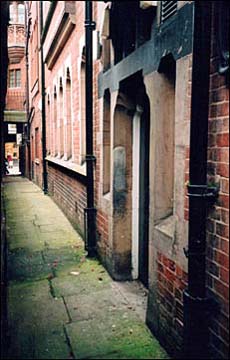 Church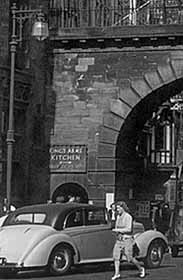
 the
mention
of
the
immortal Handel,
whom
he
made
a
god
of.
Was
organist
at
Eccleston
Church-
two
and
a
half
miles
out
of
Chester-
for
40
years,
where
he
went
twice
on
a
Sunday
and
once
in
the
week
to
choir
practice,
counted
the
steps
from
his
house
to
the
church
door,
and
could
gauge
it
to
the
half-dozen.
Did
space
permit,
I
should
like
to
tell
you
some
of
his
anecdotes-
nearly
always
against
himself.
the
mention
of
the
immortal Handel,
whom
he
made
a
god
of.
Was
organist
at
Eccleston
Church-
two
and
a
half
miles
out
of
Chester-
for
40
years,
where
he
went
twice
on
a
Sunday
and
once
in
the
week
to
choir
practice,
counted
the
steps
from
his
house
to
the
church
door,
and
could
gauge
it
to
the
half-dozen.
Did
space
permit,
I
should
like
to
tell
you
some
of
his
anecdotes-
nearly
always
against
himself.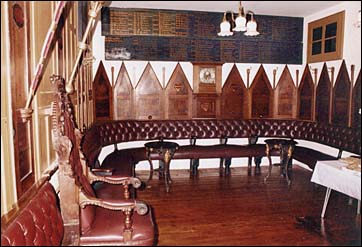 "If you show any airs,
  The bar was not large, hence the bill was always reasonable and anyone asking for spirits was frowned upon (beer was then about a shilling a pint!) It was always a pleasure to take visitors in, an 'historical occasion' for them, calling themselves 'Honorary Cestrians', plus a free drink and a laugh for us.
The Eastgate | Quotes from Chester's
Visitors | Chester Walls Introduction
| Site Front Door | Site Index | Top of Page
©
Steve
Howe
/
B&W
Picture
Place