|
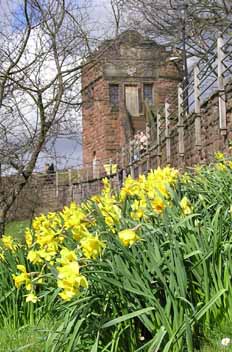  he
Phoenix
Tower
is
a much-restored
medieval
structure standing
on,
or
close
to,
the
site
of
the
original
Roman
North
East
Tower. Between
here
and
the Northgate formerly
stood
two
further
interval
towers,
projecting
inward
from
the
wall.
They
were
constructed
and
placed
according
to
the
specifications
of
Roman
military
architects
such
as Marcus Vitruvius Pollio who
directed
that
towers
should
be
round,
to
deflect
missiles and the
force
of
battering
rams,
and
placed
so
as
to
be
within
bow-shot
of
each
other.
He
also
directed
that
a wall
should
be
of
such
a thickness
that
two
armed
men
could
pass
on
top
of
it
without
impediment. he
Phoenix
Tower
is
a much-restored
medieval
structure standing
on,
or
close
to,
the
site
of
the
original
Roman
North
East
Tower. Between
here
and
the Northgate formerly
stood
two
further
interval
towers,
projecting
inward
from
the
wall.
They
were
constructed
and
placed
according
to
the
specifications
of
Roman
military
architects
such
as Marcus Vitruvius Pollio who
directed
that
towers
should
be
round,
to
deflect
missiles and the
force
of
battering
rams,
and
placed
so
as
to
be
within
bow-shot
of
each
other.
He
also
directed
that
a wall
should
be
of
such
a thickness
that
two
armed
men
could
pass
on
top
of
it
without
impediment.
Vitruvius' works were the standard reference on building principles from Roman times right up to the 18th century and his was the second book- after the Bible- to roll off the printing presses of Gutenberg. Read the whole of his On Architecture on Bill Thayer's magnificent website at the University of Chicago here.
"The
towers",
wrote William
Webb in
the
middle
of
the
17th
century, "whereof
there
are
divers
upon
the
said
walls,
were,
as
I suppose,
made
to
be
watch
towers
in
the
day
and
lodging
places
in
the
night,
and
in
the
time
of
storms,
for
the
watchmen
that
kept
watch
upon
the
walls
in
those
times
of
danger,
when
they
were
so
often
besieged
by
armies
of
enemies,
and
in
such
perilous
surprizes,
though
now
some
of
them
be
converted
to
other
uses".
In December 2009, the foundations of a previously-unknown Roman interval tower were discovered during archaeological investigations upon a section of the City Wall near the Grosvenor Precinct which had collapsed in the Spring of the previous year. Go here to learn more...
As
late
as
1571, Braun's
map of
Chester
shows
that
the
walls
boasted
no
fewer
than
seventeen
towers.
Sadly, a mere
handful
survive
today
and
of
these,
the
Phoenix
Tower
is
probably
the
best
known.
 By
the
mid-17th
century,
the
tower
was
in
a ruinous
condition,
but
was
nontheless taken
on
as
the
meeting
place
of
two
of
the
city
guilds-
the
Company
of
Barber Surgeons, Tallow Chandlers and Wanchandlers, the other was that of the Painters, Glaziers, Embroiderers & Stationers-
on
the
understanding
that
they
would
put
it
in
good
order
and
subsequently
maintain
it.
Because
of
the
battering
it
had
received
during
the
Civil
War
siege,
the
upper parts of the tower
had
to
be
largely
rebuilt. By
the
mid-17th
century,
the
tower
was
in
a ruinous
condition,
but
was
nontheless taken
on
as
the
meeting
place
of
two
of
the
city
guilds-
the
Company
of
Barber Surgeons, Tallow Chandlers and Wanchandlers, the other was that of the Painters, Glaziers, Embroiderers & Stationers-
on
the
understanding
that
they
would
put
it
in
good
order
and
subsequently
maintain
it.
Because
of
the
battering
it
had
received
during
the
Civil
War
siege,
the
upper parts of the tower
had
to
be
largely
rebuilt.
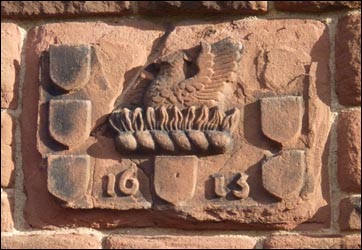
The
badge
of
the
Painter's
Guild
was
a phoenix
and
a fine
carving
of
it
by
the
heraldic
artist
and
historian Randle
Holme
III was
placed
above
the
door
to
the
lower
chamber (illustrated left).
He
was
paid
18
shillings
for
it,
and
6 shillings
was
paid
to
the
mason
who
fixed
it
in
place.
The
rebuilding
took
place
in
1658
and
the
stone
was
fixed in place
at
that
time.
You
may
notice
that
under
the now rather battered
phoenix- one of its wings and a surrounding shield being now missing-
the
date
1613
is
clearly
visible.
This
records
the
date
when
the
two
companies
first
began
their
joint occupation
of
the
tower,
and not the
date
of
its
restoration. Randle
Holme
recorded
that
he
was
not
actually
paid
for
his
labour
until
1693-
35
years
later!
 He
had
been
born
in
Chester in 1627
and
was
the
most
distinguished
of
the
four
persons
who
bore
that
name.
He
was
a member
of
the
Stationer's
Company,
and
served
it
as
an
alderman
for
forty
years,
until
his
death
in
1699.
He
is
said
to
have
been
the
first
freemason in
Chester,
and
in
1688
was
appointed
to
the
illustrious
position
of Sewer
of
the
Chamber-in-Extraordinary to
his
Majesty,
King
Charles
II. He
had
been
born
in
Chester in 1627
and
was
the
most
distinguished
of
the
four
persons
who
bore
that
name.
He
was
a member
of
the
Stationer's
Company,
and
served
it
as
an
alderman
for
forty
years,
until
his
death
in
1699.
He
is
said
to
have
been
the
first
freemason in
Chester,
and
in
1688
was
appointed
to
the
illustrious
position
of Sewer
of
the
Chamber-in-Extraordinary to
his
Majesty,
King
Charles
II.
The task of a sewer, we should explain, was
that of food taster, the official who tested each of the dishes placed before the King to ensure they were of sufficient quality- and, one assumes, not poisoned! He was also responsible for serving the meal- inferior servants brought the food from the kitchen but the sewer placed the dishes before the King and removed them afterwards. A rather menial task for a favoured, high-ranking official, one may think, but nothing compared to such as the Groome of the Stoole, who was responsible for wiping the Royal bottom, inspecting the contents of the pan and consulting with the physician should anything seem amiss... Positions such as these meant that those so 'honoured' were closer to the King and had his ear (at the very least) on a daily basis and were thus considered most privileged.
 The four generations of men bearing the name Randle Holme were, The four generations of men bearing the name Randle Holme were,
• Randle (Randulph) Holme I (1571-1655). His father had been a blacksmith from Tranmere near Birkenhead. He became Sheriff of Cheshire and reputed deputy to the College of Arms for Cheshire, Shropshire and North Wales in 1615-1616, and was Mayor of Chester between 1633-1634. He is recorded as a painter (probably an heraldic painter) in the Stationers Company in Chester.
• Randle Holme II was Sheriff during his father's term as Mayor 1633-1634, and a royalist Alderman of Chester during the Civil War siege from 1643-1645.
• Randle Holme III (1627-1699. The one connected with the Phoenix Tower). In 1688 he wrote and illustrated the most comprehensive encyclopedia of everyday life of the English 17th century we posess today, "The Academy of Armory, or 'A storehouse of armory and blazon microform. Containing the several variety of created beings, and how born in coats of arms, both foreign and domestick. With the instruments used in all trades and sciences, together with their terms of art. Also the etymologies, definitions, and historical observations on the same, explicated and explained according to our modern language. Very usefel for all gentlemen, scholars, divines, and all such as desire any knowledge in arts and sciences'.
 It was
said
to
have
been
one
of
the
most
voluminous
and
extraordinary
books
ever
written,
and
the
first
book
of quality to
be
printed
in
Chester. Actually, only Books one, two and some of Book three were actually printed by Holme at his house in Chester as the project eventually proved to be too expensive to complete. The rest of Book three and Book four had to wait until 1905 when they were finally published by an organisation of bibliophiles known as The Roxburghe Club. It was
said
to
have
been
one
of
the
most
voluminous
and
extraordinary
books
ever
written,
and
the
first
book
of quality to
be
printed
in
Chester. Actually, only Books one, two and some of Book three were actually printed by Holme at his house in Chester as the project eventually proved to be too expensive to complete. The rest of Book three and Book four had to wait until 1905 when they were finally published by an organisation of bibliophiles known as The Roxburghe Club.
• Randle Holme IV (1659-1707). He worked in partnership with his father, was Sheriff of Chester in 1705–06 and Deputy Herald. He married Margaret Lloyd from Llanarmon, Denbighshire, and had five children who all died young. He himself died, the last of his line, on 30 August 1707 and was buried at the church of St Mary's-on-the-Hill, Chester- as were his three predecessors. Their memorials can still be seen there today. Now deconsecrated, St. Mary's today serves as a fine education centre. Find out more about this remarkable family here.
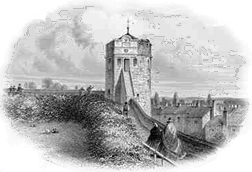
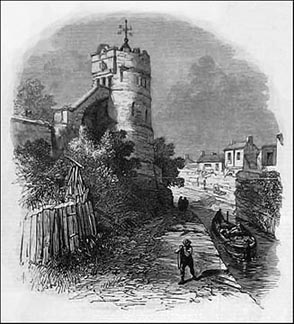
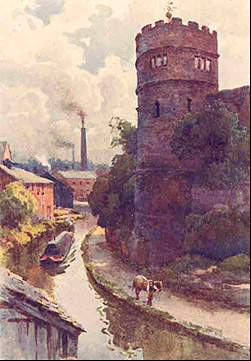
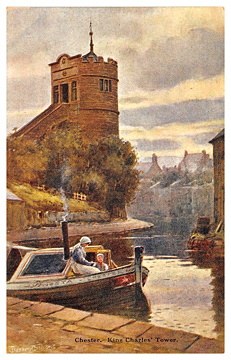
Left (and below): a couple of fine watercolours of the Phoenix Tower, published as postcards. Note the horse-drawn barge on the towpath. Over the years, the towing ropes have left deep grooves in the sandstone at the base of the tower that can be seen to this day.
The
Phoenix
Tower
was
later
also
let
to
various
of
the
other
companies,
including
the
barbers,
coopers,
butchers,
weavers,
joiners
and
clothworkers,
and
in
this
way
became
the
headquarters
of
the
city
guilds.
They
held
their
meetings
in
the
upper
chamber,
which
was
strewn
with
rushes
and
decorated
with
garlands
of
flowers
at
their
annual
meeting
on
the
festival
of
St.
Luke
in
October.
During
the
Civil
War,
the
guilds
met
instead
in
Watergate
Street,
the
Phoenix
Tower
being
used
for ordnance-
a gun
emplacement.
Their
carved
crests,
along
with
the
old phoenix,
were
formerly
displayed
on
the
tower,
but
around
1810,
they
were
replaced
with
the
much-photographed
plaque
we
see
above
the
door
today, together with a newly-carved phoenix. The sharp-eyed may notice that the two phoenixes on the tower are of different varieties: the Holme bird is based on the Painter-Stainers' 'Chinese Phoenix', first used in a 1486 crest, and the later bird in the peak above the upper chamber door is the standard heraldic device of a 'demi-eagle, wings displayed, issuant from flames'.
I will
now
tell
you
a little
of
the
great
events
the commemorative plaque
commemorates.
King
Charles
The
Phoenix
Tower
was, in earlier times, generally
known
as
the Newton
Tower,
that
being
the
name
of
the
suburb
overlooked
from
the
wall
at
this
point,
and,
more
notably,
later as
the King
Charles
Tower to
commemorate
the
events
of
September
1645,
during
the
English
Civil
War,
when
King
Charles
I,
together
with
the
mayor,
Sir
Francis
Gamul,
stood
on
the
roof
and
witnessed
the
rout
of
his
army
by
Parliamentary
forces
after
the Battle
of
Rowton
Moor (or Rowton Heath). The
inscription
upon
the
tower
states:
'KING
CHARLES
STOOD
ON
THIS
TOWER
SEPT
24th
1645
AND
SAW
HIS
ARMY
DEFEATED
ON
ROWTON
MOOR'
Actually,
it
would
have
been
impossible
to
see
the
field
of
battle
from
here-
what
they
probably
witnessed
was
later
action
on
Hoole
Heath
and
fugitives
from
the
fray
being
pursued
and
harried
through
the
eastern
suburbs.
From
the
first,
Chester
had
supported
the
King's
cause
and
now,
with
his
last
remaining
army,
he
had
hurried
to
the
relief
of
its
garrison.
Charles,
with
a strong
bodyguard,
had
entered
the
city
across
the Old
Dee
Bridge from
Wales
on
the
23rd
September
while
his
main
force
closed
from
the
Cheshire
side.
On
the
following
morning,
it
was
surprised
by
a Parliamentary
army
at
Rowton
Moor,
two
and
a half
miles
south
east
of
Chester.
In
the
fierce
engagement
which
followed,
the
Royalists
were
overcome
but
rallied
on
Hoole
Heath,
(now
the
site
of
the
pleasant
residential
suburb
where
these
words
are
being
written)-
one
and
a half
miles
east
of
the
Phoenix
Tower.
Here
again,
they
were
defeated.
In
the
words
of
a witness,
they
were "as
much
dispersed
as
the
greatest
rout
could
produce..."
 Much
of
this
was
seen
by
the
King
from
where
he
stood,
but,
wishing
for
a better
view, "he
removed
to
St. Werburgh's
steeple
(the Cathedral tower)
where,
as
he
was
talking
with
a captaine,
a bullet
from
St.
John's
gave
him
a salute,
narrowly
missing
the
King,
hit
the
said
captaine
in
the
head,
who
died
in
the
place". Much
of
this
was
seen
by
the
King
from
where
he
stood,
but,
wishing
for
a better
view, "he
removed
to
St. Werburgh's
steeple
(the Cathedral tower)
where,
as
he
was
talking
with
a captaine,
a bullet
from
St.
John's
gave
him
a salute,
narrowly
missing
the
King,
hit
the
said
captaine
in
the
head,
who
died
in
the
place".
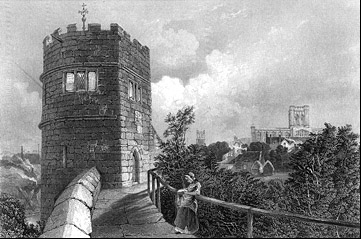
You
may
just
see
the
tower
of St. John the Baptist's
Church (lying
between
the
Phoenix
Tower
and
the
Cathedral, just to the right of the tall tree) in
the
background
of
this
handsome
1860
illustration. But
not,
sadly,
any
more
in
reality,
for
it
fell
down on
Good
Friday
1881, the
weight
of
the
Parliamentary
guns
mounted
high
up
in
the
tower
and
the
shock
of
their
explosions
no
doubt
contributing
greatly
to
its
eventual
collapse.
Only
its
still-impressive base,
rising
to
a height
of
around
twenty
feet,
remains
with
us
today.
The lovely Norman church itself- once Chester's first cathedral when our current one was an abbey full of monks- although sorely abused during the conflict, survived and should be considered an essential place to visit when you come to Chester.
(The
picture
predates
Scott's
restoration
and
'improvement'
of
the Cathedral in
1868-76,
when
the
ornamental
spires
and
towers
we
are
familiar
with
today
were
added.
And this remarkable
aerial
view-
a detail
from
John
McGahey's
famous View
of
Chester
from
a Balloon shows
the
area
around
the
Phoenix
Tower
as
it
appeared
around the
same
time). In addition, here is an interesting watercolour of the tower as it appeared in 1885.
The
Battle
of
Rowton
Moor
ended
Charles'
military
career
and
from
thenceforth
he
was
a fugitive.
After
spending
the
night
at
the
house
of
the
Mayor
in
Lower
Bridge
Street
(the
splendid Gamul
House,
which
now houses
a unique public house, The Brewery Tap),
he
fled
from
Chester
the
following
day
with
500
horsemen,
en
route
for Denbigh
Castle.
The dastard Charles, careless of renown,
Stood here and saw his army overthrown.
A British Prince, to basely run away
From heroes, slaughtered in his cause that day! |
Before
leaving,
he
advising
the
citizens
to
hold
out
for
a further
ten
days
before
honorably
surrendering.
In
fact,
they
endured
the
siege
for
a further four
months,
until
January
1646,
having
been
brought
by
necessity
to
a diet
of
vermin,
horseflesh
and
pet
animals.
These
privations
doubtless
contributed
greatly
to
the
great
plague
of
1647/8
when "2000
persons
died
and
the
city
became
so
deserted
that
grass
grew
high
in
the
street
at
the
High
Cross".
 A
little
more
than
three
years
later,
on
Tuesday,
January
30th
1649,
just
over
three
hundred
and
fifty
years
ago,
a vast
gathering
of
people
stood
in
the
snow
before
the
Palace
of
Whitehall
in
London
to
see
a man
in
a mask
sever,
at
one
blow,
the
King's
head
from
his
body,
and,
holding
it
up
before
them,
exclaim, "This
is
the
head
of
a traitor". A
little
more
than
three
years
later,
on
Tuesday,
January
30th
1649,
just
over
three
hundred
and
fifty
years
ago,
a vast
gathering
of
people
stood
in
the
snow
before
the
Palace
of
Whitehall
in
London
to
see
a man
in
a mask
sever,
at
one
blow,
the
King's
head
from
his
body,
and,
holding
it
up
before
them,
exclaim, "This
is
the
head
of
a traitor".
Right: a fine 19th century view of the Phoenix Tower by the famous watercolourist Louise Rayner. This is actually one of the monochrome photographs she had commissioned from her paintings as an additional source of income.
See much more of Louise's evocative Chester work here..
A stained
glass
window,
in
the
Barnston
chapel
of St. Chad's Church, Farndon
depicts
a number
of
those
who
participated
in
the
Siege
of
Chester,
and
provides
an
interesting
illustration
of
the
costume
and
arms
of
the
period.
Farndon-
and
Holt,
across
the
river-
are
beautiful
villages
connected
by
an
ancient
stone
bridge,
itself
the
scene
of
Civil
War
skirmishes,
just
a few
miles
from
Chester
and
well
worth
visiting
if
you
can.
I
can
also
recommend,
if
you
can
find
it, Norman
Tucker's novel Master
of
the
Field (Brian
Beveridge
Ltd
Chester:
1949,
but
unfortunately
no
longer
in
print)-
a wonderful
evocation
of
our
city
and
its
people
during
these
stirring
events
of
so
long
ago.
The Chester guide and author Joseph
Hemingway,
writing
in
his Panorama
of
the
City
of
Chester of
1836,
says
of
the
vicinity
of
the
Phoenix
Tower, "We
cannot
but
observe
that
this
portion
of
the
circuit
of
the
walls
is
remarkably
pleasant.
On
the
left
hand
are
seen
the
Cathedral,
Abbey
Street
and
Square,
the
Dean's
Field
and
mansion,
and
Abbey
Green,
with
a
row
of
genteel
houses;
and
on
the
right,
towards
the
centre
of
the
county...
are
the
Broxton
and
Peckforton
hills,
the
old
castle
of Beeston,
rising
in
the
clouds,
the
shattered
battlements
and
ruined
fragments
of
which
are
perceptible
to
the
naked
eye
on
a
clear
day".
 "Inclining
more
to
the
left,
the
eye
skims
the
ancient
forest
of Delamere...
till
at
last,
in
the
same
direction,
the
interesting
landscape
terminates
by
a
distinct
view
of
the
bold
and
precipitate
hill
of Helsby.... "Inclining
more
to
the
left,
the
eye
skims
the
ancient
forest
of Delamere...
till
at
last,
in
the
same
direction,
the
interesting
landscape
terminates
by
a
distinct
view
of
the
bold
and
precipitate
hill
of Helsby....
The
intermediate
scenery
is
most
rich
and
various,
forming
a
level
vale,
with
very
slight
declivity.
Here
may
be
viewed
the
church
of Waverton and
the
church
and
village
of Christleton,
with
the
thickly-studded
mansions
of Littleton, Vicar's
Cross, Hoole and Newton.
Still
nearer
is
seen
the
beautiful
hamlet
of
Flookersbrook (close to where these words are being written) ,
abounding
in
neatly-built
modern
dwellings,
to
which,
if
the
epithet
elegant
be
not
admitted,
the
term
comfortable
is
very
appropriate".
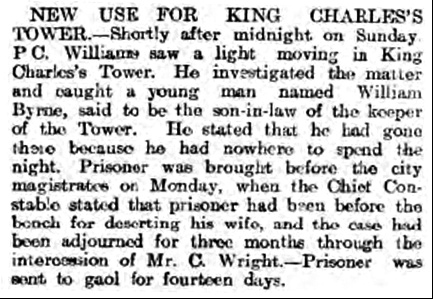
Left: this sad little story appeared in the long-defunct Chester Courant in January 1903
Today,
this
view
from
the
City Walls
is
considerably
curtailed,
thanks
to
a
combination
of
mature
trees
and
tall
buildings.
In
1854,
Mr
Benjamin
Huxley
rented
the
top
floor
of
the
Phoenix
Tower
at
a
rent
of
2s
6d
per
annum,
on
condition
that "he
only
use
it
as
an
observatory".
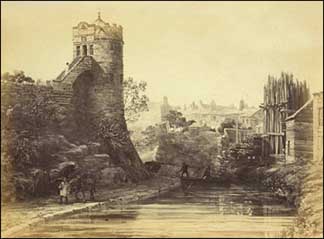
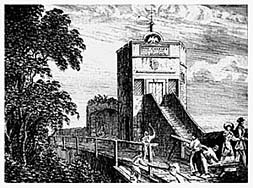 This
interesting
18th
century
drawing
of
the
tower
records
the
erection
of
the
first
handrail
on
the
inner
face
of
the
walls
(
the
city
wall
of York bear
no
such
protection
to
this
day) -
as
part
of
their
restoration
after
the
long
battering
during
the
Civil
War.
Also
to
be
seen
is
a
mysterious
extension
resembling
a
stone-built
arbour
on
the
far
side
of
the
tower,
of
which
no
apparent
trace
remains
today. This
interesting
18th
century
drawing
of
the
tower
records
the
erection
of
the
first
handrail
on
the
inner
face
of
the
walls
(
the
city
wall
of York bear
no
such
protection
to
this
day) -
as
part
of
their
restoration
after
the
long
battering
during
the
Civil
War.
Also
to
be
seen
is
a
mysterious
extension
resembling
a
stone-built
arbour
on
the
far
side
of
the
tower,
of
which
no
apparent
trace
remains
today.
However,
on
looking
over
the
parapet,
the
base
of
this
structure
is
visible. In
1697,
the
great
astronomer Edmond
Halley-
he
of
comet
fame-
sat
on this very spot
and
observed
a
rare
triple
rainbow: "On
the
Sixth
Day
of
August
last,
in
the
Evening,
between
Six
and
Seven
of
the
Clock,
I
went
to
take
the
air
upon
the
Walls
of
Chester,
when
I
was
surprized
by
a
sudden
shower,
which
forced
me
to
take
shelter
in
a Nich that
afforded
me
a
seat
in
the
Wall,
near
the
North
East
Corner
thereof.
As
I
sat
there,
I
observed
an
Iris,
exceedingly
vivid,
as
to
its
Colours,
at
first
on
the
South
Side
only,
but
in
a
little
time
with
an
entire
arch..."
 A
double
rainbow
is
quite
common,
but
the
third
rainbow
is
actually
around
the
sun
and
is
very
difficult
to
see.
Halley's
third
rainbow
was
of
a
different
type-
the
water
in
the
Dee
estuary
was
calm
enough
to
act
as
a
mirror,
producing
an
image
of
the
sun
below
the
horizon.
The
third
rainbow
was
the
primary
rainbow
from
the
image
of
the
sun,
as
Halley
concluded.
So
intrigued
was
he
that
he
later
went
on
to
investigate
the
mathematical
details
of
rainbows. A
double
rainbow
is
quite
common,
but
the
third
rainbow
is
actually
around
the
sun
and
is
very
difficult
to
see.
Halley's
third
rainbow
was
of
a
different
type-
the
water
in
the
Dee
estuary
was
calm
enough
to
act
as
a
mirror,
producing
an
image
of
the
sun
below
the
horizon.
The
third
rainbow
was
the
primary
rainbow
from
the
image
of
the
sun,
as
Halley
concluded.
So
intrigued
was
he
that
he
later
went
on
to
investigate
the
mathematical
details
of
rainbows.
Halley
spent
two
years
in
charge
the
mint
at Chester
Castle.
This
had
been
set
up
in
1696
as
part
of
an
effort
to
completely
renew
the
nation's
currency,
and
the
man
in
charge
in
London
was
one Isaac
Newton (later
knighted
for
these
efforts,
but
not
for
his
science) and he used his influence to gain Halley the appointment.
After leaving the mint at Chester, Halley was given the command of a warship, the Paramore Pink, by King William III. This was not as strange as it sounds, for Halley had been working on determining the longitude using variation of the compass and this was the main purpose of the voyage, although he was also required by the king to "attempt the discovery of what land lies to the south of the western ocean"...
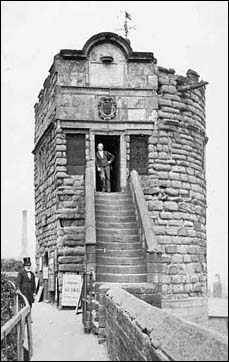
Left: a visitor poses for his photograph in the upper doorway of the Phoenix Tower in 1869. A sign on the walkway advertises a museum within. No such institution exists there today.
Halley had examined reports of a comet approaching Earth in 1531, 1607 and 1682. He concluded that these three comets were actually the same comet returning over and over again, and predicted the comet would come again in 1758 but he did not live to see it as he died in 1742. You
can
read
more
of
his remarkable
life at here and learn more of his impressions
of
Chester here.
On the subject of mints,
Britain's
currency-
and
also
the
coinage
and
banknotes
of
many
other
countries-
is
today produced
at
only
one
location, The
Royal
Mint at
Pontyclun in
South
Wales.
In
1978,
extensive
repairs
were
carried
out
on
the
Phoenix
Tower,
when
all
the
roof
slates,
leadwork
and
guttering
were
renewed
and
a
new
weathervane,
representing
a
phoenix
rising
from
the
flames,
was
provided.
The tower's whitewashed
interior
has
a
remarkable
atmosphere
that
is
well
worth
experiencing. It
had
long
been
used
as
a
museum,
and, until a few years ago,
housed
a
fascinating
exhibition
depicting
events
during
the
English
Civil
War
in
Chester,
including
17th
century
armour,
pottery
and
musket
balls,
and
on
the
upper
floor,
a
map
of
the
Rowton
Moor
battlefield
and
several
detailed
miniature
reconstructions
of
the
key
events
of
the
siege.
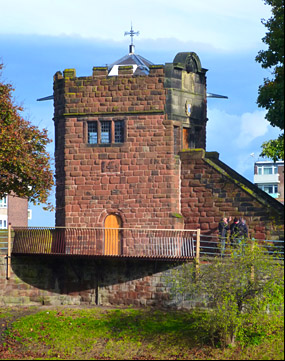
Right: the Phoenix Tower in 2014, freshly-restored with its new viewing platform.
All of this has sadly gone now and the tower lies bare of exhibits. At
the
time
of
this update
it
sadly
appears
that,
as
with
the Watertower on
the
diagonally-opposite
corner
of
the
Chester's
circuit
of
walls,
the
Phoenix
Tower
is
likely
to
remain mostly closed to
visitors
for
the
forseeable
future
due
to
a "funding shortage", and the only times they can be visited now are on special, and infrequent, 'Heritage Open Days"....
In December 2012, work commenced upon a radical restoration of the Phoenix Tower, designed to eradicate a number of serious structural problems and also, hopefully, prepare the building to once again welcome visitors. It had been discovered that the ancient structure was 'spreading', leading to the danger that the roof may fall into the tower's interior. This was cured by the addition of a specially-crafted steel reinforcing structure cleverly hidden within the building's interior.
In addition, the stonework was cleaned and repointed, the doors were replaced and a new viewing platform, visible in our recent photograph, was constructed at the angle of the City Walls in front of the tower. By the Autumn, work was completed but, several months later, there remains little of the tower re-opening to visitors..
Now we
will
now
continue
our
wanderings
by
turning
the
corner
of
the
City Walls
and
making
our
way
south
toward
the Kaleyard
Gate...
Curiosities from Chester's History no. 4
- 1115 The greater part of Chester was destroyed by fire. This
happened again in 1118, when, as the monk Bradshaw wrote, "The Monastery of
St. Michael (near today's Pepper Street) by the great fire which happened
on Midlent Sunday at eight of the clock, when all were in church, was consumed,
along with the greatest part of the city". Major fires also occured in 1140,
1180, 1278, 1471 and 1494
 1120 Richard, second Earl of Chester, his Wife Maud and the
Princes William and Richard (the sons of King Henry I) were drowned in the Candida Novis- the White Ship- along with many English courtiers
and noblemen, on a return journey from Normandy. It is said that the Master
of the ship had told the King that his father had carried Henry's father (William
the Conqueror) when he came to fight King Harold, and begged for the honour
of ferrying King Henry and his retinue back to England. The King declined,
saying he had already chosen another vessel, but said he would be pleased
to allow his two sons and many of the nobility to sail with her. The crew
were so delighted at this honour that they asked the King to give them three
hogsheads of wine- which he did- and consequently they all became hopelessly
drunk and unable to control the ship, which foundered on rocks with the loss
of about 300 lives- only one man surviving. Soon after, Hugh Lupus' nephew, Ranulf le Meschin, became the third Earl of Chester. One of his first acts
was to order all nearby Wirral farms and settlements to be destroyed, the
boundaries of the Wirral Hundred to be removed, and the greater part of the
Hundred to be planted out as a Royal forest. Chester's population around 2,500 1120 Richard, second Earl of Chester, his Wife Maud and the
Princes William and Richard (the sons of King Henry I) were drowned in the Candida Novis- the White Ship- along with many English courtiers
and noblemen, on a return journey from Normandy. It is said that the Master
of the ship had told the King that his father had carried Henry's father (William
the Conqueror) when he came to fight King Harold, and begged for the honour
of ferrying King Henry and his retinue back to England. The King declined,
saying he had already chosen another vessel, but said he would be pleased
to allow his two sons and many of the nobility to sail with her. The crew
were so delighted at this honour that they asked the King to give them three
hogsheads of wine- which he did- and consequently they all became hopelessly
drunk and unable to control the ship, which foundered on rocks with the loss
of about 300 lives- only one man surviving. Soon after, Hugh Lupus' nephew, Ranulf le Meschin, became the third Earl of Chester. One of his first acts
was to order all nearby Wirral farms and settlements to be destroyed, the
boundaries of the Wirral Hundred to be removed, and the greater part of the
Hundred to be planted out as a Royal forest. Chester's population around 2,500
- 1121 Ranulf le Meschin becomes fourth Earl of Chester (-1129) William becomes
second Abbot of St. Werburgh's (-1140). Southern section of the City Walls built around this time.
- 1129 Earl Meschin died and was succeeded by Ranulph de Gernon (-1153)
- 1135 King Henry I died, after a reign of 35 years, to be
succeeded by his nephew- and the Conqueror's grandson- Stephen of Boulogne.
- 1141 Ralph becomes third Abbot of St. Werburgh's (-1157)
- 1144 The Liber de Compositione Alchemiae or the "The Book of the Composition of Alchemy" is believed to have been the first book on alchemy that was translated from Arabic into Latin. The translator was the Englishman Robert of Chester who was one of the earliest translators to flock to Spain to learn Arabic and to translate some of the Arabic works. He completed his translation on 11 February, 1144.
- 1146 Poulton Abbey near Chester was founded, followed
the next year by the nunnery of St. Mary's.
- c 1150-1200 Western sector of the City Walls built.
- 1153 4th Earl of Chester Randle Gernon was poisoned "by witchcraft"- supposedly
by William Peverel, Earl of Nottingham. Hugh of Kevelioc becomes 5th Earl (-1181)
- 1154 King Stephen died and was succeeded by Henry II (1133-1189). From
now until 1485 the House of Plantagenet rules England
- 1154-1159 Pope Hadrian IV, Nicolas Breakspeare-
the only English pope
- 1156 Henry brought his army to Chester and camped on Saltney
Marsh en route to Wales to disarm a force led by Owain Gwynedd (1100-1170). The following
year he returned to Chester to receive the homage of Malcolm IV, King of Scotland.
- 1157 Robert Fitz-Nigel becomes fourth Abbot of St. Werburgh's (-1174)
- 1164 Henry's forces here again with the intention of invading
North Wales, but the plan was abandoned at the last minute and the army disbanded.
The earliest City Charter dates from this year- Henry II confirmed the trading
rights which the burgesses of Chester had enjoyed in Dublin under his grandfather,
Henry I. It was an indication of the growing importance of Chester's port.
|


