| |
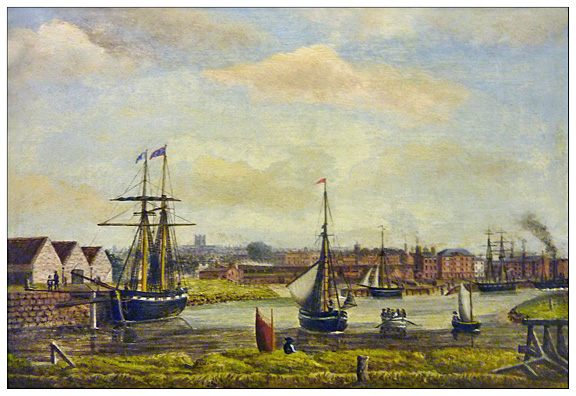 If you walk a short distance past the racecourse and under the arches of the 1840s railway viaduct, you encounter a part of
Chester very different to that of ancient walls, picturesque rows and timbered
houses, known as the Old Port. If you walk a short distance past the racecourse and under the arches of the 1840s railway viaduct, you encounter a part of
Chester very different to that of ancient walls, picturesque rows and timbered
houses, known as the Old Port.
In earlier centuries, the River Dee was a far mightier waterway than it is
today, and large ships could discharge their cargoes at wharves situated immediately
alongside the City Walls.
If you walk down the steps to the racecourse on the Roodee and grub about
behind a lot of brambles, debris and portable buildings, you will be rewarded
with the sight of the massive stones of the Roman
harbour wall, where once war gallies tied up and the trading
ships of the empire discharged their cargoes. Although only a few courses
of these stones now show above ground, they extend for at least another 15
feet underground for much of the length of the wall between here and the Watergate,
with traces of groin walls running off at right angles.
Until the start of the 14th century, the existing structure of the ancient
walls and towers proved adequate to the port's defence, but, as the silting
of the Dee estuary started to badly affect the depth of water available to
shipping, it was deemed necessary to extend the defences further out into
the river, and as a result, in 1322 the Watertower was built.
Try to imagine the scene as early illustrations show it: of armed men looking
down from this spot to where the Watertower stands solidly in the river with
ships moored to its base, the bustle of soldiers, mariners and merchants going
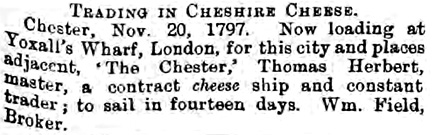
about their business. 16th and 17th century maps of Chester show the River Dee approaching close to the Watergate,
allowing just enough room for a quay for goods to be loaded and unloaded into
waiting vessels or the carts which would be dragged up the steep incline of
Watergate Street to the markets in the city.
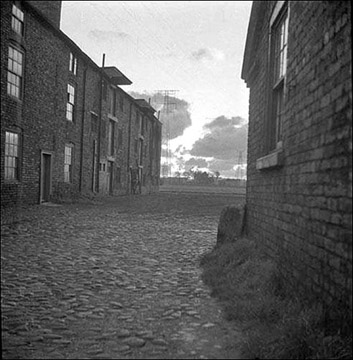 Right: Crane Bank in the 1930s Right: Crane Bank in the 1930s
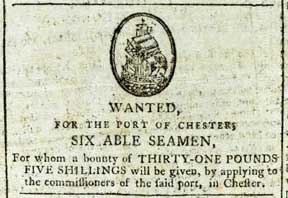
Over succeeding centuries the river silted further, nautical trade seriously
declined and Chester lost its ancient position as the principal seaport of
northern England.
Majestic and gay were the vessels adorning
Thy banks, lovely Dee! as I wandered along;
Where I loved to inhale the pure breath of the morning,
And listen with glee to the mariner's song.
How proudly I gaz'd on thy port that was crowded
With barks that were freighted from India's shore;
Nor thought of the time when thy hopes would be clouded,
And commerce and industry bless thee no more!
But
a
renaissance
came
in
the
1730s
when
the
Dee
was
canalised,
new
quays
and
shipyards
were
established
and New
Crane
Street was
laid
out
to
link
the
new
wharves
to
the
city.
Joseph
Hemingway,
writing
in
1836,
stated
that
the
river
here
"is
navigable
for
ships
of
350
tons
burthen.
From
the
quays
are
exported
some
of
the
richest
cargoes
of
that
excellent
commodity
which
affords
to
the
taste
of
the
Londoners
the
most
grateful
flavour,
and
presents
the
Cockney
with
what
he
calls
"the
fattest
Velsh
rabbits
in
the
Vorld"-
good
old
Cheshire
Cheese".
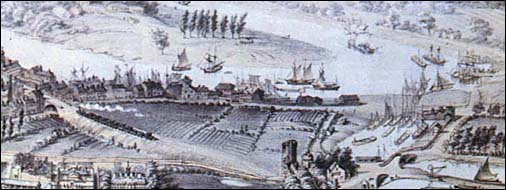
Twenty
years
later, this remarkable
aerial
view-
a
detail
from
John
McGahey's
famous View
of
Chester
from
a
Balloon- was published,
showing
the
Old
Port
and
its
surroundings
as
they
appeared
around
the
year
1855. A small section of it is illustrated below.
At the end of the nineteenth century, it was proposed that Chester's revolutionary new electricity generating station should be built in the Hop Pole Paddock- better known to us today as The Kaleyards- much to the distress of many, including the Cathedral authorities, who in October 1893 wrote to the council that it "would be a grievous eyesore and a permanent injury to the city itself if that site is so used... Architecturally, the works would seriously effect the Cathedral which is now such an attractive feature of the city... The Chapter have always been desirous of the Hop Pole Paddock being kept as open space for the benefit of the city at large and they are quite willing to approach the Ecclesiastical Commissioners in order to see whether some substantial step can be taken to place the Paddock in trust for the enjoyment of the citizens".
 The Mayor assured the Dean and Chapter that their appeal would "receive the careful consideration of the Council" but, by the following January (1894) they had formerly decided that the thing would be built here anyway, despite objections, and also that "having settled on the site, it was not for them to deal with suggestions for keeping open space." (sounds familiar, doesn't it?) The Mayor assured the Dean and Chapter that their appeal would "receive the careful consideration of the Council" but, by the following January (1894) they had formerly decided that the thing would be built here anyway, despite objections, and also that "having settled on the site, it was not for them to deal with suggestions for keeping open space." (sounds familiar, doesn't it?)
In March 1894, the Cathedral authorities offered to pay the sum of £1,000 to purchase the Paddock, but their offer was initially rejected, the committee declaring that this was still the best site for the generating station. A mere month later, however, came an abrupt about-turn when the council decided to accept the Cathedral's £1,000 subject to the following conditions, 1. That it never be built upon and be forever kept open and, 2. That the Chapter relinquish theCorporation a strip of land 12 feet wide at the back of Frodsham Street if and whenever the Corporation require it for widening that street".
The electricity generating station was eventually opened in 1897 here in the Old Port instead, where, after a long resident's battle to fight off a developer's bid to demolish it, it (or at least a token part of it) remains with us today, as we will learn shortly...
 With the continuing silting of the Dee and the meteoric rise of the Port of Liverpool,
the shipping faded away (although steam coasters continued to visit Crane
Wharf until the 1930s) and the area continued to decline, to the degree that
if you walk around today, it is difficult to imagine the bustle during the
two hundred years or so of the so-called Old Port's
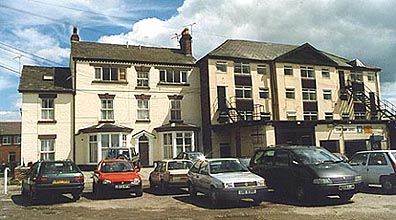
existence. To the sharp-eyed, however, numerous reminders remain, in the form
of weed-covered harbour walls, the 1730s warehouses (currently serving as
the Sea Cadet's HQ) and quayside buildings such as the Harbourmaster's house
illustrated above. The area nontheless maintained- and continues to maintain-
a thriving residential community and many small businesses: garages, engineers,
hire companies and the like occupy the arches of the railway viaduct. Above
their heads thunder the trains travelling from London to Holyhead and the
boats for Ireland, as they have done for 150 years. With the continuing silting of the Dee and the meteoric rise of the Port of Liverpool,
the shipping faded away (although steam coasters continued to visit Crane
Wharf until the 1930s) and the area continued to decline, to the degree that
if you walk around today, it is difficult to imagine the bustle during the
two hundred years or so of the so-called Old Port's
existence. To the sharp-eyed, however, numerous reminders remain, in the form
of weed-covered harbour walls, the 1730s warehouses (currently serving as
the Sea Cadet's HQ) and quayside buildings such as the Harbourmaster's house
illustrated above. The area nontheless maintained- and continues to maintain-
a thriving residential community and many small businesses: garages, engineers,
hire companies and the like occupy the arches of the railway viaduct. Above
their heads thunder the trains travelling from London to Holyhead and the
boats for Ireland, as they have done for 150 years.
Recently, much new building has occured around the Canal Basin and facing
South View Road- much of which was undertaken by housing associations to provide
new social- and young people's accomodation. This is to be followed by more
new houses on cleared land between Tower Road and South View Road.
So far so good. The area's restoration has been long overdue and the new,
low-rent homes were badly needed. Unfortunately, proposals for the second
phase of the Old Port redevelopment- involving the needless demolition of
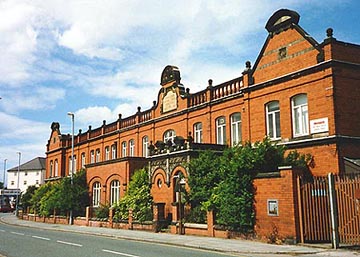
the handsome Victorian Electric Lighting Company Building (illustrated right) and its replacement by a series of ugly, overlarge and
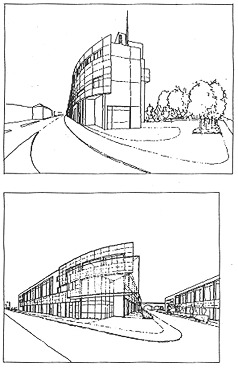
inappropriate office blocks- 'artist's impression's' of which may seen below- received, as we shall see,
an extremely hostile reception by the people of Chester.
 The Electric Light Building was Chester's first electric
generating station, designed by I. Matthews Jones and built by a forward-looking Corporation in
New Crane Street in 1896, under the auspices of the eminent Professor Kennedy
and overseen by no less than the world famous scientist Lord Kelvin. The men
responsible for the distribution of the electricity were the engineers
F. Thursfield (until 1904) and S. E. Britton (until 1946)- both, sadly, rarely remembered today. The Electric Light Building was Chester's first electric
generating station, designed by I. Matthews Jones and built by a forward-looking Corporation in
New Crane Street in 1896, under the auspices of the eminent Professor Kennedy
and overseen by no less than the world famous scientist Lord Kelvin. The men
responsible for the distribution of the electricity were the engineers
F. Thursfield (until 1904) and S. E. Britton (until 1946)- both, sadly, rarely remembered today.
The three original generators have long disappeared, but in recent years the attractive
office building of the former power station had been occupied by local electricity
provider Manweb. With the ending of their lease, thought had to be
given to the future of the building- considered by many to be an eloquent
symbol of our region's industrial heritage and as such, eminently worthy of
preservation. Architect Francis Graves presented
the case in the Sunday Times for its conversion to a possible exhibition
or 'heritage' centre and restaurant. Not only did Graves recommend retaining
the building for its appearance but noted it as a "central landmark" suitable
for public use, etc. There was, after all, ample space for office development
across the road on the land recently vacated by the gasworks, together with
more houses- which may do something to lift the threat of development in other
parts of the city, such as the much-valued allotments on Cheyney Road and
the Blacon Meadows, to name just two.
Chairman of the Chester Civic Trust, Stephen Langtree, wrote in the Trust's newsletter that "no economically
viable new use could be found for the building" and the council therefore
decided to hold an architectural competition in conjunction with Wilmslow-based
developers F T Patten- with Langtree himself as
one of the judges- to "see whether a scheme might emerge which would enhance
the area and justify the loss of the Victorian building".
 These experts plumped
for a design by architects Mills Beaumont Leavey Channon which, believe it or not, "evoked the maritime context through the use of glass cladding, lighting
and external water features." Consequently, we're told, "some of the more
exuberant aspects" of the design were subsequently done away with during the
planning permission process- leaving us with the delightful escapees from
Milton Keynes illustrated here and below... These experts plumped
for a design by architects Mills Beaumont Leavey Channon which, believe it or not, "evoked the maritime context through the use of glass cladding, lighting
and external water features." Consequently, we're told, "some of the more
exuberant aspects" of the design were subsequently done away with during the
planning permission process- leaving us with the delightful escapees from
Milton Keynes illustrated here and below...
Langtree
continued, "I know some of you are deeply unhappy about the loss of the old
Lighting Company Building. It is undoubtedly one of important local interest but is not, we believe, of any great architectural merit. Retaining the facade might have been an option, but part of it straddles a
large old sewer over which no new construction would have been allowed". This
was a crude, easily-exposed untruth, which, as the apparent major reason for
demolition, somehow continued to be repeated- most recently by City Council
Head of Planning Andrew Farrall in the Chester Standard of 6th
August 1998.
Curiously, both Welsh Water and the city council's
own engineers said there was absolutely nothing wrong with the Victorian sewer and no remedial action would be necessary should
the building be retained. Only in the event of its replacement would a three-metre
wide 'exclusion zone' come into operation. And even if there were a problem,
as is pointed out in a letter below, the repair
and replacement of sewers, however large, has been going on for some time
now. The process can be tricky, but is hardly high tech, and certainly does
not require the demolition of existing buildings- otherwise there would be
a lot of gaps in most city centres!
 In the words of Councillor Steve Davies (one of the very few elected
representatives to speak up against these absurd proposals)- "I believe the
developers don't want this building, so we are looking at ways to get rid
of it". He felt that the developers- doubtless backed up by elements within
the city council and Civic Trust- did not want to retain the building because
it did not fit in with their bright new 'high tech' image, and would therefore not attract
the 'right sort' of company to occupy it- "This is a historic city, so why
should we welcome developers who want to put up modern offices you could see
in Milton Keynes? The people of Chester placed their trust in us when they
voted for us. Let us not betray that trust or we will earn the same contempt
from future generations that we have for those who pulled down the old Market frontage". In the words of Councillor Steve Davies (one of the very few elected
representatives to speak up against these absurd proposals)- "I believe the
developers don't want this building, so we are looking at ways to get rid
of it". He felt that the developers- doubtless backed up by elements within
the city council and Civic Trust- did not want to retain the building because
it did not fit in with their bright new 'high tech' image, and would therefore not attract
the 'right sort' of company to occupy it- "This is a historic city, so why
should we welcome developers who want to put up modern offices you could see
in Milton Keynes? The people of Chester placed their trust in us when they
voted for us. Let us not betray that trust or we will earn the same contempt
from future generations that we have for those who pulled down the old Market frontage".
In sharp contrast, back to Stephen Langtree: "Retaining a partial facade was,
in the opinion of the Civic Trust Council, a less satisfactory solution than
making way for a new group of three buildings which will untie the space,
providing a 'gateway' to the city and be a commercially stimulating centrepiece
for the revival of the area".
 In a similar vein, in the course of reviewing 15 years of conservation
'progress' since European Architectural Heritage Year in 1975, one David
Pearce wrote, "Now the emphasis is on preservation and conservation of
old buildings, and their intelligent adaptation to new uses. And in a bizarre
reversal, old buildings are now too often assumed to have greater intrinsic
merit than any new design". In other words, as this same individual remarked
when adressing Chester Civic Trust in 1989, "We cannot, and must not, try
to keep everything". In a similar vein, in the course of reviewing 15 years of conservation
'progress' since European Architectural Heritage Year in 1975, one David
Pearce wrote, "Now the emphasis is on preservation and conservation of
old buildings, and their intelligent adaptation to new uses. And in a bizarre
reversal, old buildings are now too often assumed to have greater intrinsic
merit than any new design". In other words, as this same individual remarked
when adressing Chester Civic Trust in 1989, "We cannot, and must not, try
to keep everything".
Music, we're sure, to the ears of the planners and developers...
Attempts were made to protect the Electric Light
Building by getting it listed- buildings not needing be particularly ancient
to qualify for this. Harry Weedon's Odeon Cinema of 1936 in Northgate
Street is an example- but 'national experts' declared it to be "only
of local interest" and therefore not worth saving.
Speaking in response to the deeply depressing news that, despite the massive
public outcry against the destruction of the building by people who considered
it a vital part of Chester's industrial history, local campaigner Avril Coady referred to Langtree's weasel words when she said, "We looked to the council
to protect us, but developers have been given the priority yet again. They
took the Civic Trust's comments into consideration when the Civic Trust has no mandate to represent the people of the area. We DO have a mandate.
We've got a 1000-plus signatures from the people who matter- the people who
live in the district".
We heard around this time that the compulsory purchase order on the attractive
Victorian cottages in Kitchen Street, directly opposite the Electric Light
building had been rescinded. Also that the City Council Property Development
Officer responsible for dealing with the Old Port scheme, Craig Booton,
had taken up a job with FT Patten, the developers who wanted to build the
office blocks- presumably taking all his valuable inside knowledge with him.
In
mid-September 1998, Manweb's 50-odd maintainance workers started to "reluctantly"
move from the site where electricity workers have been based for over a century
to their new depot on the Chester West Business Park. The company were unhappy about the move, which was
requested by the city council, but nevertheless said that they left "in order
to assist the council plans for redevelopment in the Old Port area".
Reader Alan Edwards has kindly supplied some of his reminisciences of working for Manweb in the old building:
"I joined Manweb (Merseyside and North Wales Electricity Board) in 1972 as an apprentice telecoms in the Technical Section. I was to be based in Chester at various sites. One of these was Crane Street, the 'New' (of New Crane Street) never seemed to feature in Manweb.
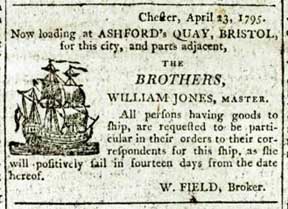 So what was in the Depot? Well, the main job of an Electricity Board was to keep the lights on as it were, aka supply electricity. The main building was a former generating station for Chester and the mountings for the machinery could still be found in the stores area. Various “trades” worked in the depot, electricians who would do repairs and re-wires of properties both industrial and people's homes. Fitters who would maintain and construct substations electrical equipment. Linesmen who maintained and constructed overhead lines. Jointers who worked on underground cables and Engineers who designed the network, looked for faults and switched circuits in and out, these were highly trained people usually with degrees in Electrical Engineering.There was a garage to maintain all the vehicles needed to do these jobs. These were the norm across all of Manweb from Aberystwyth to Southport and over to Oswestry. So what was in the Depot? Well, the main job of an Electricity Board was to keep the lights on as it were, aka supply electricity. The main building was a former generating station for Chester and the mountings for the machinery could still be found in the stores area. Various “trades” worked in the depot, electricians who would do repairs and re-wires of properties both industrial and people's homes. Fitters who would maintain and construct substations electrical equipment. Linesmen who maintained and constructed overhead lines. Jointers who worked on underground cables and Engineers who designed the network, looked for faults and switched circuits in and out, these were highly trained people usually with degrees in Electrical Engineering.There was a garage to maintain all the vehicles needed to do these jobs. These were the norm across all of Manweb from Aberystwyth to Southport and over to Oswestry.
Crane Street, however, had some unique departments. There was the Polyphase Meter Test. This tested and calibrated industrial metering. Ordinary domestic meters were tested in Liverpool. There was protection where the equipment was tested, this stuff was used to “protect” substations and cables and had to be precisely calibrated. In short if someone dug up a cable in the Road or damaged an overhead line the power needed to be disconnected more or less instantly to avoid a fire or even an explosion in the substation. Finally there was the Radio Workshop where I was to spend quite a lot of time though I worked in the other areas too. Manweb had a large radio network right across the company and the equipment to go into the base stations and vehicles was maintained here.
What was it like working there? Pretty good actually, we didn’t take ourselves too seriously and wind ups were very common. Quite a few people worked in the depot obviously, but most people knew each other and would stop for a chat and how's tricks. It was a happy place and people generally looked forward to going to work, I know I did. A colleague once told me that in the 60s when people generally didn’t have cars, everyone would leave the depot en masse and walk into Chester, most would pause in the Watergate Pub for a pint and a natter before heading home.
Privatisation was to end our happy existence and conditions went downhill sadly. Many depots including Crane Street closed and as we know it is now a collection of flats with very little of the original building left. Progress- NOT."
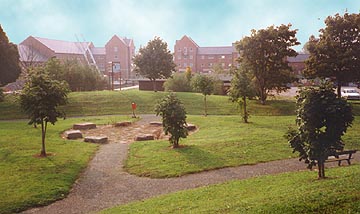 Also in September 1998, and despite the inevitable resident's objections,
the council planning sub-committee unanimously voted for the obliteration
of the last piece of green open space in the vicinity of the Old Port- the
so-called Stone Park (illustrated right in its final days with new
developments rising behind)- by the building of houses and flats. The original
council 'masterplan' for the area showed this proposed development, but also
the closure of Tower Road and the extension of Tower Gardens to reach the
canal bank, thus creating a replacement, easily-accessible park for the benefit
of the community. Also in September 1998, and despite the inevitable resident's objections,
the council planning sub-committee unanimously voted for the obliteration
of the last piece of green open space in the vicinity of the Old Port- the
so-called Stone Park (illustrated right in its final days with new
developments rising behind)- by the building of houses and flats. The original
council 'masterplan' for the area showed this proposed development, but also
the closure of Tower Road and the extension of Tower Gardens to reach the
canal bank, thus creating a replacement, easily-accessible park for the benefit
of the community.
However, once planning permission was obtained, this 'masterplan' was mysteriously
altered, omitting the promised extension to the park. Thus existing- and future-
residents of the area would be deprived of anywhere for their children to
play in safety- the nearby, and very attractive- Tower Gardens contains
a putting course, tennis courts and bowling greens, but nowhere for rollerblades,
bikes and dogs (and in addition is closed all Winter)- and the city as a whole
is to be robbed of yet another badly-needed 'green lung'.
How then, in the face of this ongoing saga of
greed and stupidity, was the citizen to equate the attitudes and actions of
our City Council and their developer friends with the words of Prime Minister
Tony Blair that "Community takes precedence over developers, and people count
for more than buildings"- or of their own, much-vaunted environmental guide, Agenda 21, which declared "The history and heritage of the city and
district are constant reminders of how important the environment is. Agenda
21 will help us to meet the needs of today's society without damaging the
environment, the history and the heritage for future generations".
'Seranus'
Now go on to part two of our brief history of Chester's Old Port...
|

