|
 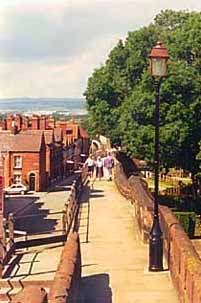 f
you
had
undertaken
this
walk round
Chester's
ancient
City
Walls at
almost
any
time
during
much
of
the
last
millennium,
a
familiar
sight
would
have
been
the
armed
men
patrolling
there: The
Watch,
said
to
have
been
established
soon
after
the
Norman
conquest
by
the
first
Earl
of
Chester, Hugh d'Avranches (known as Lupus- 'the wolf'),
following
a serious
incursion
one
Christmas
Eve
by
a combined
band
of
Welshmen
and
Saxons.
The
town
was
taken
by
surprise,
and
the
attack
resulted
in
considerable
loss
of
life
by
both
sides
before
the
raiders
eventually
withdrew,
leaving
much
of
Chester
in
flames. The
incident
was
dramatically
recreated
by
the
Rev. Robert
Rogers,
writing
in
the
16th
century: f
you
had
undertaken
this
walk round
Chester's
ancient
City
Walls at
almost
any
time
during
much
of
the
last
millennium,
a
familiar
sight
would
have
been
the
armed
men
patrolling
there: The
Watch,
said
to
have
been
established
soon
after
the
Norman
conquest
by
the
first
Earl
of
Chester, Hugh d'Avranches (known as Lupus- 'the wolf'),
following
a serious
incursion
one
Christmas
Eve
by
a combined
band
of
Welshmen
and
Saxons.
The
town
was
taken
by
surprise,
and
the
attack
resulted
in
considerable
loss
of
life
by
both
sides
before
the
raiders
eventually
withdrew,
leaving
much
of
Chester
in
flames. The
incident
was
dramatically
recreated
by
the
Rev. Robert
Rogers,
writing
in
the
16th
century:
"No
man's
memory
cannot
remember
the
original,
yet
the
collections
of
writers
doe
shew
the
beginning
to
be
in
the
days
of
William
the
Conqueror,
who
driving
the
oulde
Brittons,
or
as
is
verilie
thoughte
the
Walshemen
who
did
here
inhabitt,
mixed
with
the
oulde
Saxons,
seeing
the
Normans
to
have
gotten
the
possession
by
force
of
conquest,
at
a season
in
the
Christmas
when
all
men
give
themselves
to
securitie,
the
Walshemen,
neere
neighbours,
grudgeing
at
their
securitie
and
possession
of
their
landes,
came
in
the
night
and
made
a sudden
invasion,
and
spoiled
and
burned
some
of
this
cittie"
Earl
Hugh,
determined
not
to
be
caught
out
again,
granted
land
to
those
who
would
provide
armies
of
retainers
for
"watching
the
four
gates"
and
also
pay
a gabel (or gable)
tax every
Christmas. They were also obliged "to be in attendance at the execution of felons".
An ancient type of tenure under which property in Chester was held was known as the Execution Rent. It applied to a number of houses and inns and in addition to other services, entailed active assistance on the part of the holder on those occasions when county and city criminals and other offenders were to suffer capital punishment. As part of their privileges and duties, the Execution Rent tenants were bound to keep watch for the city on Christmas Eve, Christmas Day, and St. Stephen's Day (26th December), they were bound to mount guard over and conduct felons and robbers- whether condemned in the County Court before the Justiciar of Chester, or in the City Court or Crownmote before the Mayor- as far as the gallows. For the services these tenants were exempt from attendance on all inquisitions, juries and assizes, except when held before the Earl of Chester.
 The
Watch
on
the
walls
was
kept
up
for
centuries,
but
its
role
began
to
change
as
the
danger
of
vandalism
and
unrest
by
roistering
citizens within the
walls
was
apparently
considered
greater
than
attack
by
disgruntled
Welshmen
from
without.
As
the
Rev.
Rogers
put
it: "The
use
that
now
is
made
thereof
is...
to
watch
3
nightes
together
with
the
most
strong
and
well
appointed
armore...
but
now
we
use
the
same
to
keepe
the
cittie
from
danger
of
fire,
theeves,
dronkness
and
unmeete
meetings
and
drinkinges
in
the
nightes,
which
might
be
the
cause
of
peturbations
of
peace
and
sin
against
God,
which
to
these
times
are
most
incidente". The
Watch
on
the
walls
was
kept
up
for
centuries,
but
its
role
began
to
change
as
the
danger
of
vandalism
and
unrest
by
roistering
citizens within the
walls
was
apparently
considered
greater
than
attack
by
disgruntled
Welshmen
from
without.
As
the
Rev.
Rogers
put
it: "The
use
that
now
is
made
thereof
is...
to
watch
3
nightes
together
with
the
most
strong
and
well
appointed
armore...
but
now
we
use
the
same
to
keepe
the
cittie
from
danger
of
fire,
theeves,
dronkness
and
unmeete
meetings
and
drinkinges
in
the
nightes,
which
might
be
the
cause
of
peturbations
of
peace
and
sin
against
God,
which
to
these
times
are
most
incidente".
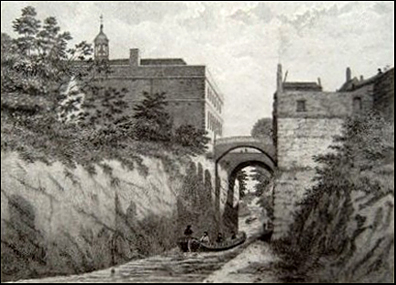
Right: The Bridge of Sighs and Northgate Bridge viewed from the spectacular deep cutting in which runs the Shropshire Union Canal. The City Wall is on the right and the Bluecoat School on the left. If you walked this way, you would find that very little has changed since this engraving was made in the 19th century.
The
Setting
of
the
Watch became
a great
annual
ceremony
which
signalled
the
start
of
the
City
of
Chester's
official
Christmas
celebrations.
The
tenants
were
summoned
before
the
Mayor
and
Corporation,
Recorders
and
Justices "In
their
scarlett
gownes,
attended
with
lights
and
torches
and
accompanied with
diverse
of
the
gentry
and
others" in
the
Common
Hall
to
render
homage
for
their
lands,
and
the
men-at-arms
were
inspected
before
parading
through
the
streets
with
banners
flying
to
the
four
gates.
The
keys
were
delivered
by
the
Mayor "to
such
of
the
watchmen
as
he was
pleased
to
intrust". These
ceremonials
were
traditionally
followed
by
much
eating,
drinking
and
merrymaking.
A thousand years before the Normans came to Chester, the cold and lonely duty of patrolling the walls fell to the soldiers of the 2nd and then the 20th Roman Legions, men posted here from every corner of the Empire. Imagine how they must have felt, at two o'clock of a winter morning with the mist swirling in from the river, contemplating another day of endless rain and miserable cold. All they could do was to pull their cloaks more tightly around them and curse the day they left sunnier climes for these inhospitable shores. The poet W. H. Auden expressed it well in his poem Roman Wall Blues:
Over
the
heather
the
wet
wind
blows,
I've
lice
in
my
tunic
and
cold
in
my
nose.
The
rain
comes
pattering
out
of
the
sky,
I'm
a
wall
soldier,
I
don't
know
why.
The mist creeps over the hard grey stone,
My girl’s in Tungria; I sleep alone.
Aulus goes hanging around her place,
I don’t like his manners, I don’t like his face.” |
Improvements
 The
North Wall
at
this
point
is
pierced
by
a
small
postern
or
gateway.
This
was
constructed
as
recently
as
1883
after
a
considerable
stretch
of
the
inner
face
of
this
section
collapsed
and
had
to
be
rebuilt.
During
the
course
of
this
work,
all manner of pieces
of
architecural
decoration
from
demolished
Roman
buildings
and
inscribed
tombstones
and
funerary
monuments
were
discovered,
mysteriously
built
into
the
core
of
the
wall.
When,
four
years
later,
in
1887,
further
repairs
were
carried
out
to
the
north
wall
in
the
vicinity
of
the Deanery
Field,
a
great
many
similar
finds
were
made. They
range
in
date
from
around
70AD
to
the
early
third
century
and
represent
every
type
of
citizen:
soldiers
and
civilians,
men
and
women,
young
and
old,
from
all parts of the empire including modern France,
Spain,
Italy,
Slovenia
and
Turkey.
The
finest
of
the tombstones
may
be
seen
today
in
their
own
wonderful gallery
at
the Grosvenor
Museum-
one
of
the
most
important
collections
of
Roman
inscriptions
and
sculpture
in
north-west
Europe.
This
gateway
through
the
walls
leads
to
a
recently-landscaped
area
that
was formerly
occupied
by
an
ugly
building
that
had
been
used
for
purposes
as
diverse
as
rifle
range,
scout
hut
and
shirt
factory
before
being
burnt
out
and
sitting
derelict
for
many
years.
The
land
was
eventually
acquired
by
the
City
Council
and
funding
obtained
to
improve
the
situation,
with
the
results
we
can
now
see
before
us:
a
compact
semi-circular
arena
with
steps
running
down
to
the
canal
locks
below,
where
the surviving
lower
courses
of
the
wall
of
the
old
building
have
been
skilfully
incorporated
into
the
design.
 If
you
enter
and
look
at
the
inside
of
the
City
Wall,
you
will
see
some
complex
and
extremely
impressive
sections
of
the
original
Roman
stones,
dating
from
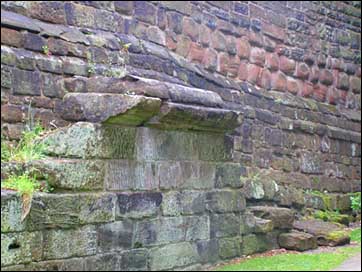
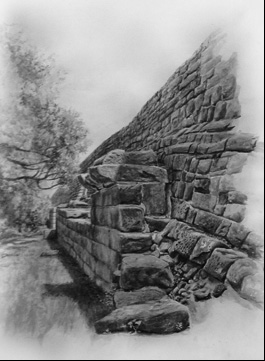
c.100AD, seen here in a photograph by the author and a fine pencil drawing by Jay Hurst. The
gradual
rising
of
the
ground
level
over
the
centuries
means
that
these
courses
would
originally
have
been
far
higher
and
much
of
the
Roman
masonry
remains
buried
below
ground
while
later
generations
successively
built
on
top
of,
or
adjacent
to,
the
older
courses,
thus
raising
the
wall
to
the
present
level. If
you
enter
and
look
at
the
inside
of
the
City
Wall,
you
will
see
some
complex
and
extremely
impressive
sections
of
the
original
Roman
stones,
dating
from
c.100AD, seen here in a photograph by the author and a fine pencil drawing by Jay Hurst. The
gradual
rising
of
the
ground
level
over
the
centuries
means
that
these
courses
would
originally
have
been
far
higher
and
much
of
the
Roman
masonry
remains
buried
below
ground
while
later
generations
successively
built
on
top
of,
or
adjacent
to,
the
older
courses,
thus
raising
the
wall
to
the
present
level.
The
creation
of
a,
more
or
less,
level
promenade
along
the
wall's
top
during
the
eighteenth
century
also
resulted
in
alterations
in
height,
as
some
sections
were
reduced
while
others
were
raised-
and
occasionally
completely
rebuilt.
A
cobbled
ramp
leads
from
here
down
to
the
canal
towpath
and the Northgate
Locks. The Chester
Canal,
which
only
went
as
far
as
Nantwich,
was
started
in
1772
and
this
first
section
was
opened
three
years
later.
It
was
a
commercial
flop
and
was
in
danger
of
closing
when
it
was
taken
over
by
the
larger Ellsmere
Canal
Company as
part
of
an
ambitious
plan
to
unite
the
River
Severn
at
Shrewsbury
with
the
Rivers
Dee
and
Mersey.
The
course
across
the
Wirral
to
a
junction
with
the
Chester
Canal
at Tower
Wharf opened
in
1796-
the
junction
itself
opening
a
year
later.
There
were
originally
five
locks
here,
but
these
were
reduced
to
three
when
the
Wirral
branch
of
the
canal
was
added.
If
you
were
to
look
down
from
the
top
of
the
cobbled
slope
where
we
now
stand,
you
would,
until
recently,
have
noticed
some
wooden
boards
set
into
the
towpath.
These
concealed
a
flight
of
stone
steps
which
was
provided
to facilitate the rescuing
of
horses
in
the
event
of
their
falling
into
the
canal.
The
boards
have
been
replaced
with
a
metal
cover
as
part
of
a
recent,
very
welcome
towpath
restoration,
but
the
emergency
steps
survive
beneath.
Regaining
the
wall
via
the
steps
near Morgan's
Mount,
on
our
left-
beyond
the
long
strip
of
garden
below-
we
see
the
deep
cutting
into
which
the
canal
has
disappeared:
the
re-excavated
original fosse of
the
Roman
fortress.
Looking
down Canning
Street on
the
right,
between
the
1882
Eddington's
Buildings
and
the
much
later,
but
still
pleasing
terrace
of
modern
homes,
King
Charles'
Court,
we
see
the
interesting
variety
of
architectual
styles
and
periods
evident
in
the
backs
of
the
old
houses
in King
Street.
Laid
out
in
Norman
times,
King
Street
was
originally
known
as
Barn
Lane
and
linked
Northgate
Street
with
the Abbey
of
St. Werburgh's tithe
barn,
once
situated
in
the Crofts in
the
northwestern
corner
of
the
city.
This
must
have
been
a
large
building-
the
Abbey
was
richly
endowed
with
many
farms
and
thousands
of
acres
of
land.
The
recent
archaeological
dig
at
the Infirmary sought
to
find
some
trace
of
it,
but
with
no
success,
and
its
site
is
now
surmised
to
lie
somewhere
under
the
present Inner
Ring
Road.
The author of an anonymous work, A Walk Round the Walls and City of Chester, published around 1800, has this to say regarding the view hereabouts, "on the descent from the Northgate, which we hear is soon to be replaced by a modern structure, a fine variegated landscape lays before us, enriched by water, wood and mountains- the River Dee navigation- a well cultivated plain of great extent- the castle and village of Hawarden with the woods abounding on the neighbouring hills, terminated by the mountains of Flintshire and Denbighshire. On the level, several thousand acres of fine land have been already enclosed and good farm houses now stand where the tide flowed a few years ago.
A person, long resident in Chester, can with difficulty recall to his recollection the appearance of the place, which the new canal warehouses, hotel &c. now occupy, and and the bustle of trade causes him to form a pleasing contrast between its former and present appearance".
What we who love old Chester would give to see what that long-dead author wrote of as "its present appearance"!
The Northgate Brewery
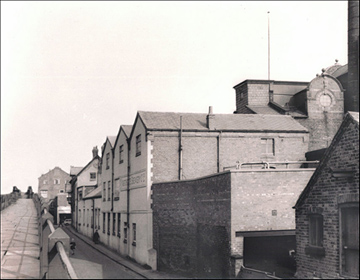 Approaching the Northgate,
we
find
ourselves
peering
through
the
windows
of
a
large modern
office
block, Centurion
House,
built
in
1977
as
the
local
branch
of
HM
Customs
and
Excise,
and, in the view of many, most
inappropriate, both
in
scale
and
style,
for
this
attractive
corner
of
the
city.
It
stands
on
the
site
of
the
former Northgate
Brewery-
shown
above-
which
closed
down
in
1969.
It formerly housed
Cheshire's
County
Court until a few years ago
with
the
opening
of
a
new
County Court
building
in
an
equally-inappropriate
location:
the
unexcavated
half
of
Chester's Roman
amphitheatre. Centurion House is now used for commercial purposes. Approaching the Northgate,
we
find
ourselves
peering
through
the
windows
of
a
large modern
office
block, Centurion
House,
built
in
1977
as
the
local
branch
of
HM
Customs
and
Excise,
and, in the view of many, most
inappropriate, both
in
scale
and
style,
for
this
attractive
corner
of
the
city.
It
stands
on
the
site
of
the
former Northgate
Brewery-
shown
above-
which
closed
down
in
1969.
It formerly housed
Cheshire's
County
Court until a few years ago
with
the
opening
of
a
new
County Court
building
in
an
equally-inappropriate
location:
the
unexcavated
half
of
Chester's Roman
amphitheatre. Centurion House is now used for commercial purposes.
Northgate Street was blessed with
a
great
number
of
inns- guide and author Thomas Hughes wrote of them as "being as common as blackberries"- and one
of
these
was
the
old Golden
Falcon
Inn, which long stood where the office block is now. It was first recorded in 1704 and for many years considered the principal inn of the city. It was here, in 1741, that the great composer George Friderick Handel stayed for several days. Prevented by bad weather from sailing for Ireland from the small port of Parkgate on the Wirral, he was forced to assemble a makeshift orchestra and chorus from the Cathedral and elsewhere to rehearse what would be, when he eventually arrived in Dublin, the first performance of his best-loved work, Messiah.
Thirty years earlier, in 1711, the Duke of Ormonde, then Lord-Lieutenant of Ireland, stopped at the Falcon until the wind allowed him to proceed on his journey from Parkgate to Ireland. On the morning when the Duke and his entourage were about to set out, one of the waiters at the inn ran after one of the duke's servants to demand payment for some articles he had omitted to discharge. The servant refused to pay, and the waiter, holding the horse's bridle, insisted on being paid before he would quit his hold. Upon this, the servant drew a pistol from his holsters, and shot the waiter dead on the spot. On the man being imprisoned, the Lord-Lieutenant directed that if his servant was convicted, an express should immediately be sent to him so that he might apply to the King for his man's pardon. The prisoner was tried and found guilty, and the Mayor being informed of the directions of the Lord-Lieutenant, replied, "I will take care to save his Majesty and the Lord-lieutenant any further trouble in this matter" and gave orders that the man should be executed the day following his conviction.
 The Duke of Cumberland stayed at the Golden Falcon in 1749, when he came to Chester to pursue his intrigue with Lady Henrietta, wife of the first Earl Grosvenor. The Duke of Cumberland stayed at the Golden Falcon in 1749, when he came to Chester to pursue his intrigue with Lady Henrietta, wife of the first Earl Grosvenor.
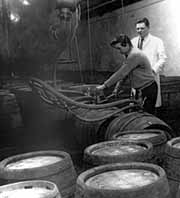
Right: a mixture of wooden and metal barrels being filled from the great vat in which the beer was brewed in the Northgate Brewery's cellars sometime during the 1960s.
Here is just one more curious story. In a small house adjoining the Golden Falcon lived one Samuel Jarvis. A ribbon weaver by trade, he had always been poor until one day it was observed that his circumstances had suddenly changed for the better. He entered into the silk trade and purchased an extensive estate near Mollington where he built himself a grand house. He served as Mayor of Chester in 1742-3 and had been selected to serve as High Sheriff of the County of Cheshire but died, an affluent and well-respected citizen, before he could take up the post.
But where did Jarvis's wealth come from? It was said that a clerk in a banking house in London stole a very large amount of money and made his escape to Chester, possibly en route to Ireland or elsewhere. He was followed and traced to the inn. Realising the game was up, immediately before his arrest he threw the bags of money out of his window and they landed among the undergrowth in Jarvis's garden. The clerk was nontheless arrested and returned to the capital where he was tried. No trace of the loot having been found, however, he was acquitted- but was later convicted of another serious crime and executed. The fortunate Mr Jarvis seems to have discovered the money bags in his garden soon afterwards and his new life commenced from that time...
 An even older inn, the White Bull, mentioned in 1642, was incorporated into the Golden Falcon in 1752. The inn was long in the hands of the Kenna family- and had been commonly referred to as Kenna's from at least 1711. The last of the family, Miss Catherine, died in 1770 but the inn had passed out of their hands by then- in 1763 it was acquired and partially rebuilt by George Smith, who also owned what was Chester's grandest coaching inn, The White Lion, which once stood where the entrance to the Forum is now. An even older inn, the White Bull, mentioned in 1642, was incorporated into the Golden Falcon in 1752. The inn was long in the hands of the Kenna family- and had been commonly referred to as Kenna's from at least 1711. The last of the family, Miss Catherine, died in 1770 but the inn had passed out of their hands by then- in 1763 it was acquired and partially rebuilt by George Smith, who also owned what was Chester's grandest coaching inn, The White Lion, which once stood where the entrance to the Forum is now.
But the great days of the Falcon had passed away with the last of the Kenna family and, in spite of the improvements carried out by George Smith, custom diminished and the career of the inn as such came to an end and the premises were put to other uses. By 1772, this former Row had become a vinegar manufactory until George Eaton bought and eventually demolished all the properties on the site to build his brewery. His son, Peter Eaton expanded the business, altered the stables to take more fermenting vessels and sunk a 33 metre well. In 1849, he was given notice by the council to control the smoke coming from his furnaces. He served as Mayor of Chester in 1856-7.
 No reference to the Golden Falcon occurs in the 1782 directory and the building was then in the occupation of "John Tomlinson, surgeon". Thirteen years later, the premises are listed as in the occupancy of "Messrs, Tomlinson, Brewers, Northgate Street" and the doctor, presumably one of the owners, had moved to Bridge Street. No reference to the Golden Falcon occurs in the 1782 directory and the building was then in the occupation of "John Tomlinson, surgeon". Thirteen years later, the premises are listed as in the occupancy of "Messrs, Tomlinson, Brewers, Northgate Street" and the doctor, presumably one of the owners, had moved to Bridge Street.
A new brewery was built on the site in the 1850s. Eaton's
Brewery
eventually
took
over
the
Kelsterton
and
St. Winnifred's
(Holywell)
breweries
and
the
company
was
bought
out
in
1864
by
Henry
Ford,
Frederic
Gunton
and
William
Kelly,
who
formed
the Northgate
Brewing
Company in
1889.
They
had
'bottling
stores,
wine
and
spirit
vaults'
at
7
Foregate
Street
and
malt
kilns
on
the
east
side
of
Lower
Bridge
Street
and
owned
pubs
throughout
Cheshire
and
North
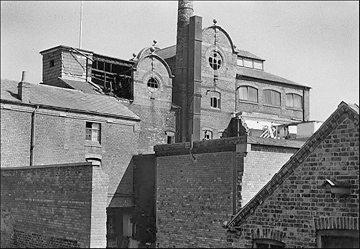
Wales. The brewery was again taken over, in 1949, by Warrington-based Greenhall Whitley, who closed it down twenty years later and the buildings were demolished in 1971.
This photograph, taken just before the demolition, shows the main building to have been rather handsome and it seems a pity that it was not, as was the case with the splendid Steam Mill on Canal Side, converted to other uses..
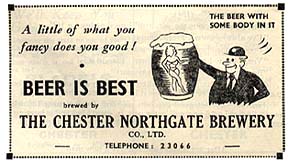
 An
advertisment
in
the now-defunct Cheshire
Observer of
May
1882
announced "Northgate
Brewery:
March
brewings
of
pale
and
mild
ales
and
porter
from
one
shilling
per
gallon".
If
only...A mixture of wooden and metal barrels being filled from the great vat in which the beer was brewed in the Northgate Brewery's cellars sometime during the 1960s. An
advertisment
in
the now-defunct Cheshire
Observer of
May
1882
announced "Northgate
Brewery:
March
brewings
of
pale
and
mild
ales
and
porter
from
one
shilling
per
gallon".
If
only...A mixture of wooden and metal barrels being filled from the great vat in which the beer was brewed in the Northgate Brewery's cellars sometime during the 1960s.
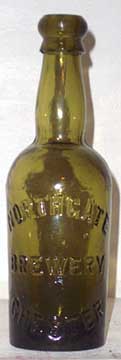
Northgate beer was widely exported as well as being produced for local consumption. Reader Steve Jacobs kindly sent us this photograph of a Northgate Brewery bottle which he recently bought "in the mountains of Asheville, North Carolina, USA". And, in June 2010, we were pleased to hear from Jenine Kramer in far-away Redmond, Oregon USA. She told us, "I came across your website after searching for information on a bottle I purchased in an antique store here in Oregon. I was looking for a thank you gift for my friend, Brian Cheeseman of Tantallon, Nova Scotia, Canada who collects antique beer bottles & cans. The bottle is dark green and has raised writing - "NORTHGATE BREWERY CHESTER". I was thrilled to read all about the brewery and very happy to see a picture of my exact bottle!"
Readers may be gratified by the knowledge that collectors of old beer bottles, such as Janine's friend, are distinguished by the name labeorphilists.
Archaeological
investigation
of
the
cleared brewery
site
conducted
in
the
early
1970s
revealed
evidence
of
Roman
rampart
buildings,
an intervallum road
that
ran
inside
the
wall
and
the
foundations
of
barrack
blocks. Also
uncovered
were
many
cellars
and
foundations
dating
from
the14th
to
the
19th
centuries.
Around 1973- a few years after its demolition- the well room from the old brewery was re-erected in the beautiful Ness Gardens on the Wirral. It is an interesting structure, roughly circular, which stands approximately 2-2.5 metres tall.
 The Northgate Brewery may have closed half a century ago but Northgate Ale is back, thanks to local brewer John Murray! "Although I am slightly too young to have sampled Northgate, I know of it well and many more senior friends and neighbours speak very fondly of it. I discovered that many of the brewery records had been lodged with Cheshire Archives and Local Studies. One item of particular interest was the 1902 brewery day book, detailing the malt, hops, water treatment, temperatures and gravities. I spent a couple of days there, transcribing these records and converting them into metric units. I decided to have a go. One problem that I needed to overcome was how to replicate the malts which were no longer available such as Burton Strong and Smyrna. After some searching, I found detailed analysis of both of these and attempted to replicate them using a blend of modern grains. The Northgate Brewery may have closed half a century ago but Northgate Ale is back, thanks to local brewer John Murray! "Although I am slightly too young to have sampled Northgate, I know of it well and many more senior friends and neighbours speak very fondly of it. I discovered that many of the brewery records had been lodged with Cheshire Archives and Local Studies. One item of particular interest was the 1902 brewery day book, detailing the malt, hops, water treatment, temperatures and gravities. I spent a couple of days there, transcribing these records and converting them into metric units. I decided to have a go. One problem that I needed to overcome was how to replicate the malts which were no longer available such as Burton Strong and Smyrna. After some searching, I found detailed analysis of both of these and attempted to replicate them using a blend of modern grains.
During a chance conversation with one of the Falcon regulars, I learned that he had worked at the brewery from 1958 to 1969. He gave me some useful information and also offered to help with the testing. I also discussed the idea with well known local historian Len Morgan, a big fan of the original brew, who gave me some other useful information. All in all I managed to recruit over 40 volunteers, all who drank the original brews, and gave them each a 500ml bottle and a questionnaire. The feedback was that I had got it nearly right, so some minor adjustments were made to the blend and another test carried out. Feedback from that was that it was probably as close as we could get, based on people’s recollections.
For interest, at that time, in an average week, the brewery did 4 brews of 40 x 36 gallon barrels. Beside the Draught Northgate Ale, other beers in the log are Mild, Harvest Ale, the bottled version of Northgate Ale (slightly stronger than the draught), and Old Chester Strong. It was really your site that inspired the original search for information. The next step may be to try it in a few pubs and see how it goes down."
 A new gallery of photographs of the Northgate Brewery is here. A new gallery of photographs of the Northgate Brewery is here.
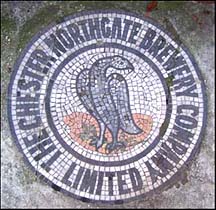
Should
you
wander
round
to
the
main
entrance
of
Centurion
House,
via Fireman's
Square,
you
will
see
set
into
the
pavement
the
attractive
mosaic
design-
shown
here-
that
was
formerly
set
in
the
old
brewery
office
doorway
in
Northgate
Street. Fireman's
Square,
incidentally,
is
so-called
because
of
its
proximity
to
the
ornate
former fire
station in
Northgate
Street and
the
row
of
cottages
still
standing
in
the
'square'
were
erected
in
the
1920s
to
provide homes for
the
firemen and their families. The fire station was built in 1911, designed in the Vernacular Revival style by James Strong, a pupil of the prolific local architect John Douglas, complete with oriel windows beneath picturesque overhanging gables. In Chester, even the fire station had to be a half-timbered building! It was designed to house three horse-drawn fire engines and later, motorised ones such as the one shown in our picture. However, unable to accomodate larger modern appliances, the station closed in 1970 and served for a while as various retail premises, but has now been tastefully transformed into a smart French restaurant.
Looking over the other side, the long, low building nestling beneath the shelter of the wall on one side and suspended above the sheer drop to the canal on the other, is today a private residence but once served as a school- reader Charles Jones wrote to tell us that it was run by a Miss Smith and that his mother Dorothy, born 1919, had studied there. Before that, it served as a tollhouse from where monies were collected from those entering the town to conduct business and attend the fairs and markets. These tolls, known as murage, were for centuries used specifically for the upkeep of the City Walls, executed by a skilled team of masons known as the murengers.
  nd
so,
we
wearily arrive
back
at
our
starting
point,
the Northgate!
We
may have
walked
just
two
miles,
but
have
seen
sights
and
heard
stories
from
over two millennia
of
Chester's
(and, in many ways, Britain's) extraordinary
history.
I
hope
you
found
the
experience
stimulating
and
have
enjoyed
our
brief
time
together. Be sure to tell your friends when you return home- and consider joining me for one of my real walking tours when you- and you will!- return to our ancient and beautiful City of Chester. nd
so,
we
wearily arrive
back
at
our
starting
point,
the Northgate!
We
may have
walked
just
two
miles,
but
have
seen
sights
and
heard
stories
from
over two millennia
of
Chester's
(and, in many ways, Britain's) extraordinary
history.
I
hope
you
found
the
experience
stimulating
and
have
enjoyed
our
brief
time
together. Be sure to tell your friends when you return home- and consider joining me for one of my real walking tours when you- and you will!- return to our ancient and beautiful City of Chester.
Regular readers will be aware that I
am
constantly
adding
to
the
site-
as
time, money
and
inspiration
allow-
and
am always
very
happy
to
receive
your
contributions (for which full credit will always be given), comments,
suggestions
and constructive criticism.
Please
bear
in
mind
that
my
'Virtual
Stroll'
is
very
much
a
personal
'labour
of
love',
designed
to
show
you
a
little
about
how
this
remarkable
city
appears
to
me-
warts
and
all-
in
these opening
years
of
the
Twenty
First
Century.
It
entertains
no
pretensions
to
being
a
definitive
history
of
the
City
of
Chester,
excellent
examples
of
which
already
exist
for
the
benefit
of
those
who
wish
to
find
out
more. Particularly recommended are British History Online's A History of the County of Chester and the excellent Chester Wiki.
I have always provided the site freely, as a gift to you, dear readers. I am, however, finding it increasingly difficult to both feed the kids, pay the bills and find the time to keep the Virtual Stroll and its associated galleries anywhere near as up to date as I'd like (there are hundreds of new pictures and stories waiting to go online even now!) So, if you are in a position to offer even a small donation, provide sponsorship or would like to advertise your business on this, we think the finest of Chester's websites, go here for details...
Next
time
for
real?
If
you
found
this Virtual
Stroll stimulating
and
are
planning to
visit
Chester (or even if you live here already)
you
may
be
interested
in
my year-round real guided
walks.
I
can
give
your
party
a
quick
introductory
tour
of
the
city
centre
or
conduct
lengthy
and
detailed
study
walks,
depending
upon
your
requirements-
and
any
sized
party
can
be
acommodated.
(I offer this service to those visiting the great city of Liverpool too. I've lived in Chester for over thirty years and raised my family here but I was born and raised in Liverpool). Click on the cover of my brochure (right) to find out more or contact
me
to
discuss
your
needs.
Curiosities from Chester's History no. 28
• 1826 Chester Waterworks established, and the intake removed to Barrel Well Hill in Boughton, where by means of a powerful steam engine and double-force pumps, water was supplied to the city. The Old Dee Bridge was widened and a footpath incorporated, at a cost of £1500. Farmers paid 2/6d per load for manure recovered from the city streets. 'Brown's of Chester' in Eastgate Street was refaced with columns in the Doric style. April 26th. Execution of Abraham Stone for a robbery near Cow Lane Bridge under circumstances of great violence. The apparatus for the execution was moved from the east to the west end of the City Gaol, where, Hemingway reported, "These melancholy spectacles have ever since been exhibited". October: The first stone of the new bridge laid by the late Marquis of Westminister, attended by the Bishop, clergy, the Corporation and a vast number of citizens. World's first railway tunnel built in preparation for the Liverpool and Manchester railway.
• 1828 July 24th and 25th. Excessive fall of rain and hail, which did immense injury to the city and neighbourhood. About fifteen yards of the city wall, between Abbey Street and the Phoenix Tower fell down "with a terrible crash, the earth having been completely excavated and washed away by the descending torrents". Vast quantities of hay and other agricultural produce were swept down the Dee, many cattle were drowned on the sands and the roads out of the city were completely inundated. Brown's of Chester trading.
• 1829 Sept 26th. Executions: Joseph Woodhouse, for the rape of his own daughter, and Joseph Henshall, for firing at a keeper while poaching. Cheshire County lunatic asylum opened
• 1830 George IV died, William IV (1765-1837) succeeded. St. Paul's Church, Boughton was built and the Infirmary was enlarged.
• 1831 An average of 26 coaches daily left Chester for distant parts of the
Kingdom. The ancient Shipgate was
taken down and re-erected in the garden of Mr H. Finchett Maddocks in Abbey
Street. It was later moved again to Grosvenor Park, where it may still be
seen today. Hemingway's acclaimed 'History of the City of Chester' was published.
Population of Chester: 21,363. Population of Britain:
13.9 million; Population of US: 12.8 million
• 1832 Jan 7th. Paganini played at the Theatre Royal. Oct 14th: The Duchess of Kent and her daughter, the 13 year old Princess Victoria (the future queen) visit the city and Eaton Hall. The Princess opened the new Grosvenor Bridge. A small earthquake was felt in the neighbourhood. The 'Cholera Morbus' prevalent; the pandemic began in India around 1826, spread from Russia into Europe and reached Chester- and as far north as Scotland- by this year.
1833 Abolition of slavery throughout British Empire 1834 A remarkable fish, the Squalus Vulgaris or 'Angel Fish', was caught off Connah's Quay. Disastrous fire destroys much of the Houses of Parliament. The Spanish Inquisition, which began during the 13th century, finally suppressed.
• 1835 New City Council established. The earliest negative photograph taken by William Henry Fox Talbot. Halley's Comet reappears.
• 1836 The 'Great Trek': Boer farmers emigrate away from British rule in South Africa; found Natal, Transvaal and Orange Free State.
On to Curiosities from Chester's
History no. 29
Read what previous visitors to our Chester Virtual Stroll have had to say | A growing list of Chester and many other links you may find useful | Images of Chester & Liverpool- old and new- people and many other subjects, as well as details of photographic and digital services are all at our sponsors: The Black & White Picture Place. |


