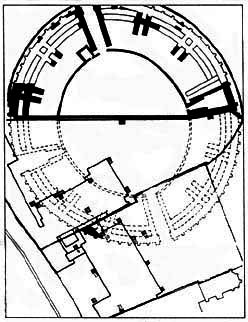
  ook
once
again at
the
stirring
Greenwood
illustration
on
the previous
page- and
then
compare
it
with
this
plan
on
the
right
showing
just
the
latest
variant
of
David
Mclean's
scheme
for
the
still-unexcavated
portion
of
the
Chester
amphitheatre,
presented
as
a fait
accompli to
an
unbelieving
public
in
early January
2000. ook
once
again at
the
stirring
Greenwood
illustration
on
the previous
page- and
then
compare
it
with
this
plan
on
the
right
showing
just
the
latest
variant
of
David
Mclean's
scheme
for
the
still-unexcavated
portion
of
the
Chester
amphitheatre,
presented
as
a fait
accompli to
an
unbelieving
public
in
early January
2000.
Which
was,
believe
it
or
not,
to
construct
a four-storey
County
law
court,
office
block
complex
and
car
park on top of
it.
That
this
was
being
arranged
well
over two
years before
the
public-
and
even
most
councillors-
were
made
aware
of
it-
and
at
a
time
when
discussions
centred
round
proposals
to
build
a
semi-circular
hotel
around
the
amphitheatre and
to
excavate it to provide a novel view for the guests-
may
prove
shocking
to
some
readers,
but
is
proved
by
a
number
of
documents
in
our
possession.
For
example,
a
letter
from
McLean's
development
director, Mark
Thomas to
the
Lord
Chancellors
Department
dated
21st
November
1997,
which,
among
much
else,
states,
"We
are
the
freehold
owners
(in
possession)
of
the
office
development
site
known
as
the
former
'Dee
House'
site
which
sits adjacent
to (our
italics)
the
Roman
Amphitheatre
and
the
City
Walls
between
Little
St
John
Street
and
Souters
Lane.
The
site
is
a
cleared
site
with
detailed
planning
permission
for
offices
of
approximately
24,000
sq. ft
and
is
ready
for
development.
It
is
currently
operated
by
us
as
a
car
park.
We
are
seeking
a
pre-let
for
the
office
development.
We
have
had
some
dialogue
with
yourselves
and
your
representatives
in
the
past,
and
we
are
now
keen
to
recommence
a
productive
dialogue
with
you,
now
you
have
determined
your
needs...
It
is
true
that
we
have
had
some
dialogue
with
the
planners
regarding
possible
adjustments
to
the
consented
scheme.
These
discussions
are
ongoing
and
nearing
a
positive
conclusion
for
us...
I
would
like
to
agree
a
proposal
with
you
for
us
to
develop
a
new
building
to
be
let
to
the
Lord
Chancellors
Department.
We
would
also
be
pleased
to
consider
taking
responsibility
for
the
liability
of
your
current
accommodation
(Centurion
House, Northgate
Street)
as
part
of
a
package..."
A
concerned
public
were
assured
by
the
City
Council
Conservation
Department
that
the
new
buildings
would "just
touch" the
ancient
remains
and
that
these
would
not
be
damaged,
as
the
planned
development
would
sit
upon
a
concrete
'raft',
but,
to
quote Stephen
Langtree,
Chairman
of
the Chester
Civic
Trust -
who
have
long
opposed
development
on
and
around
this
special
site (although Mr Langtree was, at the same time, also an advocate of the above-mentioned hotel plan)- "The
best
opportunity
for
generations
is
slipping
through
our
fingers.
It
is
a
real
tragedy".
Just
as
back
in
the
1930s,
hand-wringing
excuses
from
the
general
direction
of
our elected
representatives
and
their
officers
were
in
no
short
supply.
Head
of
Planning, Andrew
Farrall,
for
example: "The
authority
is
not
in
any
financial
position
to
fund
further
excavation
works"
and
that
the
new
complex
"could
not
have
been
skewed
to
avoid
the
archaeology
because
of
the
way
Dee
House
was
built".
 Then
they
tried
to
lump
the
responsibility
onto
someone
else's
shoulders
when
a
Town
Hall
spokeman
said, "The
council
is
taking
the
lead
from English
Heritage on
the
matter
of
the
buried
part
of
the
amphitheatre.
Their
national
policy
is
that,
unless
the
site
is
in
danger,
they
would
sooner
leave
the
archaeology
alone". Then
they
tried
to
lump
the
responsibility
onto
someone
else's
shoulders
when
a
Town
Hall
spokeman
said, "The
council
is
taking
the
lead
from English
Heritage on
the
matter
of
the
buried
part
of
the
amphitheatre.
Their
national
policy
is
that,
unless
the
site
is
in
danger,
they
would
sooner
leave
the
archaeology
alone".
Not
in
danger? Construction
engineers
we
are
not,
but
could
we
nontheless
be
justified
in
fearing
that
the
tender
attentions
of
JCBs,
heavy
lorries
and
industrial
cranes
crashing
around
on
top
of
what
is-
we
repeat-
one
of
the
finest
surviving
relics
of
the
Roman
Empire
in
Britain
will
be,
at
the
very
least,
unlikely
to
do
it
a
great
deal
of
good?
Let
alone
the
effects
of
many
thousands
of
tons
of
concrete
building
crushing
down
upon
it,
raft
or
no
raft,
for
the
next
three
or
four
decades?
(for
such
seems
to
be
the
average
life
of
the
average
commercial
building
these
days..
When,
at
that
future
time,
the
site
is
cleared
by
a
more
enlightened
local
authority
and
excavation
of
the
other
half
of
the
amphitheatre
can
finally
begin,
who
can
say
what
destruction
will
be
found
to
have
taken
place?
Much
of
the
vital
post-Roman
layers
will
certainly
have
been
destroyed
(Those
of
the
other
half
were,
for
largely
'economic'
reasons,
bulldozed
away
when
it
was
excavated
in
the
1960s).
Of
course,
by
then,
our
current
sorry crop
of
politicians
and
planners
will be,
similarly,
long
gone.
 And
then,
mere
cultural
considerations
aside,
what
effect
will
all
those
new
workers
and
visitors
and
their
single-occupant
cars
have
upon
this
already
intolerably-congested
corner
of
Chester?
Will
court
officials
and
judges
have
to
get
used
to
making
allowances
for
late
attenders
due
to
traffic
snarl-ups?
Chester
City
Council
currently
makes
a
lot
of
self-congratulatory
noises
about
its
efforts
to
reduce
the
number
of
vehicles
entering
the
city
centre.
On
those
grounds
alone,
then,
surely
this
car-dependent
scheme
and
its
forerunners
should never have
gained
planning
permission? And
then,
mere
cultural
considerations
aside,
what
effect
will
all
those
new
workers
and
visitors
and
their
single-occupant
cars
have
upon
this
already
intolerably-congested
corner
of
Chester?
Will
court
officials
and
judges
have
to
get
used
to
making
allowances
for
late
attenders
due
to
traffic
snarl-ups?
Chester
City
Council
currently
makes
a
lot
of
self-congratulatory
noises
about
its
efforts
to
reduce
the
number
of
vehicles
entering
the
city
centre.
On
those
grounds
alone,
then,
surely
this
car-dependent
scheme
and
its
forerunners
should never have
gained
planning
permission?
Surely,
there
must
have
been
numerous,
far
more
suitable,
locations
for
a
utilitarian
development
such
as
this?
Green-
and
brownfield
sites
aside,
what
about
the
old Electric
Light
Building or
one
of
the
other
vacant
sites
in
Chester's Old
Port area,
for
example?
Saved
after
a
heroic
two-year
fight
by
residents,
the
developers
were
looking
to
incorporate
the
building
into
their
new
housing
and
commercial
scheme
and
may
have
welcomed
such
an
offer.
Or even
the
site
currently
occupied
by
the
30
year-old "decaying" Police
HQ near
the
Roodee,
ripe
for
demolition
in
the
very
near
future?
Its
proximity
to
both
the
newly-built
Magistrate's
Court
and
to
the
Crown
Court
in
the Castle surely
made
it
an
ideal
location,
unifying
the
'legal
quarter'
of
the
city.
There
were
also
two
large
vacant
buildings,
Colvin
and
Napier
Houses,
which
had
been
lying
unused
for
the
past
three
years
and
consequently,
in
April
2001,
put
into
the
hands
of
an
estate
agent
with
a
view
to "redeveloping
them
for
commercial
use". (Astonishingly, Colvin
and
Napier
Houses remain decaying and untenanted well over a decade later, in 2014!)
And
all
of
these
had
the
space
for
lots
of car
parking, which
seemed
to
be
at
the
heart
of
the
apparent-
and
otherwise
mysterious-
necessity
to
move
the
County
Court
from Northgate
Street in
the
first
place.
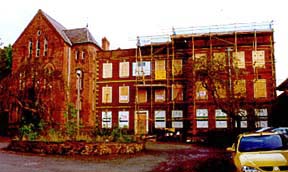
Dee
House itself
was
apparently
to
stay
put,
and,
we
were
told, "could get
a
new
lease
of
life" as
part
of
the
current
proposals,
possibly
being
utilised
for
'interactive
heritage
interpretation'
and
commercial
use-
doubtless
even
more
offices
(of
which,
incidentally,
there
was
no
shortage-
a
proposed
high-rise office
scheme
at
the
Old
Port,
for
example,
failed
due
to
a
lack
of
interested
tenants
and
vacant
properties
existed
throughout
the
city.)
Our
Head
of
Planning,
remember,
told
us that "the
authority
is
not
in
any
financial
position
to
fund
further
excavation
works",
so
how,
then,
did
it
propose
to
find
the
many,
many
thousands
of
pounds
necessary
for
the
complete
restoration,
equipping
and
staffing
of
the
rapidly-decaying
Dee
House?
(The
answer
to
this
came
to
light
in June
2000,
in
a
leaked
council
report
which
you
can
read
about here...)
 What
the
occupants
of
the
smart
new
courts
and
offices
would
think
of
having
to
share
the
site
for
the
forseeable
future
with
this
dangerous
and
derelict
building
was
anyone's
guess.
How
very
interesting
then,
that
in
early
February,
a
matter
of
days
after
all
this
came
to
the
public's
attention,
Dee
House
should
be
seriously
damaged
in
a "deliberately-started" fire... What
the
occupants
of
the
smart
new
courts
and
offices
would
think
of
having
to
share
the
site
for
the
forseeable
future
with
this
dangerous
and
derelict
building
was
anyone's
guess.
How
very
interesting
then,
that
in
early
February,
a
matter
of
days
after
all
this
came
to
the
public's
attention,
Dee
House
should
be
seriously
damaged
in
a "deliberately-started" fire...
And
then,
should
it
eventually
have
come
about
that
Dee
House
was-
for
whatever
reasons-
actually
demolished,
the
view
of
the
site
from
St. John
Street
would
comprise
little
more
than
the
slab-like
end
of
a
utilitarian
and
mediocre
office
block.
And,
of
course,
its
presence
would
ensure
that
we still wouldn't
be
able
to
uncover
a
significant
chunk
of
the
amphitheatre!
As
previously
mentioned,
the
County
Court
was at the time
housed
at
Centurion
House
in Northgate
Street,
where,
according
to
one
solicitor
we
spoke
to,
it
functioned
perfectly
efficiently-
and
was,
in
fact,
recently renovated
when
its
former
co-tenant,
the
VAT
Office
moved
out.
It
was,
however,
a
little
short
on car
parking
space.
The
new,
four-storey
building
planned
for
the
amphitheatre
would
contain
three
courts,
offices
and
facilities
for
judges
and
members
of
the
public- and a
large
car
park.
(See
illustration
on next
page)
It
remained
news
to
most
local
people
that
the
city
was
actually
in
need
of
these
new,
and
doubtless
very
expensive,
legal
facilities.
Curiously,
the
council
planning
department
told
us
at
the
time
that
the
court
complex "is
exactly
the
same
scheme
for
which
planning
permission
was
granted
in
1995",
even
though,
as
we
have
seen
above,
earlier
plans
proposed
very
different
uses:
a
hotel
and
before
that,
McLean's
own
headquarters
building.
 For the benefit of the confused reader (and who isn't?) we should clarify one thing about this 'change of use' business. Although the City Council Planning Committee gave consent for an office block, the decision for the change of use to law courts was taken by officers of the council planning department. For the benefit of the confused reader (and who isn't?) we should clarify one thing about this 'change of use' business. Although the City Council Planning Committee gave consent for an office block, the decision for the change of use to law courts was taken by officers of the council planning department.
This decision was made perfectly clear in the Head of Planning and Building Control's report to the planning board on 26th April, 2000. A number of concerned councillors asked the Head of Planning about this matter and questioned if this was the correct democratic procedure. His reply was to the effect that the decision had been taken by the planning department, without reference to any councillors, under "delegated powers", and that, if they were not satisfied with the planning department exercising this power, they should take him to court.
Chester's City
Fathers
needed
a
kick
in
the
pants
to
make
them
see
sense
seventy
year
ago, as a result of the local and national outrage at their proposal to build a road across the newly-discovered amphitheatre.
Who
would
ride
to
the
rescue
this
time?
Our
splendid
city
justifiably
attracts
thousands
of
visitors
from
all
over
the
world
every
year
and
they
contribute
a
vast
amount
to
the
local
economy.
Who
can
doubt
that
far
more
of
them
would
have
come
to
wonder
at
the
sight
of
Greenwood's
unhemmed-in,
fully-revealed
Roman
amphitheatre
than
to
stare
at
the
third-rate,
short-term
efforts
of
any
number
of
today's
speculative
developers?
But
what was one
to
think
when
Chester's
head
of
planning,
Andrew
Farrall,
was
quoted
in
the
local
press
as
saying "We
see
this
as
a
win,
win,
win
situation"?
It
seemed
the
lunatics
really had taken
over
the
asylum.
Around
this
time, Councillor
Vernon told
us
that he
didn't
recall
his
promise
of
that "long
period
of
public
consultation"
(good job we
had
the
press
cuttings)
and
was
quoted
in
the
local
press
as
saying
the
plans
"are
not
something
I
am
happy
with
but
it
is
too
late
to
turn
them
down
now.
Only
about
ten
percent
of
the
amphitheatre
will
be
under
this
new
building.
The
rest
is
underneath
the
car
park, where
there
is
the
opportunity
to
mark
out
the
amphitheatre
underneath and
take
the
partition
wall
down
to
allow
people
access
to
the
site".
He
concluded, "If
we
had
an
awful
lot
of
money,
the
council
could
buy
the
land
from
McLean
and
then
decide
what
to
do
with
the
site.
This
is
realistically
never
going
to
happen
so
this
is
about
what
is
achievable
within
a
partnership".
A
seemingly-pathetic
response,
but
nontheless
significant,
in
that
it
was
apparently
the
first
public
admission
that
the
sorry
situation
was
actually
the
planned
result
of
a
council-developer 'partnership'...
On to part
III of the amphitheatre story or read what the people really think: a collection of letters to us and
the local press - or visit the ancient Church of St. John the Baptist...
Top
of
Page | Site
Front
Door | Chester
Stroll
Introduction | The
Amphitheatre
I | 01 | III | IV | V | VI | VII | VIII | IX | | X | XI | XII | XIII | Gallery | 2 |
Some
alternative
views | Letters
page
1 | 2 | 3 | 4 | 5 | 6 | 7 | 'Round
in
Circles'
by Flavius | Chester Amphitheatre Project
Save
the
Chester
Amphitheatre! (1932) | St. John's
House | On
to
St. John's
Church |
 If you're enjoying your visit to our site, please consider donating a small sum to help us keep it online and growing for the benefit of all who love Chester. Simply click the button and enter your contribution, no matter how small. It's safe and easy- you don't even need a PayPal account. We thank you!

