 p
to
the
18th
century, burials
within
Chester
Cathedral,
and the Abbey before it, were
common
and
much
sought-after.
p
to
the
18th
century, burials
within
Chester
Cathedral,
and the Abbey before it, were
common
and
much
sought-after.
A contributor to The Cheshire Sheaf in 1879 wrote: "St. Werburgh's Abbey at Chester was a favourite place of sepulture from very early days, as the numerous memorial slabs taken out from the lower levels close to the rock, during the recent restoration, very fully prove".
The
cost
towards
the
end
of
the
practice,
to
those
not
privileged
to
free
access,
was
"£5
for
burial
in
the
side
alleys
and
£10
in
the
body
of
the
quire".
At the time, this was a
considerable
sum,
but
nontheless,
the
cumulative
effect
of
hundreds
of
such
interments
eventually
resulted
in
a
serious
undermining
of
the
Cathedral's
fabric-
by
Scott's
time,
the
side
walls
of
the
eastern
end
were
noted
to be
leaning feet
out
of
true.
Many
of
the
external
features
you
see
today
are by its major restorer Sir George Gilbert Scott,
including
the
spires
and
small
towers
atop
the
main
tower,
which
had
been
originally
built
about
1210
and
which was
described by him,
before
its
long-overdue restoration,
as
a "picturesque
and
crumbling
pile
of
soft
sandstone,
inhabited
by
jackdaws".
A confirmation of this state of affairs comes in the form of an interesting reminiscience from the February 1882 edition of the Sheaf, wherein a contributor recalled, "When some fifty years younger than I am now, I used to watch with boyish interest the movements of the sable birds that then flourished in and about the crumbling and crannied walls of Chester Cathedral. The jackdaws' nests were up far away out of ordinary reach; but the increase in population was at times so great, and the birds made such havoc in the spongy and perishing stone, that a raid had each season to be made upon them to keep the colony down. Long ladders were projected at all sorts of angles, and a dozen or two eager marauders pursued their deadly mission at the mouths of the principal nests. I'm afraid I was myself at such times one of the foremost invaders of the poor birds' territory, and have gone home at night laden with the spoil of their young".
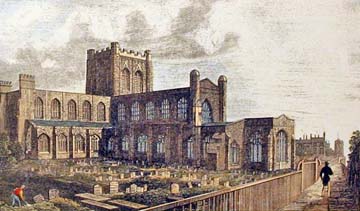 The
exterior
facing
of
the
13th
century
Lady
Chapel,
the
building
nearest
to
the
East Wall,
is
also
Scott's.
It
is
as
if
the
entire
structure
had
been
'wrapped
up'
in
a new
stone overcoat -
but
there
is
less
obviously
new
work
inside
the
Cathedral
but
many
of
the
monastic
buildings-
considered
to
be
the
finest
in
Britain-
survive
relatively
unchanged.
Among
them
is
the Refectory,
where
once
the
monks
ate
their
frugal
meals
in
silence,
except
for
the
voice
of
one
of
the
brothers
giving
bible
readings
from
the
late
13th
century
stone
lectern
or
pulpit,
which
is
built
into
the
wall
and
reached
by
an
arcaded
stairway.
It,
too,
is
considered
to
be
to
be
one
of
the
finest
in
the
country.
The
exterior
facing
of
the
13th
century
Lady
Chapel,
the
building
nearest
to
the
East Wall,
is
also
Scott's.
It
is
as
if
the
entire
structure
had
been
'wrapped
up'
in
a new
stone overcoat -
but
there
is
less
obviously
new
work
inside
the
Cathedral
but
many
of
the
monastic
buildings-
considered
to
be
the
finest
in
Britain-
survive
relatively
unchanged.
Among
them
is
the Refectory,
where
once
the
monks
ate
their
frugal
meals
in
silence,
except
for
the
voice
of
one
of
the
brothers
giving
bible
readings
from
the
late
13th
century
stone
lectern
or
pulpit,
which
is
built
into
the
wall
and
reached
by
an
arcaded
stairway.
It,
too,
is
considered
to
be
to
be
one
of
the
finest
in
the
country.
The
Refectory
itself,
though
basically
Norman,
was
remodelled
in
the
13th
century
and
the
windows
were
altered
again
in
the
15th
to
give
the
impression
of
a
later
building.
One
modern
addition
is
the
magnificent
medieval-style
hammer-beam
roof
which
was
built
under
the
direction
of
architectural
historian
F. H.
Crossley
as
recently
as
1939.
After
a
period,
ending
in
1876,
housing The
King's
School,
(look
for
the
grafitti
scratched
into
the
walls by generations of long-dead pupils)
the
Refectory
is
today
filled
with
the
gentle
chatter
of
visitors
and
other
refugees
from
the
busy
city
outside,
having
resumed
some
of
its
ancient
function
by
serving
as
the
Cathedral's
teashop
and
restaurant.
The
East
Window
had
been
completely
rebuilt
by
Giles
Gilbert
Scott
in
1913
and
in June
2001,
to
mark
the
new
Millennium,
a
great
new
stained
glass
west
window
was
installed
in
the
Refectory.
Created
by
Bristol-based
artist Rosalind
Grimshaw,
assisted
by Patrick
Costeloe,
the
window
was
inspired
by
the
biblical
quotation, "And
God
saw
everything
He
had
made,
and
behold
it
was
very
good".
There
are
six
main
panels,
each
two
feet
wide
and
sixteen
feet
high,
depicting
the
six
days
of
Creation,
including
the
passing
from
darkness
into
light,
the
creation
of
dry
land
from
the
water
and
the
coming
of
fish,
sea
creatures
and
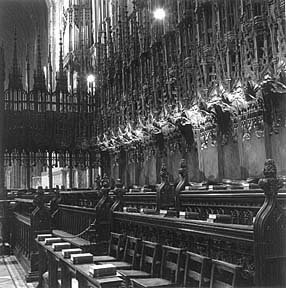
 Also
ranking
as
some
of
the
finest
of
their
kind
are
the
highly-decorated
oak Choir
Stalls of
c.1380 (illustrated
at the top of the page)
with
their
imaginatively-carved misericords.
Despite
having
been
moved
several
times
over
the
centuries,
they
have
nontheless
survived
intact
and
with
remarkably
little
sign
of
wear
or
damage
for
over
six
hundred
years of regular use.
Novelist Henry
James was
inspired
by "the
vast
oaken
architecture
of
the
stalls,
climbing
vainly
against
the
dizzier
reach
of
the
columns".
Also
ranking
as
some
of
the
finest
of
their
kind
are
the
highly-decorated
oak Choir
Stalls of
c.1380 (illustrated
at the top of the page)
with
their
imaginatively-carved misericords.
Despite
having
been
moved
several
times
over
the
centuries,
they
have
nontheless
survived
intact
and
with
remarkably
little
sign
of
wear
or
damage
for
over
six
hundred
years of regular use.
Novelist Henry
James was
inspired
by "the
vast
oaken
architecture
of
the
stalls,
climbing
vainly
against
the
dizzier
reach
of
the
columns".
(Read
his
affectionate
description
of
Chester
in
his "most
perfect" 1903
novel, The
Ambassadors here).
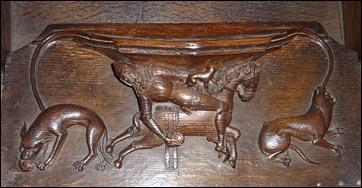
These misericords ("mercy seats") are
small
shelves
which
project
from
the
undersides
of
the
hinged
choir
stall
seats
upon
which
the
monks
supported
themselves
during
the
long
hours
of
worship. Because
they
were
usually
tucked
away
out
of
sight,
the
the
carvers
were
allowed
considerable
freedom
of
expression
in
their
decoration.
The
exquisite
finesse
of
the
pinnacled
canopies
over
the
choir
stalls
contrast
sharply
with
the
earthly
subject
matter
on
the
misericords
beneath-
men
wrestle,
foxes
steal
grapes,
a
wife
beats
her
husband,
a
unicorn
is
slain
after
laying
its
head
in
the
lap
of
a
virgin,
angels
play
lutes
and
biblical
scenes
are
flanked
by
monsters
and mythological
figures
from
distant
pre-Christian
times-
all
of
the
utmost
liveliness
and
fascination.
The
story
of St. Werburgh-
to
whom
the
Cathedral
is
dedicated-
and
the
'restored
goose'
is
here
also,
but
some
of
these
medieval
masterpieces
are
now
sadly
lost
to
us,
for
150
years
ago,
Dean
Howson
ordered
five
of
them
to
be
destroyed
on
the
grounds
that
they
were "very
improper"..
A complete photographic record of the misericords of Chester cathedral- and of many other places- may be found on Dominic Strange's excellent website, Misericords of the World.
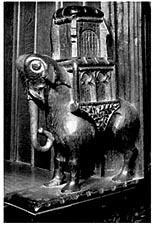 Look
out
also
for
the
curious
cloven-hoofed elephant on
the
end
of
one
of
the
choir stalls-
the
fanciful
creation
of
a
medieval
craftsman
who
had
obviously
never
laid eyes upon
the
real
thing.
One
had
been
brought
to
England
in
1255,
a
gift
to
Henry
III
from
Louis
IX
of
France,
and
carvings
made
of
it
at
the
time
were
the
model
for
copies
which
appeared
for
more
than
a
century
afterwards. Elephants
had
first
come
to
Britain
long
before
this,
however,
for
a
troop
of
them
had
accompanied
the Emperor
Claudius during
the
first
days
of
the
400-year
Roman
occupation
of
our
islands,
when
he
rode
in
state
to Camulodunum (modern
Colchester)
in
August
AD
43
to
accept
the
surrender
of
several
of
the
local
tribes-
to
whom
the
great
creatures
must
have
been
a
truly
awe-inspiring
sight.
Look
out
also
for
the
curious
cloven-hoofed elephant on
the
end
of
one
of
the
choir stalls-
the
fanciful
creation
of
a
medieval
craftsman
who
had
obviously
never
laid eyes upon
the
real
thing.
One
had
been
brought
to
England
in
1255,
a
gift
to
Henry
III
from
Louis
IX
of
France,
and
carvings
made
of
it
at
the
time
were
the
model
for
copies
which
appeared
for
more
than
a
century
afterwards. Elephants
had
first
come
to
Britain
long
before
this,
however,
for
a
troop
of
them
had
accompanied
the Emperor
Claudius during
the
first
days
of
the
400-year
Roman
occupation
of
our
islands,
when
he
rode
in
state
to Camulodunum (modern
Colchester)
in
August
AD
43
to
accept
the
surrender
of
several
of
the
local
tribes-
to
whom
the
great
creatures
must
have
been
a
truly
awe-inspiring
sight.
While
on
the
subject
of
cloven
hooves,
here
is
a
curious
story
recorded
by
one
Mr
Edward
Thomas
in
a
1906
edition
of
the Cheshire
Sheaf:
"When
I
became
a
chorister
in
Chester
Cathedral
in
the
year
1828,
I,
as
was
the
custom
with
all
new
boys,
was
shown
by
the
older
choristers
a
flagstone
at
the
north
east
corner
of
the cloisters on
which
was
a
mark (below),
said
to
be
the Devil's
footprint,
and
was
told
that
if
the
flag
was
removed
and
replaced
by
a
new
one,
on
the
following
morning,
the
footprint
would
be
there
again".
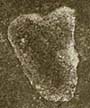 To
the
best
of
our
knowledge,
this
splendid
legend
has
of
recent
times
become
entirely
forgotten-
it
certainly
appears
in
no
contemporary
guidebooks
we
have
seen.
Our
photograph
shows
the
nearest
thing
we
could
find
to
a
'Devil's
Footprint'-
perhaps
now somewhat
worn
since
it
was
exhibited
for
the
edification
of
those Georgian
choir
boys.
To
the
best
of
our
knowledge,
this
splendid
legend
has
of
recent
times
become
entirely
forgotten-
it
certainly
appears
in
no
contemporary
guidebooks
we
have
seen.
Our
photograph
shows
the
nearest
thing
we
could
find
to
a
'Devil's
Footprint'-
perhaps
now somewhat
worn
since
it
was
exhibited
for
the
edification
of
those Georgian
choir
boys.
The
Devil
makes
yet
another
appearance
in
a
better-known
Cathedral
legend,
that
of
the Chester
Imp.
This
tells
us
that,
centuries
ago,
during
the
construction
of
the
nave,
a
priest
was
startled
by
the
sight
of
a
demonic
face
leering
at
him
through
one
of
the
windows.
This
he
took
to
be
Satan
himself,
come
to
investigate
this
latest
fortress
against
his
dark
powers.
Prompt
action
was
taken,
and
stonemasons
were
ordered
to
carve
an
equally-ugly
image
and
mount
it
where,
should
the
Devil
dare
to
look
in
again,
he
would
be
frightened
away!
At
intervals,
from
the mid-18th century
onwards,
attempts
were
made
to
hold
music
festivals
in
the
Cathedral.
Conscious
of
the
fact
that
the
rapidly-rising
and
wealthy
cities
of
Liverpool
and
Manchester
were
easily
able
to
attract
the
best
artistes,
Chester's
organisers
strove
to
compete,
but
were
continually
running
into
difficulties.
In
1821,
for
example,
one Madame
Camporese caused
a
great
stir
due
to
the
high
level
of
fees
she
demanded
for
performing.
The still-thriving Chester
Chronicle dryly
commented
at
the
time: "We
are
sorry
that
anything
like
dissatisfaction
should
have
been
expressed
by
the
lady,
after
the
very
liberal
treatment
she
experienced
from
the
committee.
We
believe
she
only
gave
five
songs
in
the
church,
for
which
she
had
£150,
enough
in
all
common
conscience
one
would
have
thought.
The
air
of
Italy,
however,
as
connected
with
pecuniary
matters,
has
unquestionably
a
bracing
tendency".
In
1842,
the
festival
had
to
be
cancelled
as "the
Bishop
has
objected
to
sanction
it
on
account
of
the
concerts
and
ball
which
follow
the
oratorio,
and
the
Dean
and
Chapter
have
refused
to
lend
the
nave
of
the
Cathedral
for
the
morning
performances".
The
citizens
of
Chester
were
said
to
have
been
"highly
incenced" by
the
uncooperative
attitude
of
the
Cathedral
authorities.
Today, however, Chester
Cathedral
continues
to
host
a
wide
variety
of (considerably
better
organised)
musical
events. Just last week, this writer and his wife greatly enjoyed a performance of one of his favourites, Mahler's Symphony no 2, 'The Resurrection', performed by the Chester Philharmonic Orchestra.
 The Treasure House Mystery
Sir George Gilbert Scott, restorer of the Cathedral, believed in the existence of a secret chamber concealed somewhere within its walls, and for two centuries or upwards lost sight of by the authorities.
Perhaps this was because he had heard that the whole of the Cathedral's records, except some Treasurers' and Receivers' papers, and a few detached fragments, were all missing for at least a century after its foundation. And it certainly is strange that little or nothing prior to the Restoration should remain in the hands of the Chapter authorities- no Chapter Act Books, no church plate, no ancient manuscripts, no library, no counterpart leases, not even the precious Charter of the Cathedral itself! What became of it all? Destruction at the time of the Civil War is one alternative, the other a secret storehouse, perhaps walled up, during the Siege, and never revealed to the successors of those responsible appointed at the Restoration.
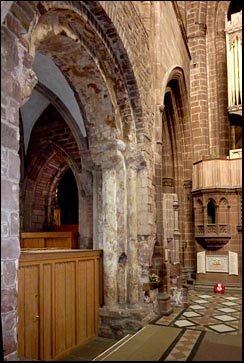
Right: Norman and Gothic architecture side by side in the North Transept of the Cathedral
Sir Peter Leycester, in his Antiquities Touching Cheshire, referring to the Charters granted by Earl Hugh to St. Werburgh's Abbey in 1093, says "This agrees in time with the Original Charter of the Foundation, which I transcribed out about 1644, then remaining among the Evidences of that Church, which were then kept in a certain room within St. Werburgh's Church in Chester." He says further, that the Evidences in question were "after removed thence in the late War". Sir Peter was resident in Chester throughout the Siege.
16th century Treasurers' Accounts of the Dean & Chapter confirm the existence then and for nearly a century afterwards of the Cathedral Treasure House:
• 1572-3. For tacking of (taking off) a locke in ya tresery house, and me'dyng ye same xiijd.
• 1583. For 2 lodes of coles and two of turfes for the Treasure house xvijd.
• 1584. Payd to Stocken (the smith) for openinge of the lockes of the Treasure house dore iijd.
• 1602. For a new key to the Treasure house dore vjd.
• 1604. For mending the looke of the Treasure house dore iiijd.
• 1623. A locke and key for the letters Patients iiijd.
From this date, the Treasure House is no more named in the Chapter records. But if it be the same room with which Sir Peter Leycester was acquainted, the disappearance of the chamber is contemporaneous with the last days of the Siege of Chester in 1646.
Unlike the terrible damage inflicted upon Chester in the Civil War, three centuries later, during World War II, it largely escaped the appalling mayhem visited upon many British cities, incuding neighbouring Liverpool. The Chester Chronicle of September 9th 1939 carried the following remarkable announcement:
"No special steps are being taken to protect the fabric or the contents of the Cathedral from attack. It is pointed out that adequate protection of the fabric would be too costly an undertaking. Unlike some cathedrals, Chester has not got a rich store of treasures".
During late 1940 and the early months of 1941, the city experienced its worst attacks from enemy bombers. The Cathedral suffered damage during the raids of November 29th / 30th and on December 1st 1940 when incendiary bombs blew out many windows, including those of the St. Erasmus Chapel, the Choir Clerestory and the South Nave Aisle. There was also much damage done to the roofs. The cost of repairs was recorded as amounting to "six thousand, five hundred and thirty eight pounds, six shillings and eleven pence."
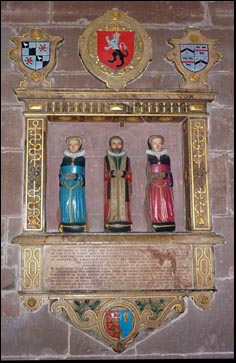 In 1949, the Cheshire Sheaf recorded that the following anonymous poem was found "on the back of an old picture in Chester Cathedral"...
Isn't it strange that princes and kings,
And clowns that caper in sawdust rings,
And ordinary folk like you and me,
Are builders for eternity?
To each is given a bag of tools,
An hourglass and a book of rules,
And each must build, ere his life is flown,
A stumbling-block or a stepping stone.
A locally better known poem is that which is inscribed upon an old clock in the Cathedral:
When as a child I laughed and wept- time crept.
When as a youth I dremed and telked- time walked.
When I became a full grown man- time ran.
And later as I older grew- time flew.
Soon I shall find
while travelling on- time gone.
Will Christ have saved my soul by then?- Amen.
The
first
known
guidebook
to
Chester,
the De
Laude
Cestrie ('In
Praise
of
Chester')
was
written
about
1195
by Lucian,
one
of
the
monks
of
the
Abbey.
For
some
fascinating
insights
into
the
city
and
Abbey
as
he
saw
them
at
the
end
of
the
12th
century,
go here.
From the 12th century to the Dissolution of the Monasteries in the 1540s, fully 25% of the area within Chester's walls was occupied by monastic communities. To
learn
a
little
of
the
Benedictine
nuns
of
St. Mary's,
go here. You
can also find out something more of them, together with the Black Friars, in our Roodee chapter and of the Grey and White Friars in our Watergate chapter. Alternatively,
visit
a
stunningly
beautiful
building,
still
very
much
with
us- well over
a thousand
years
old
and
our
city's first cathedral:
the
unique
church
of St. John
the
Baptist.
 On we go to discuss some of the controversies concerning Chester Cathedral in modern times....


